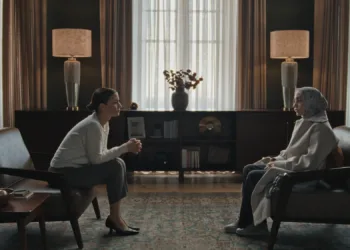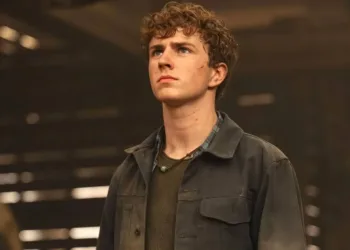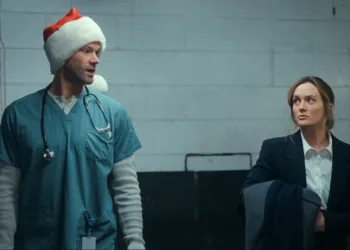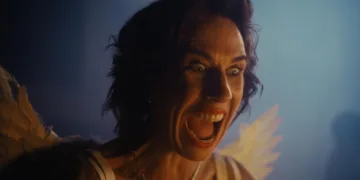
















Shooting Zombucha! on Sydney’s northern beaches gives its suburban comforts an identifiable address. This is a place where an attractively arranged home can suggest that its occupants have life under control. Emily Jansz’s production design encourages that assumption, furnishing Maddie and Leo with a domestic world worth preserving. Director Claudia Dzienny then makes preservation the dangerous impulse. The couple’s fear of losing their position licenses a succession of choices that put other people at risk.
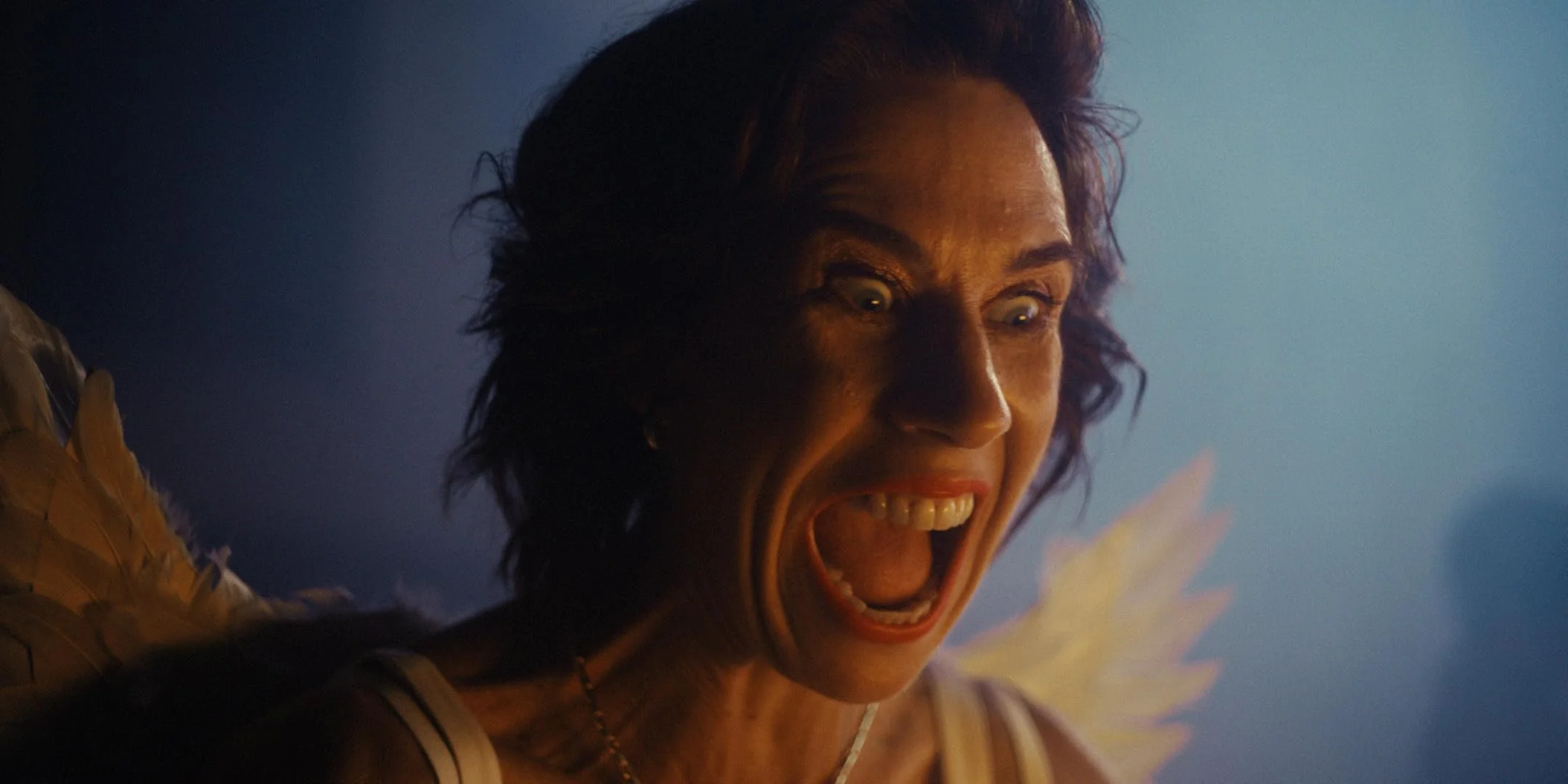
The film first offers a much simpler arrangement of guilt. Darkness, mist, advancing ghouls, an armed woman facing them: the image separates the threatened human from the threatening bodies. Then Maddie enters to attend to the monsters’ makeup, exposing a movie set. That visual division between innocence and monstrosity was somebody’s paid work. Emma Leonard, who also wrote the screenplay, plays the person responsible for maintaining it, until Maddie accidentally poisons actor Gabe and loses the job. The people who manufacture danger prove quite capable of causing it.
I recommend this amiable, occasionally barbed horror-comedy, with reservations about the modest return on its excellent premise. Its strongest passages implicate us in the pleasure of looking at something attractive. Its weaker ones explain anxieties that the creature already makes visible.
Leo’s advertising career gives the deception a second workplace. His energy-drink campaign receives absurdly grand praise, yet the hours required to sustain his success are exhausting him. His boss Hopper offers white powder to keep production moving. Jackie van Beek makes the offer’s managerial logic horribly plausible: an employee’s depleted body presents an efficiency problem, apparently soluble with a small chemical intervention.
Ryan O’Kane’s Leo quits, leaving Maddie with the unwelcome news that his secure income has disappeared alongside hers. The mortgage remains. Leonard and O’Kane keep this collision between his liberation and their shared exposure comic enough that we can enjoy their company before they start stealing.
That theft is the decision on which the satire depends. At a farmers’ market, they encounter Kai and his kombucha culture, then take the culture to establish a competing business. Greenery stolen from their neighbor Blanche’s garden completes the recipe. Entrepreneurship has seldom required so little original research.
Thirsty Virgin Kombucha offers the pair a familiar kind of control. Maddie knows how to alter an appearance; Leo knows how to sell one. Neither qualification confers an understanding of the substance they are cultivating. Their financial pressure earns sympathy, but their proposed escape transfers the cost to somebody else.
This resembles the crime film’s disastrous shortcut, adapted to people whose preferred instrument is a marketable lifestyle. The Four Fathers, the robed commune associated with Kai, extend the commercial circuit into spirituality. The joke is serviceable, though the stolen culture says enough about ownership and opportunism to make some of that additional eccentricity feel ornamental.
The laboratory gives the argument a better instrument. Its glowing jars invite admiration, turning fermentation into a display of possibility. Light appears to endorse the product before anyone has established that it is safe. That is an ethical choice in the image: we are offered the couple’s pleasure in possessing something remarkable, and encouraged to share their fascination. Their ignorance becomes easy to overlook when the object looks worth owning. The drink it produces turns its customers into zombies.
Then it bubbles. The squelching gives that luminous display an unpleasant bodily interior, suggesting processes that packaging cannot tidy away. Dzienny gets useful friction from the invitation to look and the impulse to recoil. The sound works at an intimate scale, close to ingestion and digestion, rather than announcing a distant army. Lord Fascinator’s electronic accompaniment to the counterfeit horror at the beginning establishes a conspicuous genre signal; the culture’s wet noises make the later threat feel lodged inside ordinary consumption.
This slow contamination suits the film better than an immediate outbreak would. Employment, debt, and domestic negotiation have time to become the couple’s normal conditions. An organism asserting demands of its own then disrupts a world already organized around demands they resent. The delay does have a cost. Once the culture becomes active, further discussion of the relationship can feel like a return to ground already covered. The couple’s worries need development, and too often receive another airing instead. But liking these people does not make every revisit to their difficulties necessary, particularly with the consequences of their new business waiting for attention.
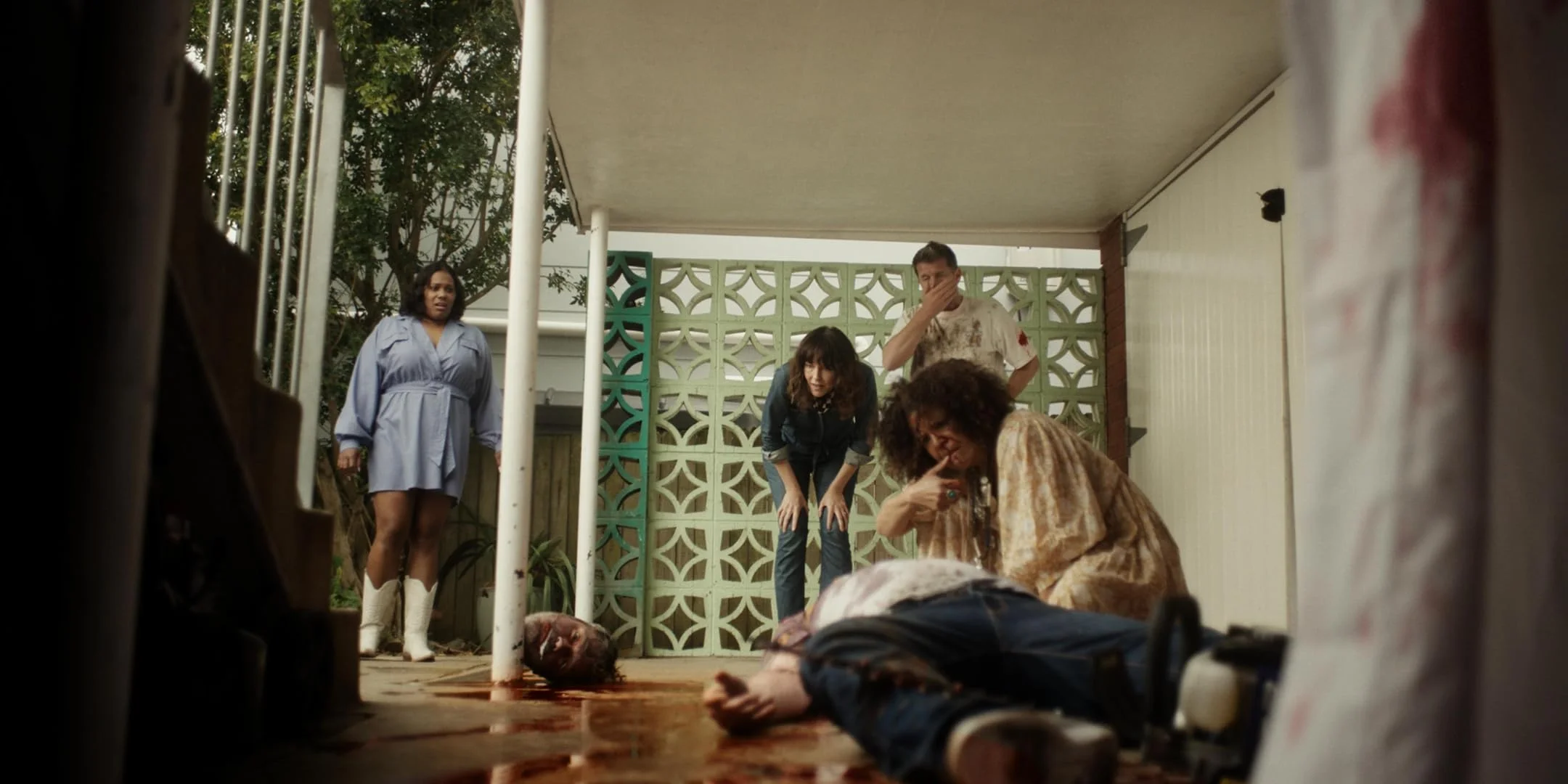
The backyard confrontation eventually supplies physical disorder, with Hopper contributing a welcome burst of aggression. Van Beek’s earlier outrage at Leo’s departure gives that violence a recognizable source. She seems considerably less troubled by the abandonment of civilized behavior than she was by his resignation. The small role leaves me wanting further interference from her.
The scale remains suburban, and the film is engaging on those terms. Its real missed opportunity concerns the culture’s name. Kai calls it Mother, giving the couple’s discomfort about parenthood an obvious biological accomplice. Here the glowing jars acquire a less flattering implication: the couple can admire the life they have cultivated before accepting what caring for it might require. They fear surrendering the independence and comforts their working lives have purchased. Their alternative produces a living thing whose demands cannot be scheduled around those comforts.
Leonard’s screenplay makes that connection legible but leaves too much of its emotional work to the metaphor. Reluctance to have children is a reasonable position; stealing, selling, and distributing something dangerous creates a different obligation. The film has precise objects for examining that obligation, from the stolen culture to the drink offered for consumption. I wanted it to stay longer with the point at which the couple’s private fear becomes somebody else’s exposure, especially once the drink’s commercial success gives their decisions a reach beyond their own home.
Zombucha! premiered at the Melbourne International Film Festival in August 2025 before opening in Australian cinemas through Maslow Entertainment on November 19, 2026. Directed by Claudia Dzienny and written by Emma Leonard, the horror-comedy follows a struggling millennial couple who become the unwitting custodians of a sentient kombucha strain that sparks a bizarre outbreak across Sydney.
Full Credits
Title: Zombucha!
Distributor: Maslow Entertainment
Release date: August 21, 2025 (Melbourne International Film Festival), November 19, 2026 (Australian theatrical release)
Rating: M
Running time: 1 hour 50 minutes (110 minutes)
Director: Claudia Dzienny
Writers: Emma Leonard
Producers and Executive Producers: Claudia Dzienny, Danielle Redford, Emma Leonard, Marc Wooldridge, Josh Pomeranz, Sam Gain-Emery, Thom Kellar, Bevan Dally
Cast: Emma Leonard, Ryan O’Kane, Shakira Clanton, Gary Sweet, Jackie van Beek, Brigid Zengeni, Johnny Nasser, Michelle Langstone, Stephen Madsen, Danny Adcock, Stephen Hunter, Jo Turner, Duncan Fellows
Director of Photography (Cinematographer): Calum Riddell
Editors: Julien De Benedictis
Composer: Lord Fascinator
The Review
Zombucha!
The misty opening assigns evil to monsters; the glowing culture jars make it look like a desirable purchase. Dzienny is sharpest when her images expose the innocence that attractive surfaces can confer. Leonard and O’Kane keep the culprits likable, and van Beek supplies the management support nobody requested. The relationship material repeats itself, and the parenthood metaphor needs emotional development. An enjoyable suburban outbreak, limited by a screenplay less curious about responsibility than its images are.
PROS
- Glowing jars and bodily sound make the product seductively unsettling.
- Leonard and O’Kane give the irresponsible couple warmth.
- Van Beek brings comic menace to Hopper’s managerial aggression.
- The stolen business foundation gives the commercial satire a concrete target.
CONS
- Repeated relationship discussions interrupt the developing threat.
- The parenthood metaphor receives insufficient emotional development.
- Hopper’s limited role underuses van Beek.