


















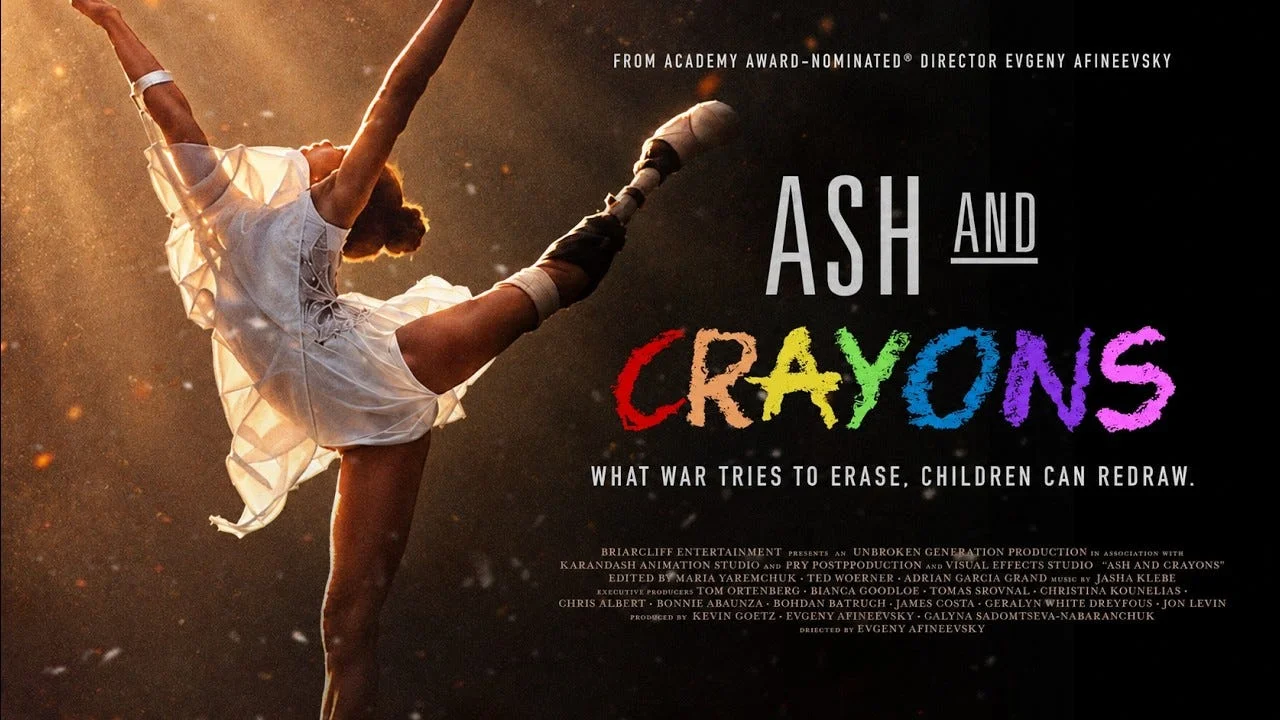

I found Ash and Crayons deeply affecting, occasionally remarkable in its visual storytelling, and frustratingly uneven in how it brings everything together. Director Evgeny Afineevsky has assembled a documentary built around testimonies that deserve our attention, yet he sometimes seems reluctant to trust their power. His decision to combine interviews with animation, archival footage, and personal records produces moments of extraordinary clarity.
It also introduces distractions that a simpler approach might have avoided. I would still strongly recommend the film, particularly for the perspective it offers on Russia’s war against Ukraine, but the filmmaking deserves closer scrutiny than the importance of its subject might initially encourage. Afineevsky previously documented Ukraine’s struggle for political independence in Winter on Fire: Ukraine’s Fight for Freedom. Here, he turns his attention to seven young Ukrainians whose lives have been permanently changed by missile strikes, imprisonment, and forced displacement.
Some have suffered catastrophic physical injuries. Others have endured captivity and attempts to erase their national identity. What makes their accounts so arresting is the composure with which they often describe experiences that should belong nowhere near childhood. These young people speak with a directness that gives the documentary an unusually strong foundation.
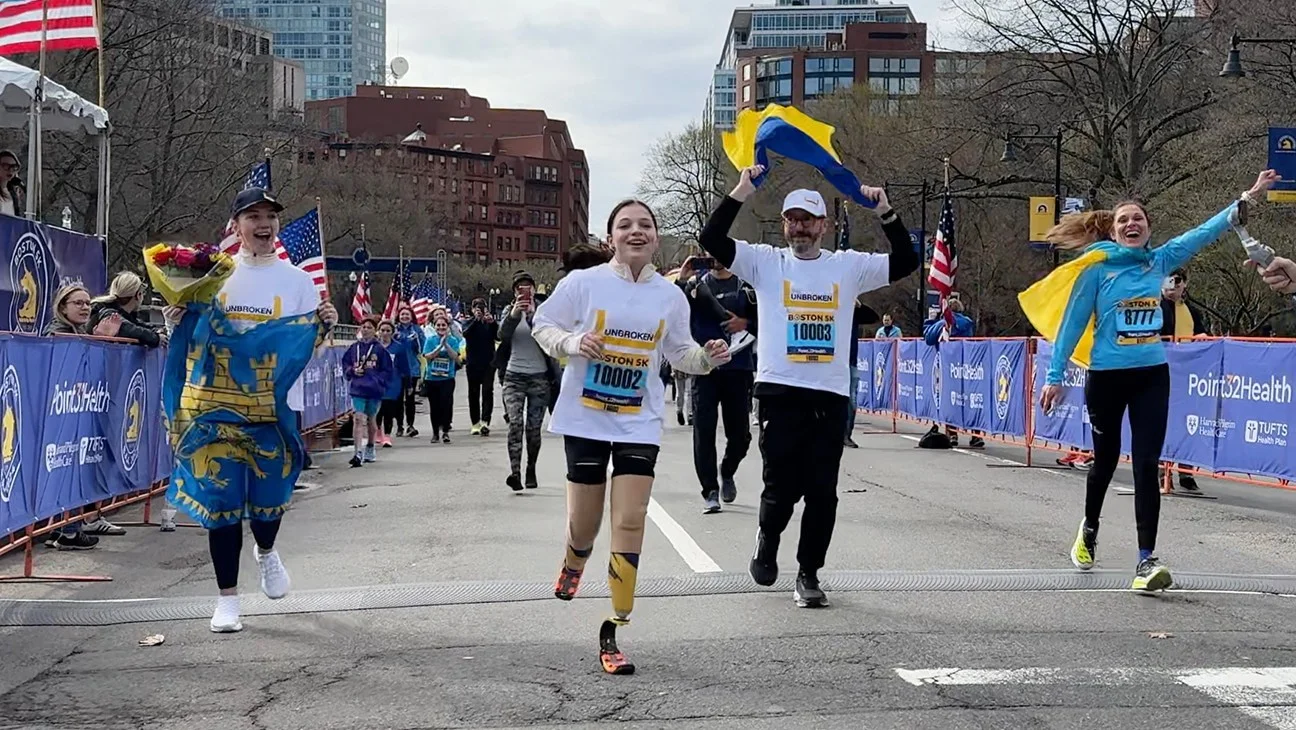
Roman Oleksiv’s story is particularly difficult to absorb. Severely burned in a missile attack on Vinnytsia that killed his mother, he survives extensive medical treatment and eventually returns to ballroom dancing. Seeing him perform in bright blue protective compression garments makes the physical demands of his recovery immediately apparent. The film doesn’t need to explain how much effort goes into movements that once seemed ordinary. His appearance communicates that through the visible evidence of his injuries and the precision of his dancing.
Then there’s Bohdan Yermokhin, whose experience involves a different assault on personal freedom. Taken from occupied Mariupol to Russia, he faces pressure to accept a Russian identity and struggles to return home. His refusal to abandon Ukraine, followed by his eventual return on his eighteenth birthday, makes for absorbing testimony. I appreciated the flashes of humor in his account. They allow his personality to emerge from circumstances that might otherwise define him entirely through victimhood.
The documentary’s most ambitious filmmaking decision involves animated reconstructions produced by Ukrainian artists. Animation can give visual form to experiences that documentary cameras never recorded, and the technique has considerable potential here. Some sequences feature movements resembling rotoscoping, a process that uses live-action imagery as a reference for animated movement. This helps human figures move with recognizable physical weight and realism. The artists also refuse to disguise the violence of the events being depicted. Injuries, destruction, and the immediate aftermath of attacks retain their disturbing severity.
One sequence demonstrates exactly why this approach can work. An animated boy crawls from a bombed building and encounters a rescuer. The film then cuts to actual footage of the rescue, a visual handoff that uses the same action to connect reconstructed and recorded images. That transition is brilliant because the archival footage transforms our understanding of what we’ve just watched. I wish Afineevsky had found that kind of precision throughout the film.
Unfortunately, many animated passages have the opposite effect. Moving from a child’s real face or authentic footage of destruction into an illustrated reconstruction can interrupt the immediacy that the preceding material has established. The problem has little to do with the animators’ abilities. Their work is often carefully detailed and visually accomplished. The difficulty comes from the documentary’s repeated insistence on showing us events that have already been communicated through extraordinarily effective testimony.
Vladyslav Buriak’s account offers a stronger justification for reconstruction. Detained in an occupied police station, he witnesses the consequences of torture and is forced to clean up the blood left behind. His description exposes horrors that no documentary crew could reasonably expect to have captured. Giving such experiences a visual representation can help an audience understand the conditions of his imprisonment. Yet even here, the most disturbing element remains the knowledge that a teenager was forced to participate in the aftermath of systematic cruelty.
Afineevsky faces another challenge in arranging these seven accounts. Rather than developing each story continuously, he moves between subjects, sometimes leaving one person’s experience for an extended period before returning to it. This fragmented construction can convey the enormous range of suffering caused by the war. In practice, it frequently interrupts the emotional momentum of individual stories. A child’s account begins establishing a particular relationship with the viewer, only for the documentary to shift elsewhere before that connection has fully developed. By the time the original narrative resumes, other experiences have occupied our attention.
The scrapbook-like presentation, filled with drawings, photographs, and diary entries, is similarly inconsistent. Its underlying idea is meaningful because these objects preserve experiences that might otherwise disappear. One girl’s description of keeping a diary because she feared she would die, hoping that someone would eventually recover it from the rubble of her building, makes this especially clear. Her writing becomes potential evidence of what happened to her.
That’s an enormously powerful idea, and the documentary’s visual framing has a genuine connection to it. Still, the recurring presentation can feel overly designed, as though the material needs an additional aesthetic identity to hold everything together.
I also became increasingly aware of the film’s musical choices. Melancholy piano music accompanies much of the testimony, frequently reinforcing emotions that the children’s words already establish. Music can help shape a documentary’s emotional rhythm, particularly during transitions between different experiences. Here, its persistent sadness sometimes leaves little space for viewers to process events independently. Bohdan’s moments of humor are especially welcome because they briefly offer a different emotional register amid the film’s otherwise relentless intensity.
That intensity becomes particularly noticeable in the documentary’s repeated emphasis on recovery. Oleksandra “Sasha” Paskal, who loses her left leg following a missile strike, returns to rhythmic gymnastics using a prosthesis. Yana Stepanenko, who loses both lower legs during the attack on Kramatorsk railway station, works toward running again. Together with Roman’s dancing, these achievements offer remarkable examples of physical determination. Watching Sasha perform is genuinely inspiring, especially given the coordination and discipline her sport demands.
Yet organizing so many experiences around survival followed by achievement gradually establishes a familiar dramatic pattern. The children’s accomplishments are real, but the repeated progression can make their lives seem shaped toward uplifting moments. Their injuries remain permanent, and their experiences cannot be resolved through an athletic performance or a successful rehabilitation milestone.
The accounts involving forced displacement make the limitations of that approach particularly apparent. Valeriia Sydorova describes being taken from Nova Kakhovka to a camp in occupied Crimea, where restrictions and propaganda become instruments of control. Veronika Vlasova recounts intimidation, interrogation, and prolonged separation from home. Their experiences reveal another dimension of the war’s impact on children, involving psychological injury and threats to identity. Such damage cannot be demonstrated through a prosthetic limb or measured through a return to competitive sport.
Bohdan’s determination to return home gives the documentary one of its strongest examples of personal agency. His resistance consists of insisting on his own identity despite the authorities attempting to determine his future. The film is particularly effective when it allows him to describe that struggle directly, including the decisions and risks involved in securing his return.
Near the end, statistics extend the documentary’s attention beyond the seven young people whose stories we have followed. They remind us that countless other children have experienced violence, displacement, and separation, many of them unable to tell their stories on camera. After spending so much time watching Roman dance, Sasha perform, and Bohdan recount his escape, those figures leave us confronting the experiences that remain undocumented and the children who have yet to return home.
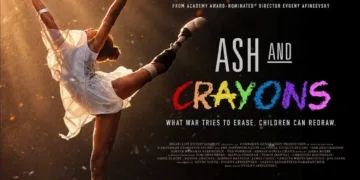
Ash and Crayons opened in limited U.S. theaters via Briarcliff Entertainment on November 20, 2026, ahead of its December 3, 2026 theatrical release in Ukraine. Directed by Evgeny Afineevsky and blending verité footage with animation by Ukrainian artists, the documentary follows seven Ukrainian children who have endured severe injuries, displacement, or forced deportation during the war as they hold onto their resilience and hopes for the future.
Where to Watch Ash and Crayons (2026) Online
Full Credits
Title: Ash and Crayons
Distributor: Briarcliff Entertainment (U.S.), Kinomania (Ukraine)
Release date: November 20, 2026 (U.S. limited theatrical release), December 3, 2026 (Ukrainian theatrical release)
Running time: 1 hour 38 minutes (98 minutes)
Director: Evgeny Afineevsky
Writers: Evgeny Afineevsky
Producers and Executive Producers: Evgeny Afineevsky, Galyna Sadomtseva-Nabaranchuk, Kevin Goetz, Tomáš Srovnal, Bohdan Batruh
Cast: Yana Stepanenko, Bohdan Yermokhin, Vladislav Buryak, Sasha Paskal, Roman Oleksiv, Valeriia Sydorova, Veronika Vlasova
Director of Photography (Cinematographer): Evgeny Afineevsky, Mykhailo Dzhos, Oleksandr Ratushnyi, Galyna Sadomtseva-Nabaranchuk, Adrian Garcia Grand
Editors: Mariia Yaremchuk, Adrian Garcia Grand, Ted Woerner
Composer: Jasha Klebe
The Review
Ash and Crayons
Ash and Crayons is a moving, worthwhile documentary whose greatest strength lies in the courage and honesty of its young subjects. Evgeny Afineevsky captures remarkable stories of survival, resistance, and recovery, with occasional flashes of brilliant visual storytelling. Yet fragmented editing, persistent melancholy music, and an overreliance on animation sometimes dilute the children's powerful testimony. Despite these shortcomings, the film deserves attention for its intimate portrayal of lives devastated by Russia's war against Ukraine. Its most affecting moments come when the children are simply allowed to speak for themselves.
PROS
- Powerful firsthand testimony from young survivors
- Remarkable stories of courage and recovery
- Effective transitions between animation and real footage
- Strong individual personalities emerge through the interviews
CONS
- Animated reconstructions occasionally weaken emotional immediacy
- Fragmented editing interrupts individual stories
- Persistent melancholy music feels emotionally heavy-handed
- Repetitive inspirational framing oversimplifies recovery