



























In August 2021, the Taliban’s return to Kabul marked a catastrophic reversal for Afghan women. It also offered cinema a convenient dramatic clock: count the days until a society loses its remaining freedoms. The trouble with such a clock is the suggestion that oppression begins at an identifiable moment, as though history has the decency to announce its crimes before committing them.
Chabname Zariab’s When She Hears the Bells initially appears to accept this division between a troubled present and an approaching catastrophe. Its strongest scenes, however, expose the cruelty already functioning quite efficiently before the Taliban arrives.
The existing social order soon determines the options available to Leila (Golshifteh Farahani), who comes to Kabul after her husband, Sohrab, is killed fighting for government forces. He has arranged some assistance for her through acquaintances, but widowhood has left her financially vulnerable in a city where survival requires constant negotiation.
Selling bolanis on the street brings little security, particularly with government troops interfering with vendors. A better opportunity appears through Roya (Venus Nazari), who arranges kitchen work at a private residence. The money is attractive, the arrangements are peculiar, and Leila soon discovers that the establishment hosts bacha bazi gatherings, where boys are forced to dance for powerful men and subjected to sexual exploitation.
Zariab has made an intelligent, often gripping debut that deserves attention, though its final act settles for a conventional form of heroism that weakens its political argument. I would recommend it for the questions it raises about collective responsibility, and for Farahani’s ability to make those questions painfully immediate. The film is considerably less persuasive when it attempts to answer them through an escalating rescue mission.
The most revealing exchange occurs after Leila discovers what happens inside the residence and refuses to return. Roya responds with a practical lecture. The abuse has continued for generations. Religious authorities have tolerated it, the Americans have failed to stop it, and Leila is free to resume her miserable roadside employment if she finds the new arrangement unacceptable.
Someone else will gladly take her place. There is something horrifyingly recognizable about this reasoning. Roya does not need to defend the exploitation itself because she has already accepted its permanence. Her argument concerns wages, opportunities and the futility of individual resistance. Morality, apparently, is a luxury item (and Leila can scarcely afford groceries).
I initially regarded the approaching Taliban takeover as the film’s principal political subject. Roya’s response made that interpretation inadequate. The violence operating inside the house depends on people who have learned to explain their participation as an unfortunate necessity. The authorities have failed, the customers have money, the workers need employment, and responsibility can be passed indefinitely between them.
Call this the permission economy, a system in which everyone claims insufficient power to intervene while collectively maintaining the conditions that allow exploitation to continue. Roya is particularly important because she occupies an uncomfortable position within that economy.
She is herself constrained by a society organized around male authority, yet she helps perpetuate the suffering of people with even less protection. Zariab understands that participation in injustice does not always require ideological commitment. Sometimes it requires a salary and the conviction that nothing can be changed.
That is a far less comforting proposition than the familiar division between courageous individuals and obviously wicked institutions.
The film’s physical environments reinforce this understanding. Casablanca stands in for Kabul, and Zariab presents a city where damaged streets coexist with functioning businesses and ordinary social activity. A visit to a beauty parlour briefly suggests the possibility of pleasure, self-expression and continuity.
Yet Farahani’s guarded movements make clear that the apparent normality offers little reassurance. Leila approaches unfamiliar people with visible caution, measuring the danger of each interaction before allowing herself to participate. Her vulnerability develops through these small calculations rather than through declarations about the condition of Afghan women.
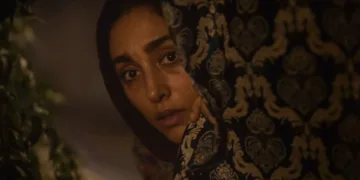
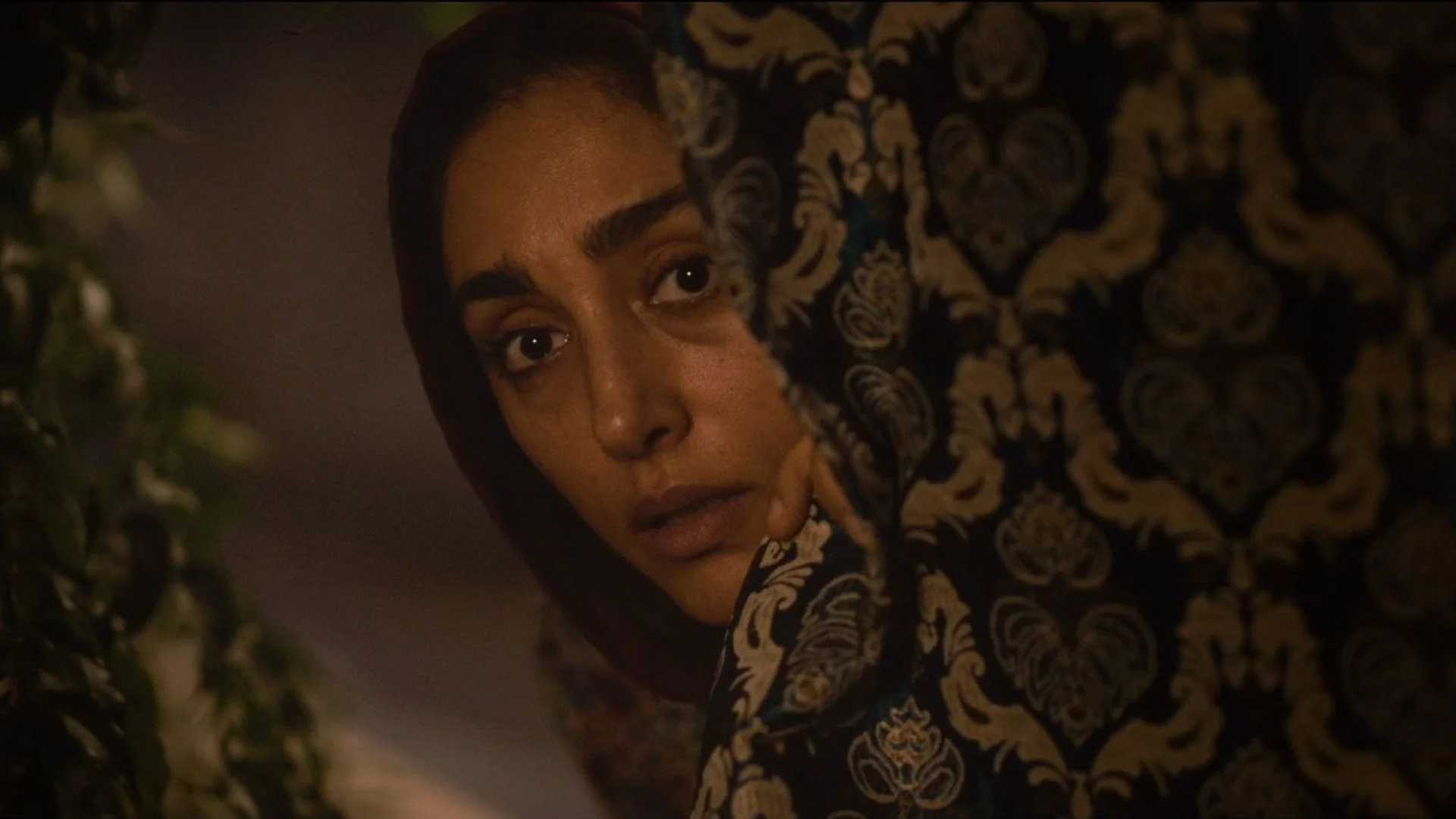
Zariab’s use of curtains, drapes and clothing is particularly effective. The barriers separating female workers from the male guests offer a fragile kind of protection while confirming the inequality that makes protection necessary. When Leila must serve food directly to the men, the removal of that physical distance exposes her to harassment.
The contradiction is embedded in the arrangement of the space: the rules that promise safety simultaneously establish who possesses the authority to threaten it. The score contributes to this unease through abrupt phrases of plucked strings as Leila approaches her new workplace, preparing us for danger before she understands its source.
Farahani gives these arrangements their emotional force. Her Leila possesses a guarded quality that occasionally resembles innocence, although her decisions reveal a woman fully capable of recognizing the danger surrounding her. There is intelligence in the hesitation, particularly as she becomes familiar with the residence. Farahani makes fear compatible with moral determination, allowing Leila’s courage to emerge from her awareness of the consequences. A person who understands exactly how badly things might end has reasons to remain silent. Leila refuses that option.
Her connection with Tamim (Mojtaba Ahmadi), one of the exploited teenage dancers, gives this refusal its strongest dramatic foundation. When a man harasses Leila, Tamim intervenes and suffers for his defiance. The incident reverses their apparent positions: a boy with almost no control over his circumstances assumes responsibility for protecting an adult woman.
His action establishes a moral obligation that Leila cannot easily dismiss. Her subsequent decision to hide him and help him escape develops from something witnessed and personally experienced, rather than from the screenplay simply announcing that its protagonist has discovered a heroic purpose.
But the relationship also introduces the film’s central artistic difficulty. As Leila’s efforts expand to include rescuing other boys, the story increasingly reorganizes her identity around the mission. The widow struggling to establish an independent existence becomes a figure through whom the narrative attempts to correct a much larger injustice. Her grief, economic insecurity and uncertain future recede as the mechanics of escape demand attention.
I am hesitant to criticize this transformation too severely. Why should an ordinary woman be denied the possibility of extraordinary courage simply because her circumstances are difficult? There is something politically unpleasant about demanding that the oppressed demonstrate a particular level of helplessness before we consider their stories credible.
Yet the problem here lies in the screenplay’s construction of possibility. Zariab has spent considerable time demonstrating how thoroughly the powerful control employment, movement and personal safety. The later rescue operation asks us to accept a comparatively straightforward expression of agency inside those same conditions.
Come on. The difficulties cannot vanish merely because the protagonist has finally decided what she must do.
The approaching Taliban takeover accelerates the action, and Zariab handles several passages of suspense with considerable assurance. Disorderly crowds and a frantic drive through Kabul translate political collapse into immediate physical danger.
There is an undeniable momentum to this material, particularly after the comparatively contained threat of the private residence. Yet the change also reduces the film’s intellectual specificity. Earlier, danger emerged from everyday social arrangements and the willingness of ordinary people to tolerate abuse. During the final movement, danger becomes increasingly dependent on obstacles that must be overcome before time runs out.
Milad (Rohed Khan), a local restaurant owner who assumes an important role in the climax, illustrates the consequences of this acceleration. His limited earlier development leaves his eventual importance insufficiently supported. The screenplay needs his contribution to move its rescue operation forward (the plot is running short of time), but it has not given his involvement the same attention it devotes to Leila’s relationship with Tamim. The abrupt resolution intensifies the impression that the narrative is hurrying to secure an emotionally satisfying outcome before its political questions become unmanageable.
What troubles me about this is the implication that personal rescue can provide an adequate dramatic response to systemic cruelty. Leila’s courage deserves recognition, and her refusal to accept Roya’s reasoning constitutes the film’s clearest moral achievement. Yet that reasoning remains terrifyingly intact beyond the immediate rescue. The permission economy does not depend on any particular victim remaining captive.
Its participants have already established procedures for replacing workers, rationalizing abuse and transferring responsibility elsewhere. The film understands this perfectly when Roya tells Leila that someone else will accept the kitchen job. By the time the streets of Kabul descend into chaos, Zariab has shifted her attention toward the possibility of getting people out, leaving the arrangements that trapped them with remarkably little difficulty continuing their work.
When She Hears the Bells (Les Clochettes de Kaboul) had its world premiere on November 18, 2026, in the First Feature Competition at the Tallinn Black Nights Film Festival—where it won the First Feature Competition prize—ahead of its French theatrical release by Le Pacte in summer 2027. Directed by Chabname Zariab, the thriller-drama is set in Kabul in the summer of 2021 as the Taliban closes in, following a young widow (Golshifteh Farahani) who takes a kitchen job only to uncover an exploitative bacha bazi house and risk her life to help the trapped boys escape.
Full Credits
Title: When She Hears the Bells (Les Clochettes de Kaboul)
Distributor: Le Pacte (France & International Sales)
Release date: November 18, 2026 (Tallinn Black Nights Film Festival world premiere), Summer 2027 (French theatrical release)
Running time: 1 hour 23 minutes (83 minutes)
Director: Chabname Zariab
Writers: Chabname Zariab, Parande Zariab
Producers and Executive Producers: Jean-Etienne Brat, Lou Chicoteau, Jacques-Henri Bronckart, Tatjana Kozar, Olivier Père, Wasiliki Bleser, Nina Spilger, Stéphane Distinguin, Gary Ziegler, Juliette Bocquet, Nathalie Dennes, Olivier Fahy, Grégoire Debailly, Rémi Burah, Philippe Logie
Cast: Golshifteh Farahani, Mojtaba Ahmadi, Fatima Tawakkuli, Rohed Khan, Aziz Hamrah, Forouzan Jamshidnejad, Sayed Hashimi, Venus Nazari
Director of Photography (Cinematographer): Pierre Cottereau
Editors: Xavier Sirven, Héloïse Pelloquet, Julie Duclaux
Composer: Maxence Dussère
The Review
When She Hears the Bells
Chabname Zariab's When She Hears the Bells finds its greatest strength in exposing the cruelty that Afghan society had already learned to tolerate before the Taliban returned. Golshifteh Farahani gives its moral questions a convincing human presence, and the film's careful use of confined spaces makes oppression frighteningly tangible. Yet its increasingly conventional rescue plot reduces systemic injustice to something individual courage might solve (a reassuring proposition, if only history agreed). An intelligent, gripping debut whose political insight exceeds its narrative resolution.
PROS
- Farahani's restrained, emotionally intelligent performance
- Sharp examination of complicity and normalized cruelty
- Effective visual symbolism and atmospheric tension
- Morally complex exchanges between Leila and Roya
CONS
- Conventional rescue plot weakens the political argument
- Leila's individuality fades behind her heroic mission
- Milad's pivotal involvement lacks sufficient development
- Abrupt resolution simplifies the film's central questions