



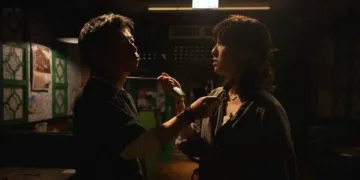























Four days and approximately $40,000 are modest foundations for a horror film, but they reveal something important about the cultural identity of Spirit Tasting. Chris LaMartina’s independent production belongs unmistakably to Baltimore, a city whose underground artistic communities have long cultivated their own forms of expression outside the industry’s usual centers.
Its central location, a former dive bar converted into a distillery, captures that identity through a small transformation. The building remains, but the culture that once occupied it has changed. For the former punks gathering there on New Year’s Eve, the renovated establishment offers an uncomfortable reminder that their younger selves belong to a disappearing world.
That sense of displacement gives LaMartina’s film an emotional foundation before the supernatural machinery begins operating. Will (Sean Doherty), Jake (Trevor Wilhelms), and their old friend, played by Melissa LaMartina, have reunited to remember a bandmate who died the previous year.
Employment frustrations and personal disappointments accompany their grief. The conversations carry the familiarity of people who have spent years sharing experiences, with jokes and casual insults occasionally concealing genuine discomfort. LaMartina and co-writer Michael Varrati understand that friendships formed through music can survive long after the circumstances supporting them have vanished.
The resulting film is an appealing, surprisingly touching piece of independent horror that deserves a recommendation, especially for audiences receptive to character-driven storytelling. Its supernatural premise sometimes struggles to justify its own cruelty, and its visual presentation lacks the personality of its writing. Still, the performances establish sufficient affection for these characters that their increasingly disastrous evening carries genuine emotional consequences.
The narrative draws from a recognizable source: W. W. Jacobs’ British supernatural tale The Monkey’s Paw. That comparison reveals an interesting transformation. Jacobs’ story belongs to a tradition of cautionary literature in which human desire encounters forces that expose the terrible cost of interfering with fate.
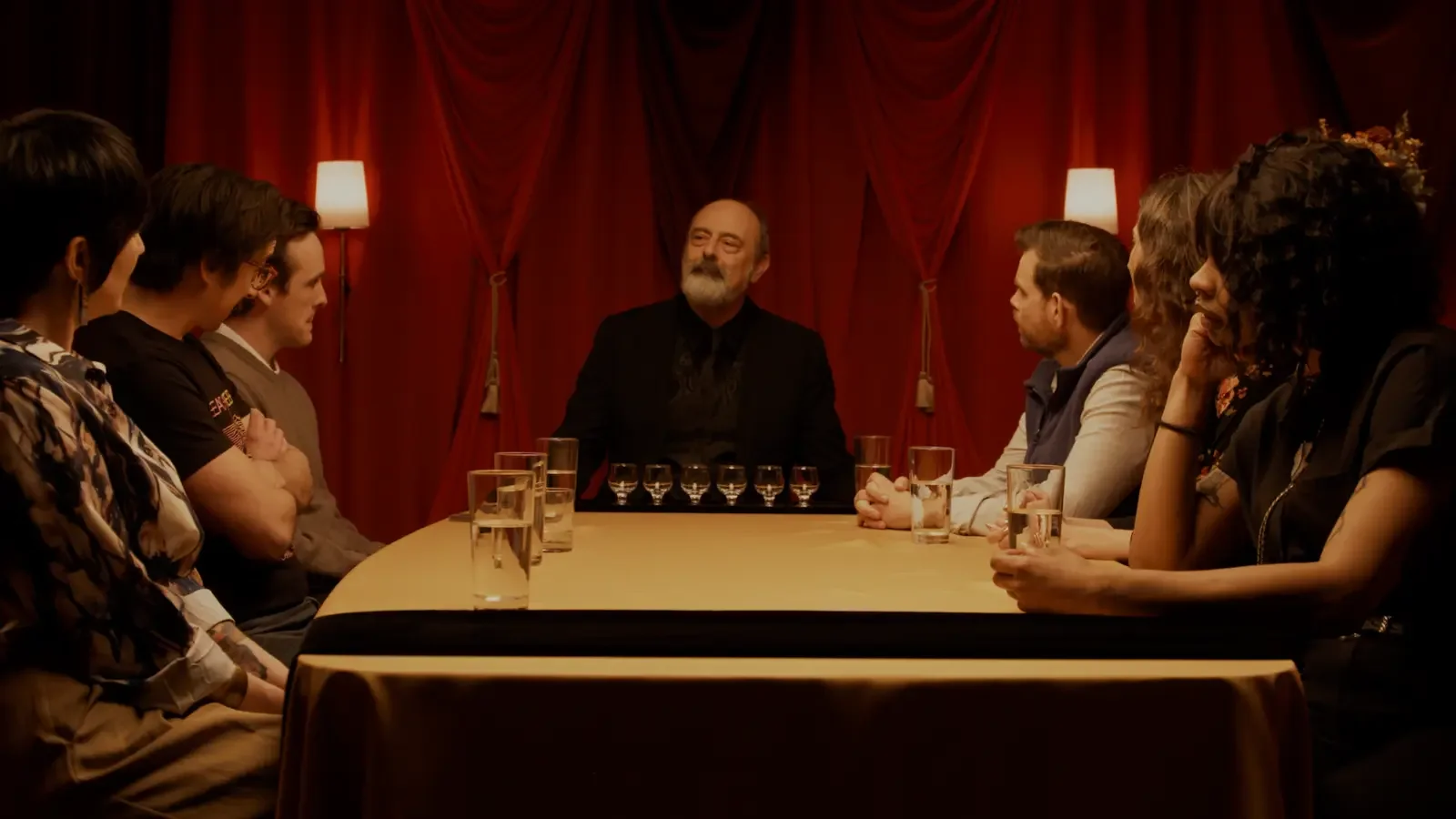
LaMartina transfers this moral structure into an American setting shaped by employment insecurity, disappointed ambitions, and the fading promises of youth. The mysterious sommelier, played by Matt Lake, invites the distillery’s customers to participate in an unusual tasting. Each bottle demands a wish, and the consequences become progressively disturbing.
Consider Will’s request for a promotion. Having already been overlooked at work, he asks for the advancement he believes he deserves. Soon afterward, his employer calls with news that the person selected for the position has died. The opportunity is suddenly available. The sequence demonstrates the screenplay’s ability to turn an ordinary professional disappointment into something grotesque. It also exposes a problem with its moral framework. Will’s desire seems reasonable, particularly in a society that encourages people to measure personal success through career advancement.
The distinction becomes important when comparing the film with its British literary ancestor. Jacobs makes the relationship between forbidden desire and punishment central to the experience. Here, the participants are often reluctant to make their wishes, and their motivations rarely approach the greed that would make such consequences satisfying as moral retribution.
Their suffering can therefore feel arbitrary. The film appears interested in questioning the impulse to change one’s circumstances, yet its characters have already endured enough disappointment to make that impulse understandable. The supernatural punishment occasionally seems far harsher than the human failure supposedly provoking it.
Fortunately, the ensemble gives these contradictions considerable dramatic value. Doherty plays Will with an approachable mixture of humor and dissatisfaction, allowing the promotion incident to register as an attack on an ordinary person’s hopes. Wilhelms brings an irreverent quality to Jake, using his position within the friendship group to introduce humor into increasingly uncomfortable situations. His disarming manner helps the conversational passages retain their energy. Melissa LaMartina contributes to the group’s fluctuating emotional atmosphere as the tasting changes their behavior and relationships.
Lake’s sommelier introduces a different register entirely. His measured hospitality contrasts with the familiar informality of the friends, creating unease through the ritual of offering drinks and inviting wishes. He occupies the tasting room like someone who understands its rules better than any of his guests. The performance makes the apparent generosity of the invitation increasingly suspicious. Bartender Grace, played by Tatiana Nya Ford, helps establish the ordinary social setting from which this strange ceremony emerges, although her comparatively limited presence leaves less room for development.
For much of its running time, Spirit Tasting resembles a gathering of old acquaintances interrupted by occasional supernatural developments. At a little over 70 minutes, it has limited space for elaborate plotting, yet the conversational opening still requires patience. The film’s affection for its characters is evident in the time spent allowing their shared history to emerge. That investment becomes valuable once the violence arrives, though viewers expecting a rapidly escalating horror experience may find the early pacing unusually relaxed.
A useful international comparison is Shinichiro Ueda’s Japanese horror comedy One Cut of the Dead, another production whose limited resources shaped its creative approach. Ueda transforms inexpensive filmmaking into an elaborate exercise in narrative construction, making the audience reconsider the images and events it has already witnessed.
LaMartina chooses a less formally adventurous route. His film depends on the authenticity of its ensemble, the details of its confined location, and the eventual arrival of practical effects. Measured against Ueda’s structural ingenuity, Spirit Tasting looks comparatively conventional. Judged through its attachment to Baltimore’s independent artistic community, however, its casual intimacy becomes a meaningful aesthetic decision.
That communal identity is particularly apparent in the production design. The carefully prepared bottles give the tasting a physical presence, and the gradual darkening of their contents offers a subtle indication that the evening is becoming increasingly dangerous.
These objects connect the story’s supernatural rules to the room itself. The later practical-effects sequences, created with contributions from Jessie Seitz and Marcus Koch, introduce a welcome burst of grotesque imagination. A bizarre bathroom incident involving an unexpectedly unsettling creature provides an especially memorable example of the film’s ability to combine revulsion with absurdity.
The photography is less distinctive. Although the distillery provides an effective contained setting, its visual treatment sometimes feels surprisingly impersonal beside the production’s punk sensibility. The location’s potential for claustrophobia and visual eccentricity remains partially unexplored.
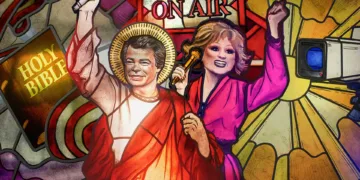
LaMartina achieves greater tonal variety through music and the television material scattered throughout the film. The score moves between humor, drama, and supernatural menace, helping the limited environment accommodate several emotional registers. The television gags introduce a playful affection for horror culture, although their Halloween associations can seem disconnected from the New Year’s Eve setting.
These choices also demonstrate the limits of interpreting the film exclusively through its budget. Financial restrictions explain the concentrated location and modest scale, but they cannot account for every visual decision. The production’s strongest achievements are deliberate: the tangible design of the bottles, the absurdity of its practical effects, and the careful distribution of humor among performers who appear comfortable together. Its weaker images deserve the same scrutiny regardless of the shooting schedule.
The final stretch makes the film’s uneasy relationship with its source material increasingly apparent. As the wishes produce escalating consequences, the story moves toward a reversal that encourages reconsideration of the characters’ grief and their desire to repair the past.
The emotional idea is effective, particularly because the earlier conversations have established the importance of the person they lost. Its moral construction is shakier. A decisive late choice loses some of its force because the promise involved has already been compromised earlier. What should become an agonizing confrontation with responsibility is softened by the screenplay’s own preceding events.
The significance of that ending may also depend on the audience’s relationship to the film’s setting. Viewers familiar with Baltimore’s underground music and horror communities may recognize a particularly affectionate portrait of artistic friendships surviving into middle age. Someone approaching the film through the British tradition of supernatural cautionary tales may be less forgiving of its uncertain moral logic. Both responses emerge from the same storytelling choices, especially the decision to make the participants sympathetic before exposing them to increasingly grotesque punishments.
New Year’s Eve provides an appropriate setting for this tension. The holiday invites people to imagine fresh beginnings, yet the former bandmates have returned to a room associated with a past they cannot recover. The distillery’s new identity makes that loss visible throughout the film, even as the characters attempt to bargain with supernatural forces for different futures. By the time the final wish brings their shared history back into question, the bottles have become an especially cruel means of asking what any of them would sacrifice for another evening with the person missing from their reunion.
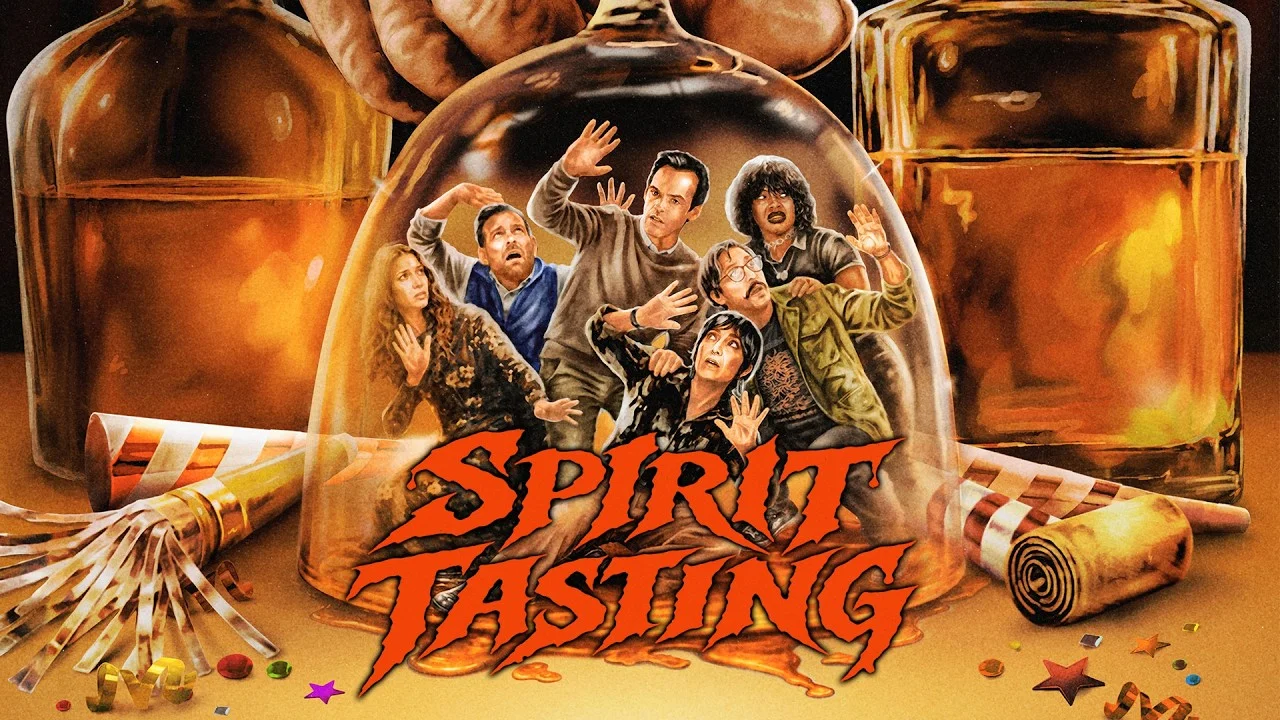
Spirit Tasting opened with its world premiere in Baltimore on November 12, 2026, kicking off a U.S. roadshow and Blu-ray release from Terror Vision Films alongside its November 20, 2026 rollout. Directed by Chris LaMartina and co-written with Michael Varrati, this horror-comedy riff on The Monkey’s Paw follows three former punks who toast a late bandmate on New Year’s Eve and accept a mysterious sommelier’s tasting where every pour demands a wish with deadly consequences.
Where to Watch Spirit Tasting (2026) Online
Full Credits
Title: Spirit Tasting
Distributor: Terror Vision Films
Release date: November 12, 2026 (Baltimore world premiere / U.S. roadshow launch), November 20, 2026 (wide release)
Running time: 1 hour 14 minutes (74 minutes)
Director: Chris LaMartina
Writers: Chris LaMartina, Michael Varrati
Producers and Executive Producers: Melissa LaMartina, Chris LaMartina, Michael Varrati, Ted Geoghegan, Ryan Graveface
Cast: Sean Doherty, Melissa LaMartina, Trevor Wilhelms, Matt Lake, Matt Baughman, Cate Paris, Tatiana Nya Ford, Grady Hendrix, Clay McLeod Chapman, Joshua Grannell, Henry Zebrowski, Michael Varrati, Helenmary Ball, Philip Doccolo, Zoe Angeli, Angie Mutolo, London St Juniper, John Dimes, Jake McClellan
Editors: Chris LaMartina
Composer: Steve Spacek
The Review
Spirit Tasting
Spirit Tasting transforms a familiar British horror premise into a distinctly Baltimore story of friendship, grief, and fading youth. Chris LaMartina's sympathetic ensemble, inventive practical effects, and intimate atmosphere give this modest production considerable personality. The leisurely opening and occasionally uninspired photography expose its limitations, and the characters' undeserved punishments weaken the moral logic of its supernatural premise. Yet the emotional sincerity survives these problems, culminating in a finale that gives the familiar wish-fulfillment formula unexpected poignancy. An affectionate, inventive independent horror film worth seeking out.
PROS
- Convincing performances and authentic friendships
- Strong Baltimore cultural identity
- Inventive practical effects and bottle designs
- Emotionally affecting exploration of grief
- Memorable supernatural finale
CONS
- Slow development of supernatural horror
- Occasionally impersonal cinematography
- Punishments feel morally arbitrary
- Final choice lacks sufficient dramatic weight