



























How much of the appeal of Tony Hawk’s Pro Skater survives when you take away the skatepark and give the player a predetermined route? The series established a remarkably flexible scoring formula, one that OlliOlli later adapted into a succession of tightly designed courses.
Denshattack! takes that evolution in an unexpected direction. Developer Undercoders replaces the skateboard with a train carriage capable of performing kickflips, grinding rails and transferring between vertical ramps. The change of vehicle gives the developers an excuse to attempt things that would look ridiculous even by the standards of arcade skateboarding games.
The visual similarities to Jet Set Radio are immediately apparent, from the cel-shaded characters to the street art and fashionable rival gangs. The campaign takes place in a future Japan devastated by climate change, where the Miraido corporation controls a network of protective domed cities and the high-speed VACTRAIN service connecting them.
Outside those cities, an underground competitive sport has developed around the remaining railway infrastructure. Emi, a cheerful ramen delivery driver with considerable talent behind the controls of her train, discovers the competition through Fernando, an enthusiast who documents the scene in his independent magazine.
Denshattack! is an excellent arcade game and one of the most imaginative extensions of the trick-sports formula in years. Its closest contemporary relative is OlliOlli World, particularly in the way its courses gradually increase the demands placed on the player. Anyone who enjoyed mastering the intricacies of that game should give this one serious consideration, though familiarity with skateboarding games will only get you so far through the early tutorials.
There is a pleasing amount of technique involved in driving the train between trick opportunities. The shunt mechanic allows Emi to switch between parallel tracks or cover additional horizontal distance during a jump. Applying the brakes around a corner brings up a timing gauge, with a successful release generating a burst of speed. Approaching a ramp at the right velocity and judging the position of the next track become fundamental skills long before complicated tricks enter the equation.
The right analog stick handles the tricks themselves. Simple directional flicks produce basic moves, and increasingly elaborate stick motions unlock advanced combinations. Some require the sort of precision usually associated with fighting games. The scoring system discourages repetition, giving players a good reason to consult the conveniently accessible Tricktionary and practice unfamiliar moves. Manuals allow combinations to continue between jumps, making the stretches of track separating ramps valuable scoring opportunities.
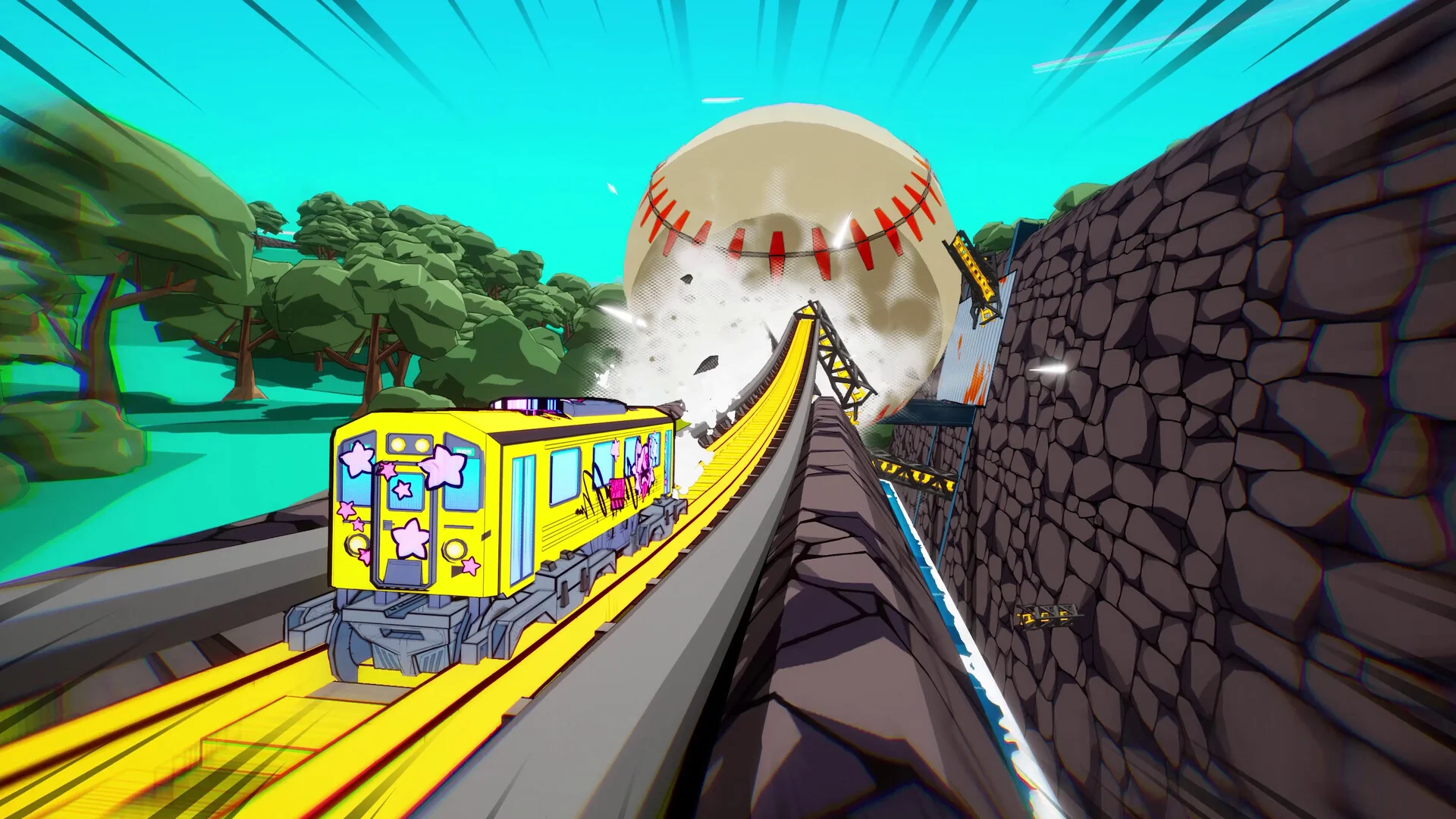
Veterans of Tony Hawk will probably find themselves instinctively searching for opportunities to extend a combination. Here, the challenge frequently comes from managing the train’s position at the same time. A spectacular aerial trick counts for little if the carriage misses its intended track or encounters a sharp bend immediately after landing.
The first two regions introduce a considerable number of mechanics, and the concentration of tutorials can make the opening hours feel unnecessarily fragmented. OlliOlli World benefits from presenting its increasingly elaborate challenges through a relatively consistent set of movement rules. Denshattack! asks players to absorb those lessons alongside frequent changes in traversal conditions. There is also surprisingly little pressure to learn the most advanced tricks during ordinary campaign progression. Simple stick movements can carry a player through many stages, particularly if collecting gold medals holds little immediate interest.
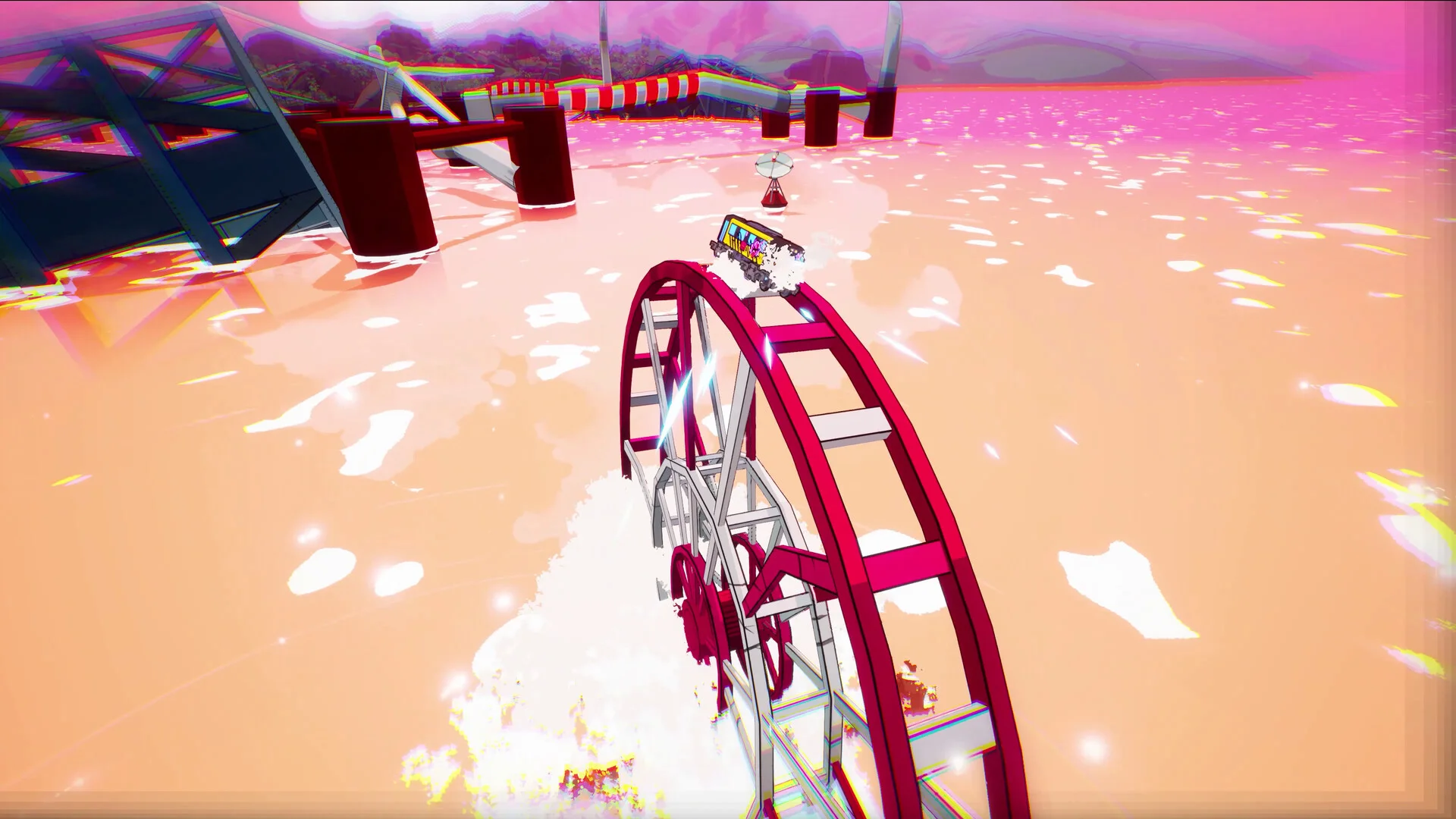
Undercoders makes excellent use of the freedom afforded by its absurd premise. An early stage has Emi land her carriage on a Ferris wheel, which breaks away from its supports and becomes a vehicle for crossing a bay and destroying satellite dishes. Elsewhere, the railway passes through volcanic environments and incorporates elements of kabuki theatre. Later traversal mechanics include attaching the carriage to monorail tracks and using air currents to stay airborne. These additions sustain a campaign lasting somewhere between ten and fifteen hours.
The courses also become increasingly interesting to explore. Races and traditional score challenges share space with missions built around multiple objectives, including one that involves clearing a bridge, restoring censored artwork and delivering soba. Maintaining stylish combinations fills an energy gauge that activates the Yaoyorozuo, known as the Eight Million Roads. These spectacular rainbow-colored tracks open additional routes through stages, making trick proficiency useful for discovering alternative exits.
Compared with Tony Hawk’s Pro Skater, Denshattack! sacrifices some improvisational freedom for far greater variety in the situations surrounding its tricks. That exchange works beautifully during the Ferris wheel sequence, where an entirely unexpected traversal challenge grows out of familiar controls. It becomes considerably less enjoyable when the game struggles to communicate the rules of an upcoming obstacle.
Orange grinding rails can be difficult to distinguish from nearby lanterns of a similar color. Green air currents suffer from comparable visibility problems against certain backgrounds. There are also inconsistencies in the surfaces that permit wall riding, discouraging experimentation outside designated areas. The generous checkpoints keep these problems from seriously obstructing campaign progression, but a poorly communicated hazard can ruin an otherwise excellent attempt at a crash-free run.
Emi’s competitive ambitions give the campaign the structure of a traditional martial arts anime. She travels between regions, proves herself against local gangs and earns the respect of their leaders through competition. Her cheerful determination makes the repeated conversion of opponents into allies quite agreeable, even if the character development rarely strays from familiar conventions. The experienced rockabilly engineers returning to action after recognizing her talent fit particularly well into a story celebrating enthusiasm and craftsmanship.
The confrontations marking the end of each region are substantially less predictable. One involves several trains combining into an enormous mechanical opponent. Another features a serpentine train that doubles as a grinding surface. These encounters are particularly satisfying because they find creative applications for techniques already practiced throughout the preceding courses. Trick-sports games rarely have much need for conventional boss battles, and Undercoders deserves credit for incorporating them into the progression so successfully.
The story’s rebellious attitude owes something to Jet Set Radio, although its characters express their resistance through an unusually friendly competitive community. Fernando’s magazine is especially effective in establishing that community’s identity. Collecting photographs allows players to assemble issues containing regional information, character profiles, details about their trains and Emi’s thoughts on ramen. The fictional publication gives the supporting cast a presence outside their competitive encounters.
Returning to completed stages reveals how much attention has gone into the optional challenges. Individual Dares reward specific tricks, hidden exits and clean finishes. Different trains introduce worthwhile strategic considerations, too. A carriage offering faster tricks sacrifices manual distance, potentially complicating extended combinations. Another fills the energy gauge faster at the expense of scoring potential, making it an attractive choice when searching for alternative routes.
Against the established trick-sports classics, Denshattack! is competitive in mechanical depth and particularly impressive in course variety. Its scoring opportunities are less open-ended than Tony Hawk’s, but players who enjoyed pursuing individual stage objectives in OlliOlli World will find plenty of comparable challenges here. Some of the most interesting decisions involve choosing a train specifically suited to a missed collectible or an alternative exit.
The catchy soundtrack and extravagant cel-shaded presentation help make repeated attempts enjoyable, even when the initial surprise of a particular setpiece has worn off. Chasing the highest scores can expose the occasional shortcomings in visual clarity, especially during the busiest stages. For players interested in completing every Dare, learning the position of an unexpected hazard may become just as important as mastering the elaborate inputs stored in the Tricktionary.
The Review
Denshattack!
Denshattack! takes the established trick-sports formula in a wonderfully imaginative direction. Its elaborate courses, inventive boss encounters, demanding trick system, and rewarding optional challenges give it considerable replay value. The steep learning curve, inconsistent traversal rules, and occasional visual clutter can frustrate players pursuing perfection. Fans of OlliOlli World will find plenty to appreciate, particularly in the carefully constructed stages and opportunities for mechanical mastery. Undercoders has created an arcade experience with enough personality and invention to stand comfortably alongside its genre predecessors.
PROS
- Exceptionally inventive course design and setpieces.
- Deep and rewarding trick mechanics.
- Creative boss encounters that utilize established abilities.
- Extensive replay value through Dares and train customization.
- Stylish visual presentation and catchy soundtrack.
CONS
- Steep learning curve and tutorial-heavy opening hours.
- Occasional visual clutter obscures hazards.
- Inconsistent traversal rules discourage experimentation.
- Limited improvisational freedom compared with traditional skating games.