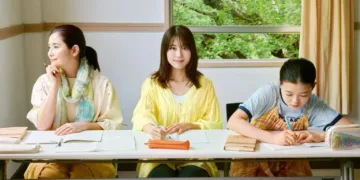








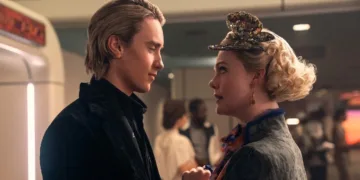








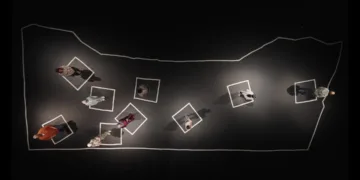










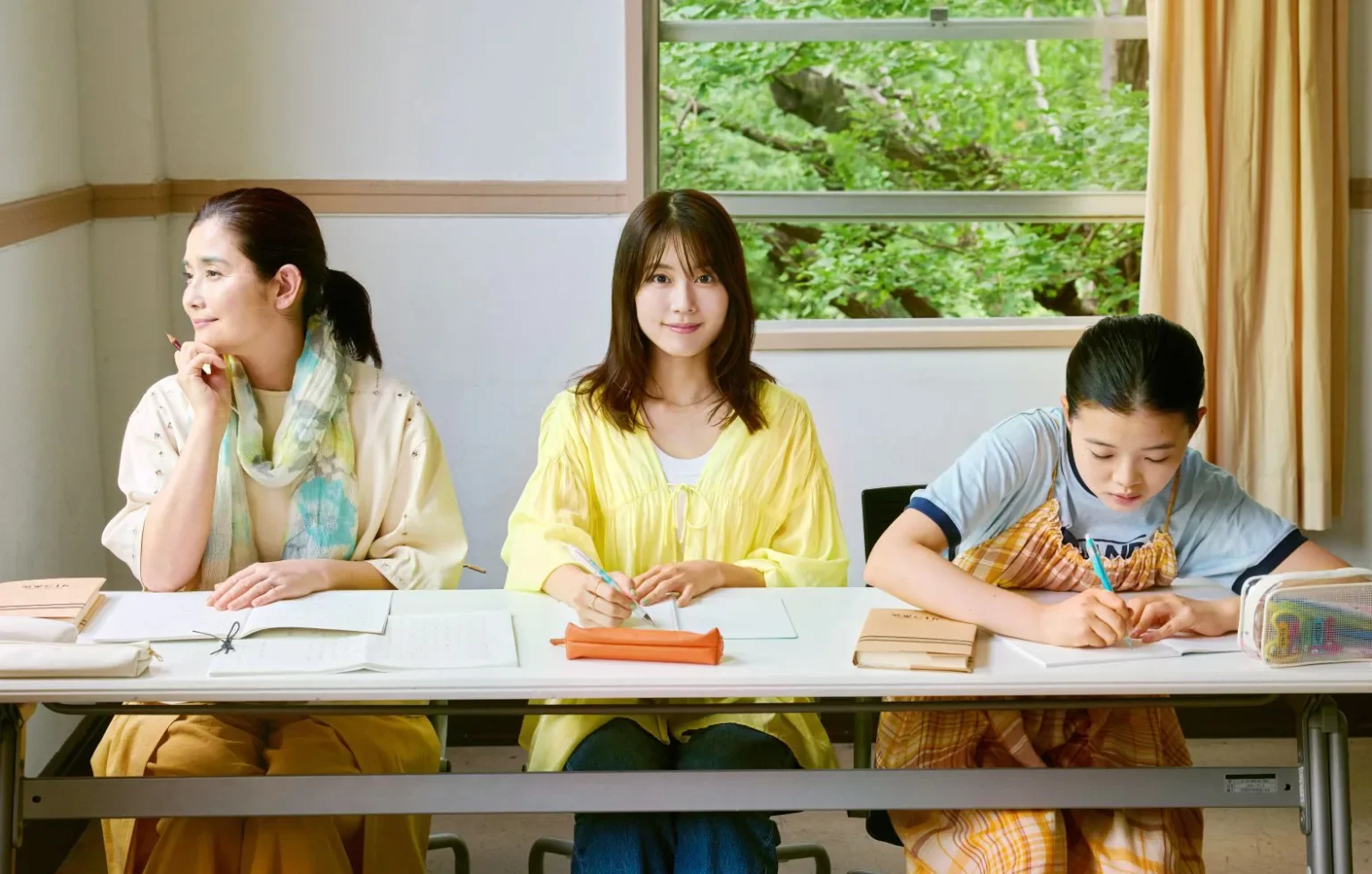

The Japanese language permits several ways of writing the same given name, a possibility Shuichi Okita exploits with considerable ingenuity in Satoko Always. His three protagonists share the name Satoko, yet each writes it using different kanji.
For Japanese-literate audiences, their individuality is established through a linguistic distinction that largely disappears in translation. International viewers encountering the film through subtitles must rely on other clues, including the women’s handwriting, habits and relationships. This small difference in accessibility is particularly pertinent to a film concerned with the capacity of written language to shape our understanding of people.
Okita distributes his story across three generations. Satoko Nakai (Kashun Himeno) is fifteen, Satoko Nishida (Kasumi Arimura) is thirty-five, and Satoko Iijima (Hikari Ishida) is fifty-five. Each discovers or rediscovers an appetite for writing fiction during a period of emotional uncertainty. Their experiences belong to recognizable genres of Japanese popular cinema, although Okita gradually complicates these associations by introducing elements of South Korean television melodrama and animated fantasy. The women’s lives intersect in ways that invite speculation about their identities.
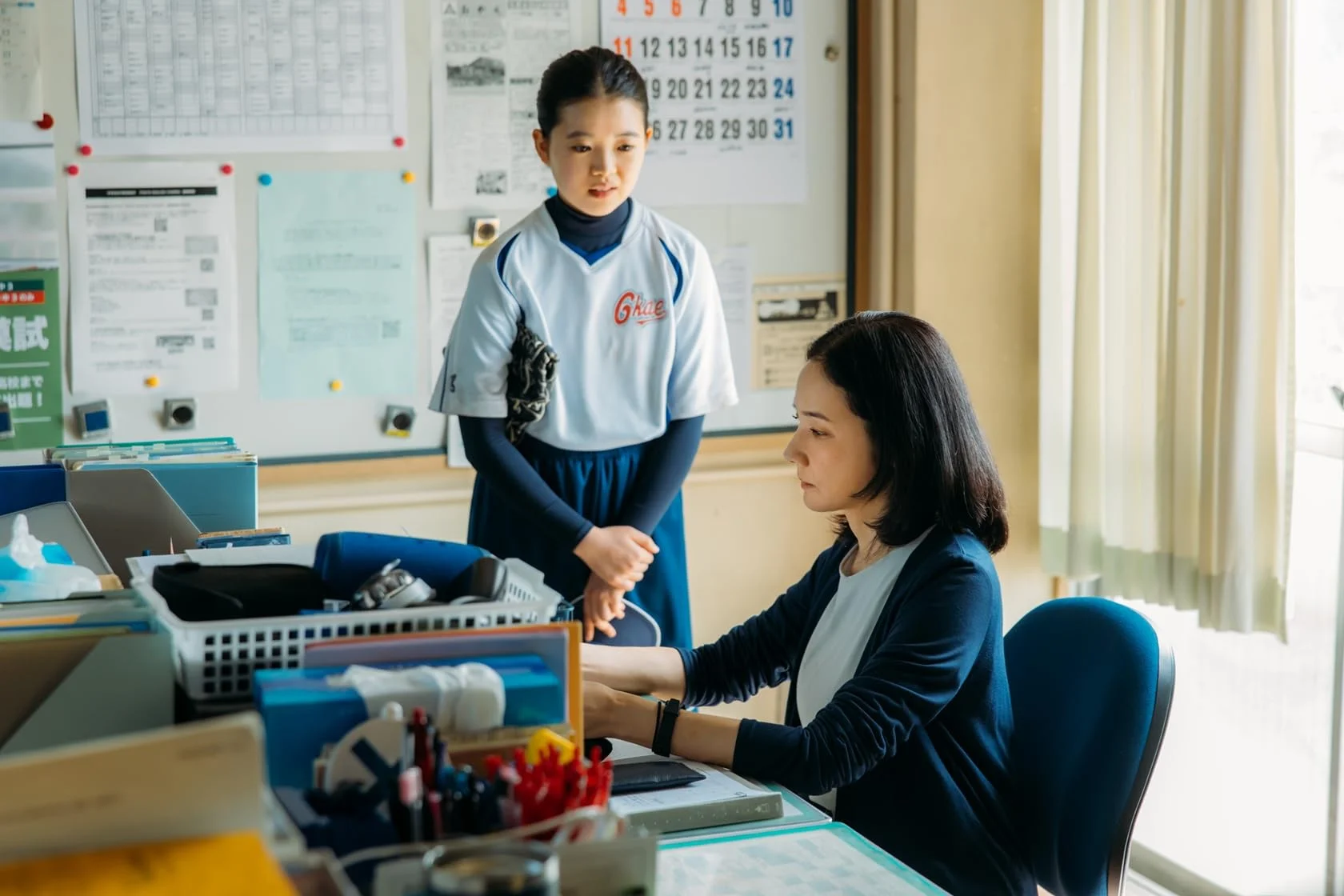
It is a wonderfully inventive comedy-drama, deserving of a wide international audience despite some indulgence in its storytelling. Okita’s affection for his characters survives the occasional excess of sentiment, and his treatment of literary composition has a delightful physicality. The film is especially rewarding when its protagonists discover that writing can have a purpose entirely independent of publication or professional ambition.
The teenage Satoko inhabits the familiar territory of the Japanese seishun eiga, a cinematic tradition concerned with youth, personal formation and the emotional discoveries of adolescence. Her romantic aspirations begin in the decidedly unromantic surroundings of an ear, nose and throat clinic. Receiving nebulizer treatment for allergic rhinitis, she encounters her classmate Hayase (Toharu Ogawa), who suffers from a similar condition.
Their encounters develop into a friendship, although his apparent indifference toward her at school creates considerable confusion. Himeno has an excellent instinct for the comedy of adolescent self-consciousness, particularly in a setting where the indignities of medical treatment frustrate any attempt at romantic sophistication.
Satoko’s literary ambitions emerge through an encounter with an older Japanese artistic tradition. Having slept through a kabuki performance that she was supposed to document for school, she produces an entirely fictional account. Her teacher, Ms. Terao, recognizes an imaginative talent where another educator might have identified academic dishonesty. Yoh Yoshida plays the teacher with an amusingly impenetrable seriousness, making her exchanges with the expressive Himeno especially enjoyable.
An assignment to compose a love letter to a favorite food produces an extravagant declaration of affection for shiokara, a Japanese delicacy of salted, fermented seafood. Satoko’s feelings for Hayase are barely concealed within the exercise. The cultural specificity of the food gives the scene much of its humor, even for viewers unfamiliar with its pungent qualities.
The appearance of shiokara in Nishida’s life establishes continuity just as Okita changes his cinematic vocabulary. Working in entertainment publicity, the adult Satoko spends her leisure time consuming romantic Korean television dramas. Her imaginative life draws upon a different country’s conventions of screen romance, an amusing acknowledgment of the circulation of popular culture throughout East Asia. The Japanese youth film’s relatively modest romantic aspirations give way to the grand emotional gestures and improbable developments of the television programs she admires.
Nishida’s affair with a married business associate, Muramoto (Joe Odagiri), ends in a violent confrontation with his wife that leaves Satoko hospitalized. She begins reconstructing the relationship through fiction, and Okita adopts the heightened register of her preferred entertainment. Judged against the naturalistic charm of Nakai’s story, these passages can appear excessively theatrical. Their debt to Korean melodrama makes the exaggeration considerably more interesting, since Nishida has internalized a dramatic vocabulary through which she interprets her experiences.
The difficulty is that her chapter affords Arimura relatively little space to establish an identity outside the affair. Okita moves through her circumstances with an enthusiasm for dramatic incident that occasionally comes at the expense of characterization. Her professional life, which involves writing promotional material for entertainment, deserved greater attention given the film’s interest in the distinction between commercial and personal creativity.
Iijima’s circumstances bring the film into the domestic sphere. Having raised three sons, she faces the prospect of her youngest leaving home for university. The preparation of his final school bento acquires considerable emotional significance. A routine through which she has expressed parental care for years is coming to an end, and Ishida communicates the uncertainty accompanying this change with considerable sensitivity.
American films about aspiring writers frequently organize their drama around an external measure of accomplishment, be it publication, professional recognition or the completion of a significant manuscript. Okita finds little use for such milestones in Iijima’s story. Her return to a childhood ambition is meaningful because she can now dedicate time and imagination to something she desires for herself. There is no professional hurdle the screenplay needs her to overcome.
This approach also permits a generous treatment of domestic affection. Iijima’s initial feeling that her family undervalues her gradually encounters evidence of their care. The image of a message painstakingly written in sauce across a bed of rice captures the film’s sensitivity to the expressive possibilities of ordinary Japanese household customs. Writing here has an intimate audience and a modest practical medium.
Okita’s account of female creative independence does invite some reservations. Each woman’s imagination receives considerable stimulus from her relationship with a man, which risks narrowing the possibilities of the artistic freedom being celebrated. Terao’s encouragement of the teenage Satoko is particularly valuable for this reason. She recognizes the girl’s talent before it can become wholly identified with her romantic aspirations. Iijima, too, is recovering an ambition that predates her maternal responsibilities.
Okita is at his most inventive when he translates literary composition into cinematic action. Words appear onscreen, and the events they describe can unfold before us or undergo immediate revision as their authors reconsider an idea. The distinction between the handwritten character and the moving image becomes wonderfully unstable. Tight framing gives even the digital cursor and typed characters a satisfying material presence. The sound design emphasizes the physical process of composition through the scratch of pencils and clatter of keyboards.
There are passages where Okita trusts this device less than he should. The persistent verbalization of feelings occasionally deprives the actresses of opportunities to communicate through expression alone. Across a film approaching two and a half hours, the repetition of imaginative exercises can become tiring. Himeno’s face already conveys much of the embarrassment that Nakai articulates through her writing.
The connections between the three women, including encounters at the clinic and hospital, acquire an appealing ambiguity through this treatment of fiction. A viewer looking for the precise chronology associated with puzzle films may find the experience frustrating. The recurrence of particular foods, locations and emotional circumstances offers a different means of understanding their relationship, one that leaves room for the individuality suggested by their written names.
Iijima’s fictional bird, brought to life through stop-motion animation within a live-action setting, represents an especially lovely extension of this approach. Her domestic experiences have furnished the material for a small fantasy about a bird visiting a bookshop in Hokkaido. The change of medium permits Ishida’s character a degree of imaginative freedom that her everyday surroundings could scarcely accommodate. Her little bird needs neither a publisher nor a readership to merit such careful animation.
Satoko Always (Satoko wa Itsumo) opened in Japanese theaters on September 18, 2026, and had its international premiere in competition at the Busan International Film Festival on October 7, 2026. Written and directed by Shuichi Okita and distributed by Happinet Phantom Studios with international sales by Hakuhodo DY Music & Pictures, the drama follows three women named Satoko at ages 15, 35, and 55 whose separate lives begin to intertwine as each turns her personal experiences into written stories.
Full Credits
Title: Satoko Always (Satoko wa Itsumo / さとこはいつも)
Distributor: Happinet Phantom Studios, Hakuhodo DY Music & Pictures
Release date: September 18, 2026 (Japan theatrical release), October 7, 2026 (Busan International Film Festival international premiere)
Running time: 2 hours 19 minutes (139 minutes)
Director: Shuichi Okita
Writers: Shuichi Okita
Producers and Executive Producers: Ryohei Tsutsui, Miyuki Sato, Suguru Kubota, Yuya Tanaka
Cast: Kasumi Arimura, Hikari Ishida, Kashun Himeno, Daisuke Kuroda, Junko Miyabe, Yota Kawase, Momoi Shimada, Tomo Nakai, Yuko Nakamura, Yui Narumi, Mansaku Takada, Kanji Furutachi, Yoh Yoshida, Joe Odagiri, Yuzu Aoki, Kanata Hosoda
Director of Photography (Cinematographer): Akiko Ashizawa
Editors: Masaya Ozaki
Composer: Satoko Shibata, Yuta Orisaka
The Review
Satoko Always
Satoko Always finds considerable charm in the cultural particulars of everyday Japanese life and the imaginative possibilities of literary expression. Shuichi Okita's fluid movement between adolescent comedy, Korean-inspired melodrama and animated fantasy gives each woman's creativity a distinctive cinematic language. Kashun Himeno and Hikari Ishida are particularly impressive. The abbreviated middle chapter, excessive verbal exposition and occasional repetition diminish the film's impact, yet its celebration of artistic fulfillment independent of professional recognition remains deeply rewarding.
PROS
- Inventive interplay between written language and cinematic imagery.
- Expressive performances from Himeno and Ishida.
- Thoughtful incorporation of Japanese and Korean storytelling traditions.
- Imaginative stop-motion animation.
- Sensitive exploration of private creative fulfillment.
CONS
- Nishida's storyline lacks sufficient character development.
- Excessive verbal exposition undermines expressive performances.
- Repetitive narrative devices occasionally strain the pacing.