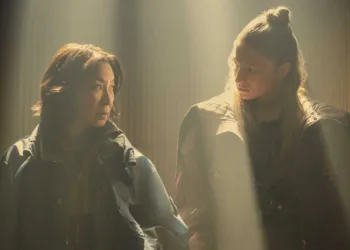







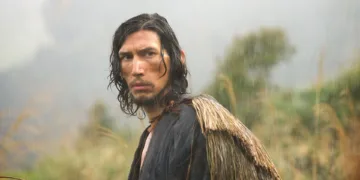



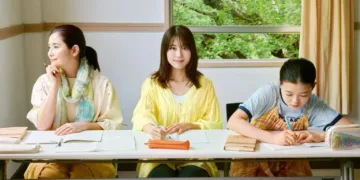





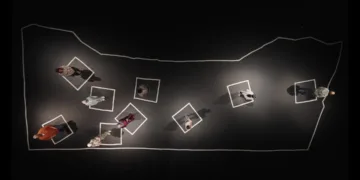












Sumiati digs into the dry earth, searching for water beneath a village that seems to have forgotten the existence of rain. The labor is exhausting, repetitive, and almost absurd in its stubbornness. There is no assurance that the ground will yield anything, only the possibility that another day’s effort might bring her closer to something she needs. In Eddie Cahyono’s Ibuku, this act of digging gradually acquires the weight of an entire existence. A woman lowers herself into the earth because the world above has given her so few places to turn.
Christine Hakim plays Sumiati, or Sum, a widowed Javanese woman whose husband, Wagiman, died by suicide years earlier. Her daughter Sri (Ayushita Nugraha) has been absent for years, working in Saudi Arabia after escaping a violent marriage. When Sum learns that Sri has been sentenced to death for killing her employer after resisting sexual assault, the terrible distance between them becomes a matter of life and death.
She must somehow gather enough money to travel overseas, although poverty has already consumed nearly every possibility available to her. Ibuku is a deeply affecting film, made extraordinary by Hakim’s performance and Cahyono’s ability to give suffering a physical presence. Its occasional narrative confusion rarely diminishes the emotional force of what unfolds.

The cruelest part of Sum’s situation lies in the history she shares with her daughter. Wagiman forced Sri into marriage with Tejo to settle his gambling debts. When Sri suffered abuse and wanted to escape, her mother encouraged her to remain. Sum had accepted the expectations imposed upon women of her generation so completely that she could scarcely recognize her daughter’s desperation as a legitimate reason to disobey them.
This history makes the mother’s present devotion difficult to separate from her earlier failure. She wishes to protect the daughter whose suffering she once helped prolong. Her determination is sincere, yet sincerity cannot rewrite the past. When Sri communicates that she does not want to see her mother, even with execution approaching, the refusal has a terrible moral clarity. Sum can cross an ocean, perhaps, but she cannot demand entry into a life from which she was deliberately excluded. Cahyono lets Sri’s refusal stand, even as Sum presses ahead with her plans.
Hakim’s performance is especially remarkable in the way it refuses to settle into a single emotional register. In one confrontation with Tejo, Sum’s anger gives way to a sudden collapse, only for her fury to return almost immediately. The movement between these feelings is painfully recognizable. Grief seldom arrives in an orderly progression, and guilt has a peculiar ability to disguise itself as resentment.
Hakim makes these contradictions visible through her changing expression and the physical exhaustion that increasingly defines Sum’s existence. Her face seems permanently occupied by thoughts she cannot bear to examine for long. Even her determination carries the fatigue of someone who has spent years surviving choices that were never entirely her own.
There is something particularly devastating about the film’s treatment of work. Sum once performed Jathilan, a traditional Javanese dance associated with communal ritual and trance. Now her days are consumed by the ordinary demands of survival and the desperate need to finance an impossible trip.
The movement of a dancer has been replaced by the movement of a laborer. Both require the body to surrender itself to repetition, but only one once offered her the possibility of joy. Cahyono returns to Jathilan throughout the film, allowing its music and ritualistic associations to disturb the apparent solidity of the present. Scenes of Sum and Sri dancing together preserve an intimacy that their later separation has almost erased.
Their shared participation in the performance expresses something that their damaged relationship can no longer communicate through conversation. These moments are particularly affecting because they belong to a time that cannot be recovered. Their bodies once occupied the same rhythm. Now even the possibility of a meeting depends on forces neither woman controls.
Muhammad Firdaus’s 16mm cinematography gives this world a remarkable sense of age and physical texture. The rural surroundings, the drought-stricken landscape, the dark corners and encroaching vegetation acquire a presence that sometimes feels indifferent to human suffering. The images possess the rough intimacy of documentary observation, yet their colors and textures also suggest a past that continues to seep into the present. As memories interrupt the narrative and spectral elements emerge, the distinction between what Sum remembers and what she experiences becomes increasingly uncertain. The landscape seems to carry the residue of lives that have already disappeared.
This movement between realism and spiritual unease is among the film’s most successful artistic decisions. The recurring dance sequences and the presence of the supernatural grow naturally from a world where tradition continues to shape the living. Cahyono does not treat grief as an emotion that remains contained within the individual. It alters time, transforms familiar surroundings, and allows the dead to occupy space in the lives of those who remain.
The nonlinear construction sometimes strains against this achievement. Greg Arya and Cahyono’s editing moves between different periods with an elliptical freedom that can obscure the precise relationship between events. Some transitions deepen the sensation of disorientation, particularly as Sum’s memories increasingly intrude upon her present circumstances. Others make the narrative unnecessarily difficult to follow. The final stretch occasionally lingers on established emotional states long enough for their intensity to weaken. Repetition is central to the film’s atmosphere, but its dramatic value is not inexhaustible.
A deeper limitation concerns Sri herself. Her experiences in Saudi Arabia remain largely beyond the film’s immediate perspective, despite their significance to the conflict. Nugraha communicates considerable feeling through silence, her expressions, and the remembered scenes of dancing with her mother, but Sri’s independent emotional life receives comparatively little attention. Her refusal to meet Sum is one of the story’s most painful developments, and a fuller understanding of her experiences might have given that decision greater complexity.
Yet I am uncertain how much of Sri’s absence Cahyono intends us to experience as a loss of knowledge. We remain confined to the mother’s incomplete understanding, confronted by the limits of what she can recover about someone she believed she knew.
That restriction makes the estrangement particularly severe. Still, the daughter’s suffering deserves an existence beyond its effect upon Sum’s conscience. Her escape from domestic violence was an assertion of independence, and the film sometimes allows that independence to disappear beneath the weight of maternal grief.
The social realities surrounding the women remain equally oppressive. Sum approaches village chief Djatmiko for assistance, but his limited ability to help exposes the fragility of her position. The prospect of selling ancestral land becomes another painful calculation. Family, community, and established authority have failed to protect Sri, and the distance to Saudi Arabia makes those failures almost impossible to confront directly. Cahyono presents these circumstances through the practical obstacles facing a woman who has almost nothing left to sacrifice.
The well gradually becomes the film’s most troubling expression of Sum’s persistence. Her effort to bring water to the village extends her capacity for care beyond the daughter she cannot reach. There is generosity in this work, but it would be too easy to interpret the act as redemption. The villagers’ need for water exists independently of Sri’s suffering. Helping them cannot erase the years when Sum failed to recognize her daughter’s need for protection. The earth demands her labor without asking about her motives, and still she digs.
The film’s later passages approach an emotional release that might have seemed sentimental in less capable hands. Hakim allows a rare smile to emerge from a face that has carried so much resentment, fear, and exhaustion. It is a small expression, almost startling in its unfamiliarity.
Its power comes from the physical and emotional suffering that preceded it, particularly those moments when Sum seemed incapable of holding any feeling long enough to understand it. The smile offers no simple assurance that her choices have been forgiven. It recalls, instead, the earlier image of mother and daughter dancing together, when closeness required nothing beyond the possibility of sharing the same movement.
Ibuku (My Mother) had its world premiere in competition at the Busan International Film Festival on October 8, 2026, where it won the Special Jury Award, with international sales handled by Asian Shadows. Written and directed by Eddie Cahyono and starring Christine Hakim, the Indonesian drama follows an elderly widow in a Javanese village who scrambles to raise money and reach her daughter on death row in Saudi Arabia after learning of her tragic fate as a migrant worker.
Full Credits
Title: Ibuku (My Mother)
Distributor: Asian Shadows (World Sales), Talenta Media, Knockonwood
Release date: October 8, 2026 (Busan International Film Festival world premiere)
Running time: 1 hour 36 minutes (96 minutes)
Director: Eddie Cahyono
Writers: Eddie Cahyono
Producers and Executive Producers: Tika Bravani, Shin Yamaguchi, Aris Nugraha, Zunan Farid
Cast: Christine Hakim, Ayushita Nugraha, Landung Simatupang, Tika Bravani, Udik Supriyanta, Sriwidiyanti, Nano Asmarodono, Gati Handoko, Rendra Bagus, Juminten, Liek Suyanto, Intan Kemalasari, Heru Prasetya, Noel Kefas, Eko Bebek, Lucky Ucok, Adi Marsono, Ibnu Gundul, Naomi Srikandi
Director of Photography (Cinematographer): Muhammad Firdaus
Editors: Greg Arya, Eddie Cahyono
Composer: Krisna Purna
The Review
Ibuku
Ibuku finds its deepest sorrow in the distance between love and forgiveness. Christine Hakim gives a remarkable performance as a mother whose relentless devotion cannot erase the damage she once helped cause. Eddie Cahyono's textured 16mm imagery and haunting Jathilan rituals transform grief into something almost tangible. The nonlinear storytelling occasionally loses clarity, and Sri deserves greater space beyond her mother's suffering. Yet the film's emotional power survives these shortcomings, particularly in its quiet recognition that sacrifice offers no certainty of redemption.
PROS
- Christine Hakim's profoundly moving performance
- Haunting 16mm cinematography
- Powerful use of Jathilan rituals and music
- Morally complex portrayal of motherhood and regret
- Evocative atmosphere of grief and isolation
CONS
- Occasionally confusing nonlinear structure
- Sri's perspective remains underdeveloped
- Repetitive passages weaken the final stretch