























Can a camera record the truth and still make its audience an unjust judge? The question hangs over The Cuckoo Clock, a psychological horror film whose visual language is considerably less innocent than its domestic setting suggests. Cinematographer Chad Courtney favors ordinary compositions, allowing rooms and familiar household objects to retain their everyday appearance. Then an occasional Dutch angle introduces a quiet disturbance. The tilted frame offers no evidence of wrongdoing, yet it encourages suspicion. Writer-director Lisa Jay understands a fundamental principle of noir: the spectator can become an accomplice to a false judgment simply by accepting the camera’s invitation to distrust someone.
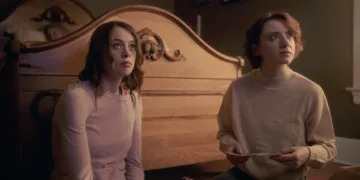
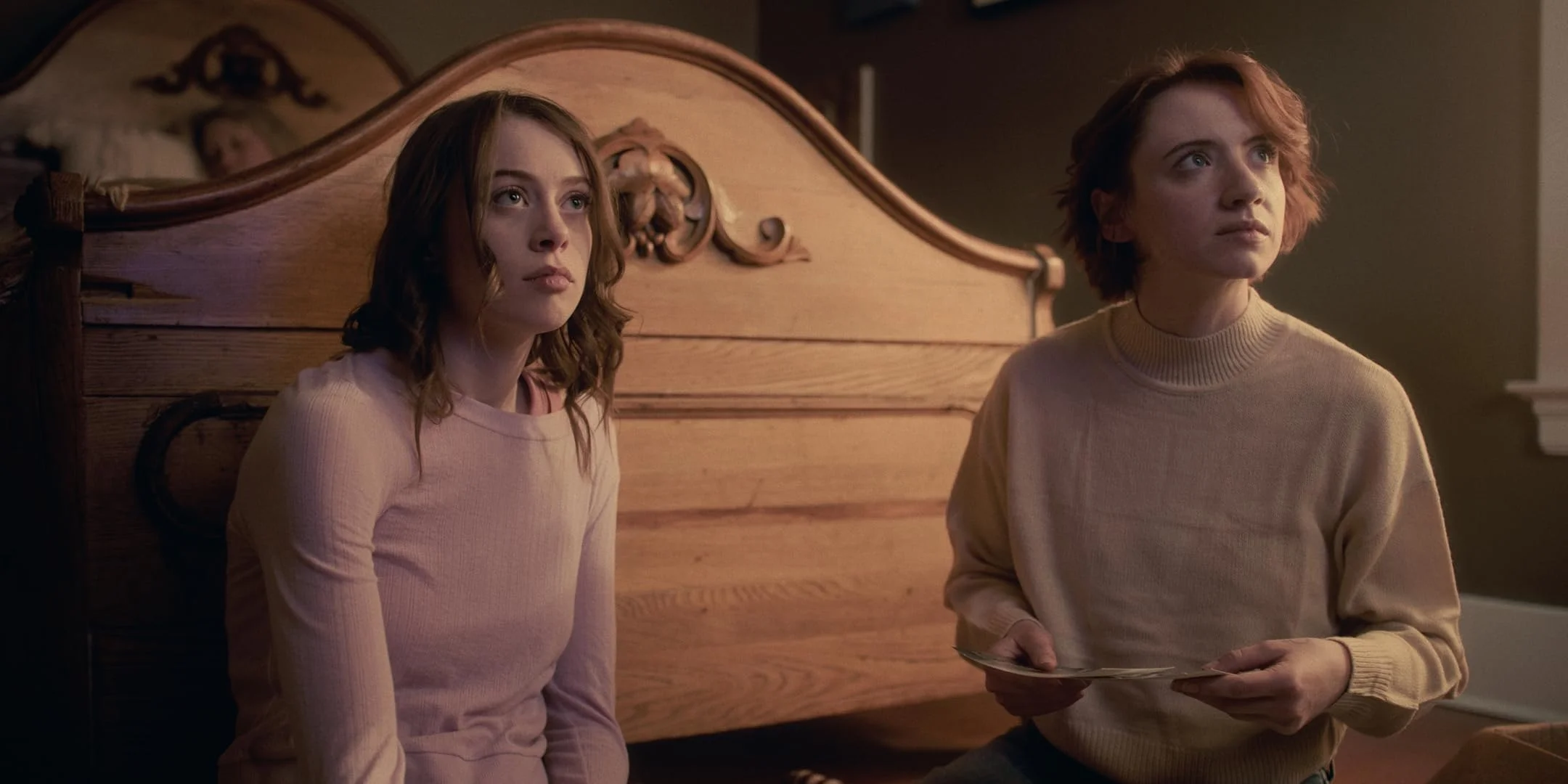
That suspicion acquires a human cost through Penny (Hana Hahn), whose grandmother Adele (Laura Drake) is recovering from surgery and living with dementia. Megan (MaKenna DeCaro), Adele’s live-in healthcare worker, develops a romantic relationship with Penny, bringing affection into a household already strained by uncertainty. When Megan disappears, Penny searches for answers and begins taking guidance from her grandmother’s talking cuckoo clock. An unusual investigative partner, certainly, and one whose qualifications appear to consist entirely of being able to tell the time.
Jay’s feature debut is an impressively controlled, frequently disturbing piece of psychological horror, and an easy recommendation for viewers who appreciate mysteries that demand active interpretation. Its surrealism occasionally exceeds the emotional foundations supporting it, but the film earns considerable trust through its performances, visual restraint, and carefully managed revelations. The central achievement lies in making Penny’s uncertainty infectious. The audience begins questioning characters whose intentions appeared understandable only moments earlier.
Courtney’s cinematography establishes a visual baseline against which the stranger elements can register. When the camera introduces a canted composition, familiar surroundings acquire a perceptual imbalance. The technique recalls the expressionist inheritance of psychological noir, where distorted geometry can suggest a corrupted moral environment. Here, however, the distortion carries a further complication. A tilted image encourages us to perceive danger, yet it cannot establish the moral character of anyone occupying that image. The camera influences the verdict before the evidence has been examined.
The film’s occasional point-of-view compositions create a related problem. By placing the spectator inside a character’s visual perspective, Jay encourages identification with that character’s immediate interpretation of events. In Penny’s case, this becomes ethically dangerous. Her fear is understandable, particularly after Megan’s disappearance, but the emotional legitimacy of her distress offers no guarantee that her suspicions are correct. A subjective image can make a mistaken interpretation feel authoritative.

Sound operates according to a different, equally manipulative principle. Ticking persists across quiet and louder passages, maintaining a mechanical rhythm beneath the film’s increasingly unstable events. The sound suggests an approaching deadline, although the narrative initially refuses to identify precisely what is approaching.
Each passing second is measurable, yet Penny’s understanding of her circumstances remains uncertain. The clock promises order through its mechanical function and undermines that promise through its apparent ability to speak. Its intermittent conversations with Penny introduce peculiar humor, although the implications of accepting advice from such an unreliable object are rather less amusing.
Jay extends this manipulation into the film’s temporal structure. The early sequences are frequently brief, presenting mysterious individuals, unexplained visual glitches, and ambiguous interactions before their significance becomes apparent. Cross-fades and fades to black separate incidents that might otherwise provide clearer information about the characters. Such transitions leave the spectator to construct causal connections from incomplete material.
This approach occasionally tests patience. Some early passages feel disconnected, and the refusal to develop individual encounters can make the mystery seem unnecessarily evasive. Yet later sequences grow longer, allowing previously obscure relationships to acquire definition. Jay gradually changes the amount of information available to the audience rather than depending on a succession of arbitrary shocks.
The performances give this strategy its necessary emotional credibility. Hahn’s Penny moves from recognizable affection toward an increasingly unstable mixture of fear, desperation, and paranoia. Her concern for Adele remains understandable even as her interpretation of the household becomes harder to accept. Hahn maintains that continuity, making Penny’s growing suspicion psychologically persuasive. The character’s perception may be unreliable, but her emotional responses possess an internal consistency that keeps the audience invested.
DeCaro introduces another form of uncertainty through Megan. Her chemistry with Hahn makes their romantic attachment believable, establishing a relationship whose intimacy complicates the subsequent mystery. Hints of jealousy and tension prevent Megan from becoming an uncomplicated figure of affection. Once Megan disappears, those earlier tensions acquire possible significance, although the film provides insufficient grounds for confidently interpreting them as signs of wrongdoing. The audience is left examining the relationship retrospectively, often attaching suspicious meanings to behavior that previously seemed ordinary.
Laura Drake faces perhaps the most delicate dramatic responsibility. Adele’s dementia produces genuine confusion and frustration, but her behavior can also suggest deliberate deception. Drake preserves that uncertainty through a performance grounded in the recognizable difficulties of her condition. The audience is invited to consider the possibility of concealed intentions, yet the character’s cognitive vulnerability makes such judgments morally hazardous. Forgetfulness can resemble evasion to someone already searching for an explanation. Confusion can be mistaken for dishonesty.
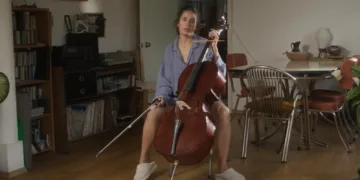
This is where Jay’s use of older footage becomes especially significant. Images from Adele’s past appear among present-day events, establishing a contrast between earlier experiences and her current difficulties with memory. The characters’ interactions with this material prevent it from functioning as detached historical exposition. Its presence gives the past an active place within the film’s unstable present.
The visual implication is unsettling. Recorded images ordinarily possess a certain evidentiary authority: they establish that something existed in front of a camera at a particular moment. But their apparent objectivity cannot settle the meaning of present behavior.
The older footage preserves fragments of Adele’s life that her current condition may prevent her from recalling consistently. It also invites the other characters to interpret her through a version of herself that no longer corresponds neatly to the woman before them. Jay places two kinds of visual testimony in tension, and neither can provide a complete account of her identity.
That treatment of memory gives the supernatural uncertainty its strongest philosophical dimension. Adele depends on those around her for care, but their interpretations of her behavior also influence how she is understood. Penny’s increasing desperation threatens that responsibility. Her search for certainty creates the possibility that she will mistake an interpretation for an established fact, particularly when the clock begins supplying apparent guidance.
The film’s approach to horror changes as the mystery develops. Its early unease comes largely from incomplete information, altered compositions, and the persistent suggestion that apparently ordinary behavior conceals something threatening. Later, the supernatural elements become increasingly pronounced. Strange apparitions, elaborate effects, and gruesome imagery push the material toward a far more extravagant register. The final stretch contains bloody surprises that would seem excessive in a conventional domestic thriller, though they belong to the unsettling reality Jay has gradually established.
Here the direction becomes less disciplined. Some surreal images carry symbolic implications that the surrounding drama has not fully developed, and the heightened spectacle occasionally weakens the intimate psychological tensions established through Penny, Megan, and Adele. The problem is particularly noticeable because the earlier material generates considerable anxiety through comparatively modest techniques. A simple shift in camera perspective or the continuation of an unexplained ticking sound can accomplish what the later effects sometimes struggle to reproduce.
Still, Jay makes an intelligent decision concerning the resolution. The concluding developments clarify enough of the central mystery to establish a meaningful relationship between the film’s fragmented beginning and its increasingly extreme second half. Certain ambiguities remain, particularly around the symbolic dimensions of the horror, but the essential revelations prevent the narrative from dissolving into unrestricted abstraction. The extended later sequences make earlier gaps in information easier to understand, giving the audience a reason to reconsider incidents that initially appeared disconnected.
This represents an interesting departure from the traditional noir impulse to leave moral certainty permanently compromised. Jay permits portions of the mystery to become intelligible, then allows the psychological implications of the earlier uncertainty to persist.
The revelations do not erase the questionable judgments viewers have made during the film. Instead, they expose how readily visual distortions, incomplete conversations, suspicious behavior, and unreliable memories encouraged those judgments in the first place. The unexplained visitors, abbreviated exchanges, and fragments of older footage acquire different significance once the missing connections begin to emerge.
The Cuckoo Clock premiered on September 26, 2026, before opening in select theaters across the United States on October 2, 2026, through Compassionate Disaster Films. Written and directed by Lisa Jay in her feature debut, the psychological horror drama follows Penny (Hana Hahn), who falls for the home-health nurse (Makenna DeCaro) caring for her grandmother with dementia (Laura Drake), only to have her grandmother’s cuckoo clock speak with a chilling warning when the nurse suddenly vanishes.
Where to Watch The Cuckoo Clock (2026) Online
Full Credits
Title: The Cuckoo Clock
Distributor: Compassionate Disaster Films
Release date: September 26, 2026 (Dead Prairies Horror Movie Festival Canadian premiere), October 2, 2026 (U.S. limited theatrical release)
Running time: 1 hour 31 minutes (91 minutes)
Director: Lisa Jay
Writers: Lisa Jay
Producers and Executive Producers: Erich Cannon, Kim Hornsby
Cast: Hana Hahn, Makenna DeCaro, Laura Drake, Rodman Bolek, Brandon Johnson
Director of Photography (Cinematographer): Chad Courtney
Editors: Nathan D. Lee, Mikiech Nichols
Composer: William Cannon
The Review
The Cuckoo Clock
Lisa Jay transforms an ordinary home into a place where images, memories, and intentions cannot be trusted. Chad Courtney's restrained cinematography, the persistent ticking, and three convincing performances make suspicion increasingly difficult to resist. The fragmented opening occasionally frustrates, and the climactic spectacle sometimes overwhelms the psychological drama. Yet the revelations reward close attention, exposing how easily an audience can mistake perception for evidence. A disturbing, intelligent feature debut that earns its unsettling final revelations.
PROS
- Subtle cinematography turns ordinary spaces threatening
- Persistent ticking creates psychological tension
- Strong performances from Hahn, DeCaro, and Drake
- Thoughtful examination of memory and suspicion
CONS
- Early narrative fragmentation can feel evasive
- Some surreal symbolism lacks development
- Climactic spectacle occasionally weakens the intimate drama