



























“Sirat” emerges from the Moroccan heat haze, a cinematic intimation woven from the desert’s stark indifference and the faint tremor of an approaching void. Within this sun-blasted theatre of existence, Luis, a father whose silhouette is heavy with an unspoken sorrow, and his young son, Esteban, a surprisingly resilient counterpoint to the surrounding dissolution, meticulously scan the ecstatic, temporary anarchy of a remote desert rave.
Their tangible objective is Mar, a daughter, a sister, a name whispered into the relentless pulse of the soundscape, potentially consumed by this frantic, almost pagan, congregation. Yet, the film’s initial movements resonate with a disquiet far more profound than a familial search. This is not presented as a simple pilgrimage towards reunion; it is the precipice of an existential odyssey, a fraught passage across physical and psychological territories designed to abrade the soul.
The raw, unvarnished grain of experience is rendered with an almost painful clarity, yet it shimmers with a mythic foreboding, attuning the senses for a journey where the destination might be a dissolution, the path itself an encounter with the abyss.
Fracture in the Fugue State
The initial haven is a phantasmagoria, a desert throb engineered against the silence of eternity. Here, Kangding Ray’s score acts not as accompaniment but as architect, its bass-heavy tremors erecting an ephemeral city of sound from towering speaker monoliths. Around these totems, a congregation of self-styled techno-nomads—weathered ‘crusties,’ ‘freaks,’ and seekers of oblivion—convulse in a shared, percussive trance, their energy a defiance against an unstated despair.
Into this vortex of deliberate forgetting drift Luis and Esteban, incongruous notes of specific sorrow, their paper flyers for Mar a fragile plea against the overwhelming sensory tide. They appear as ghosts from a forsaken, quieter world, their search an almost absurd counterpoint to the collective pursuit of ecstatic obliteration.
Then, the dream shatters. The mundane, brutal authority of soldiers arrives, heralding a declared state of emergency, the distant drumbeats of global war finally breaching this isolated pocket of manufactured bliss. A character’s bleak question hangs in the air – “Is this what the end of the world feels like?” – as the illusion of sanctuary dissolves.
Evacuation becomes imperative, and in the ensuing scramble, Luis, clutching his son and the fading hope for Mar, makes a choice born of desperation: to follow the seasoned few who slip deeper into the desert’s embrace. Their new objective, another rave, another chance, is a thin thread to grasp, especially when weighed against the clear inadequacy of Luis’s small vehicle against the immensity of the path unwinding before them.
Figures Etched in Dust and Doubt
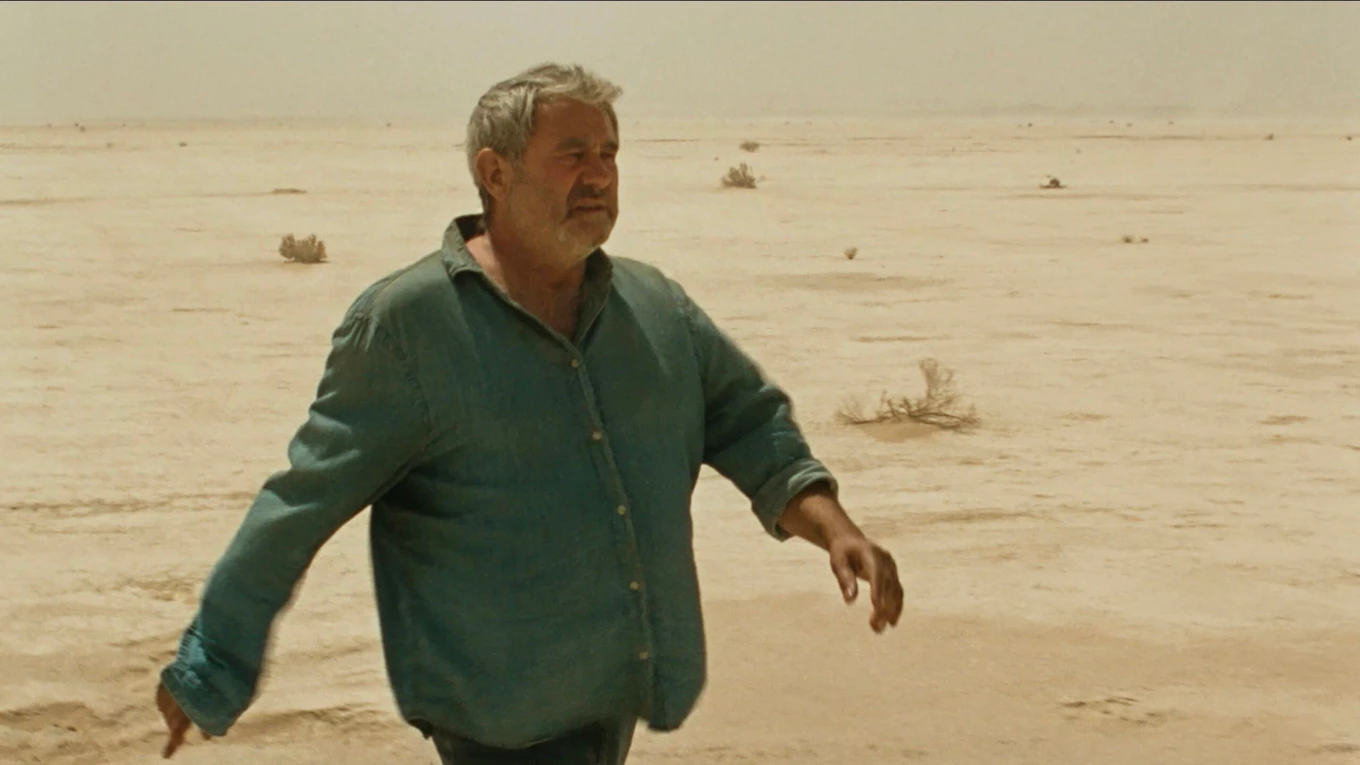
In this theatre of desolation, the human figures acquire a stark, almost monumental quality. Luis, embodied by Sergi López with a gravitas that transcends the need for copious speech, is the reluctant pilgrim. His initial conventionality, the very architecture of his fatherhood, begins to erode under the desert’s abrasive gaze, his search for Mar becoming a silent scream against the encroaching void.
López’s performance is a study in physicality, each gesture freighted with the weight of unspoken anxieties. Beside him, young Esteban offers a counterpoint of nascent resilience, his youthful perception not merely observing but subtly redirecting the trajectory of their shared fate—his insistence on following the nomadic collective a pivotal turn. Their bond, tender yet strained, becomes a fragile anchor in the swirling uncertainties.
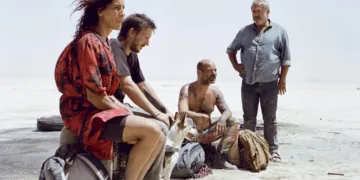
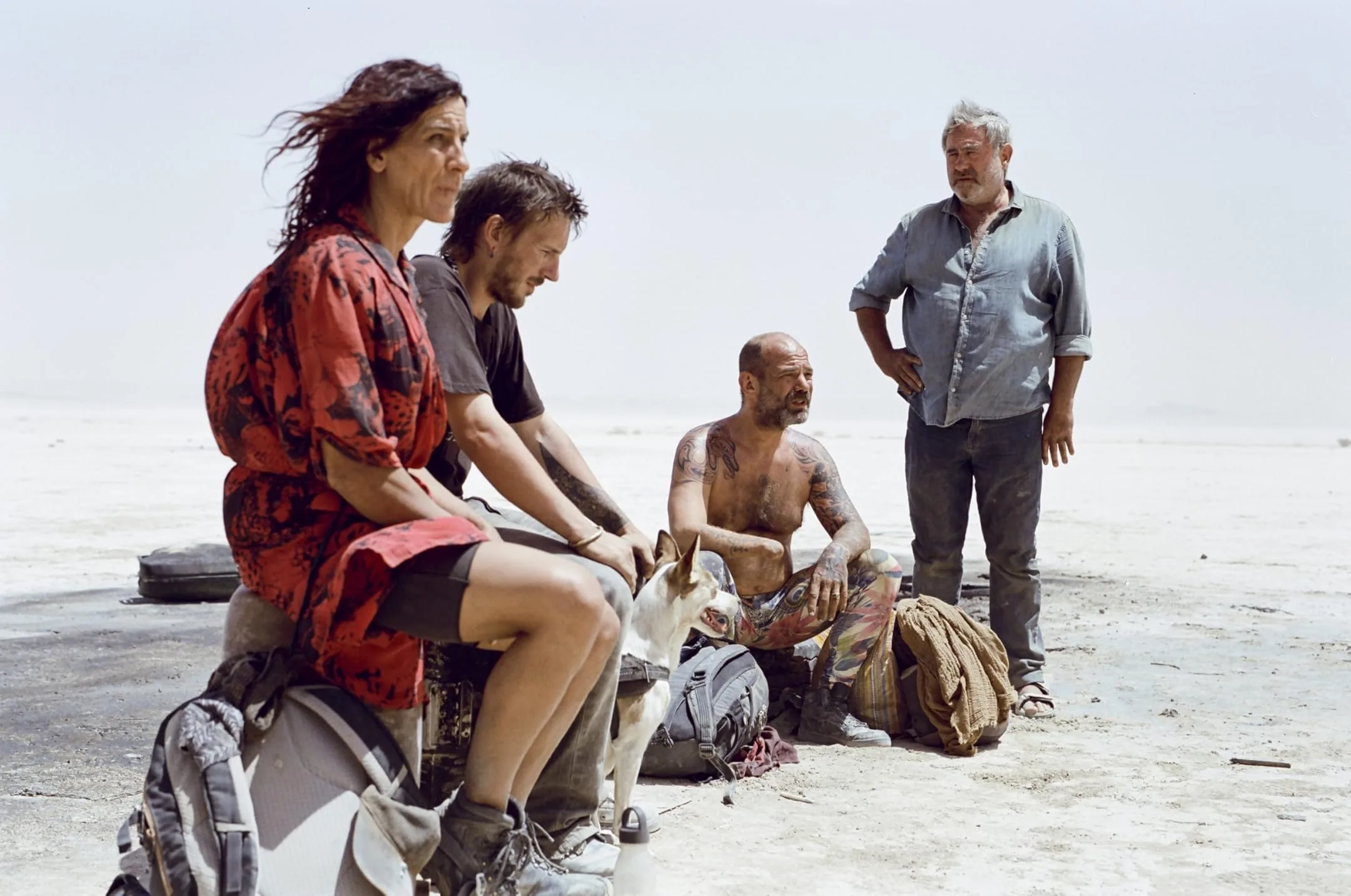
This strange caravan they join is peopled by beings who seem to have sprung from the arid earth itself. Stefania, Joshua, Jade, Richard ‘Bigui,’ Tonin—their own names serving as epitaphs to former lives—are the sun-scorched, grizzled remnants of a society renounced. Their very bodies bear the stigmata of their off-grid existence, a missing limb like Tonin Janvier’s knee stump not a mark of lack but an inscription of a brutal form of survival, even a source of bleak, defiant humor.
The collision between Luis’s world and theirs is initially one of dissonant chords. Yet, from this friction, a tentative camaraderie sparks, the loose tendrils of an unconventional kinship forming against the backdrop of shared peril. Through Esteban’s less jaded eyes, perhaps, the contours of what constitutes ‘family’ begin to blur and reform, while Luis himself is forced to confront the malleability of his own hardened perspectives, questioning the very foundations of his prior world.
Across the Knife-Edge: A Path Transfigured
The Saharan expanse, initially a canvas for problem-solving and makeshift community, soon reveals its deeper, more indifferent nature. Each league traversed is a minor victory hard-won: petrol bartered like precious water, unsteady rocks navigated with a prayer to fragile mechanics, the very earth a constant impediment. Even moments that might offer levity, such as the small dog Pipa’s unsettling encounter with LSD-laced detritus, are tinged with the absurd precarity of their existence, subtle tremors before the quake. For a time, one might be lulled into perceiving this as an offbeat adventure, a chronicle of resilience against a picturesque, if demanding, backdrop.

Then, the film convulses. Around its midpoint, an event of such shattering gravity occurs that the narrative’s spine seems to snap and reset at an altogether more harrowing angle. To detail its specifics would be to disarm its visceral power, its capacity to induce a kind of horrified paralysis in the viewer. Suffice it to say, any lingering notions of a conventional quest, any threads of a sentimental road trip, are incinerated in this moment.
The air grows dense with an almost unbreathable tension; the abstract threat of mortality congeals into a palpable, immediate presence. What was a search for a lost girl in a world teetering on collapse transforms into a stark, unforgiving meditation on loss itself, on the very possibility of coherence when the ground beneath one’s feet has turned to quicksand.
It is here, in this radically altered landscape of the soul, that the film’s title, “Sirât,” unfurls its most chilling resonance. This Islamic designation for a bridge suspended over hell, a passage described as “thinner than a hair and sharper than a sword,” ceases to be mere nomenclature. It becomes the very definition of the characters’ trajectory.
They are no longer simply travelling; they are traversing this razor-edged conduit, perhaps already suspended in a liminal state between one reality and an irrevocable other, where every forward step is a gamble against an abyss. The film itself seems to hold its breath, mirroring our own, as these figures navigate a path stripped bare of all certainties.
Sensing the Abyss: Aesthetics of Disquiet
The film’s descent into these harrowing psychic territories is rendered not merely through narrative but through a potent alchemy of sight and sound. Mauro Herce’s cinematography does not passively observe the Moroccan desert; it inhales its essence, exhaling images that oscillate between breathtaking, unearthly beauty and a crushing, indifferent vastness.
There is a profound “tactile and material basis” to the visuals; the sun-cracked earth, the worn textures of human skin, the very dust motes dancing in the oppressive heat—all possess a palpable weight. The landscape itself becomes a brooding presence, its ochre cliffs and desolate plains more than a backdrop; they are an active agent in the characters’ dissolution, the camera framing them not as passive witnesses but as elements of an encroaching, elemental power. This visual language forgoes easy spectacle, instead burrowing into the viewer’s consciousness, making one feel the grit and the glare.
Complementing this visual absorption is Kangding Ray’s formidable score, a sonic architecture as crucial as the physical setting. His bass-heavy, techno compositions are not melodic comforts but visceral incursions, the sub-bass frequencies resonating deep within the solar plexus, mimicking the earth’s tectonic groans or the body’s own thrum of anxiety.
The music functions as an auditory nerve-ending for the film, sometimes a dizzying engine of hedonistic escape, at others an ominous threnody echoing the wail of distant, perhaps imagined, emergency sirens. The overall sound design weaves a seamless shroud, from the initial rave’s overwhelming sensory assault to the desert’s later, more terrifying silences, punctuated by sounds that make the skin crawl. One does not simply watch “Sirat”; one feels its vibrations, its textures, its disquieting pulse.
Reflections in a Shattered Mirror
Beyond its visceral impact, “Sirat” resonates as a disquieting allegory for an age of unraveling. The distant hum of societal collapse, the implied wars that render borders meaningless, forms more than a mere backdrop; it is the poisoned wellspring from which the characters’ desperate pilgrimage flows.
One cannot help but see reflections of contemporary anxieties: the plight of the displaced, the search for sanctuary in a world actively hostile to it, the precariousness of any constructed utopia. The film probes what happens when the structures we erect—be they social or personal—crumble, forcing a confrontation with a more elemental, perhaps terrifying, state of being. What forms of community can be salvaged from the ruins, and what is the cost of such salvage?
These questions bleed into deeper existential territory. “Sirat” offers no comforting theses on life, death, or the resilience of the human spirit. Instead, it holds up a fractured mirror to our own uncertainties. Is there a flicker of hope, or merely the instinct to persist when all known beacons have been extinguished?
The film’s refusal to provide solace, its embrace of a profound ambiguity, is perhaps its most unsettling aspect. Even the initial quest for Mar, the narrative’s ostensible anchor, seems to dissolve, becoming something else – a ghost-limb of a former purpose, or perhaps a symbol of all that is irretrievably lost. The film leaves us adrift in its haunting silences, compelling a prolonged, uneasy contemplation long after the final images fade.
Sirât premiered at the 78th Cannes Film Festival on May 15, 2025, and is scheduled for theatrical release in Spain on June 6, 2025.
Full Credits
Director: Óliver Laxe
Writers: Santiago Fillol, Óliver Laxe
Producers: Agustín Almodóvar, Pedro Almodóvar, Xavi Font, Oriol Maymó, Mani Mortazavi, Andrea Queralt, Óliver Laxe, Domingo Corral, Esther García
Cast: Sergi López, Bruno Núñez Arjona, Richard Bellamy, Stefania Gadda, Joshua Liam Henderson, Tonin Janvier, Jade Oukid
Director of Photography (Cinematographer): Mauro Herce
Editor: Cristóbal Fernández
Composer: Kangding Ray
The Review
Sirat
"Sirat" is a formidable, searing cinematic experience, a descent into an elemental abyss where human connection is tested against a landscape of profound desolation. It offers no easy resolutions, instead etching itself onto the psyche with its potent visuals, haunting soundscape, and unflinching gaze into existential voids. A demanding yet resonant piece of art that lingers with disquieting force.
PROS
- A viscerally immersive cinematic experience with potent, tactile visuals and a formidable, body-shaking soundscape.
- Features a commanding central performance from Sergi López and an authentic, compelling ensemble of non-professional actors.
- Demonstrates bold narrative ambition, daring to shatter conventional storytelling expectations with a stark mid-film rupture.
- Offers an unflinching and profound exploration of existential desolation, human precarity, and the search for meaning in extremity.
- Its deliberate ambiguity and resistance to easy answers provoke deep, lingering contemplation.
CONS
- The film’s uncompromising bleakness and intense, often harrowing atmosphere may prove overwhelming or alienating for some viewers.
- Its radical narrative shift and deviation from the initial premise could disorient or frustrate those preferring more traditional structures.
- A pervasive sense of opaqueness and the denial of narrative comforts might leave audiences seeking clear resolution unsatisfied.
- While characters serve significant allegorical weight, some supporting figures might feel underdeveloped in terms of deep psychological interiority.