


























The coming-of-age story is a constant in global cinema, a narrative form revisited by every generation and culture. In a quiet corner of 1997 Ontario, writer-director Nicola Rose’s Magnetosphere finds a new key in which to play this familiar tune.
We meet thirteen-year-old Maggie at a moment of deep upheaval; her family has moved, thrusting her into the terrifying landscape of a new school. She faces the standard anxieties of adolescence—the desperate need for friendship, the sting of insecurity.
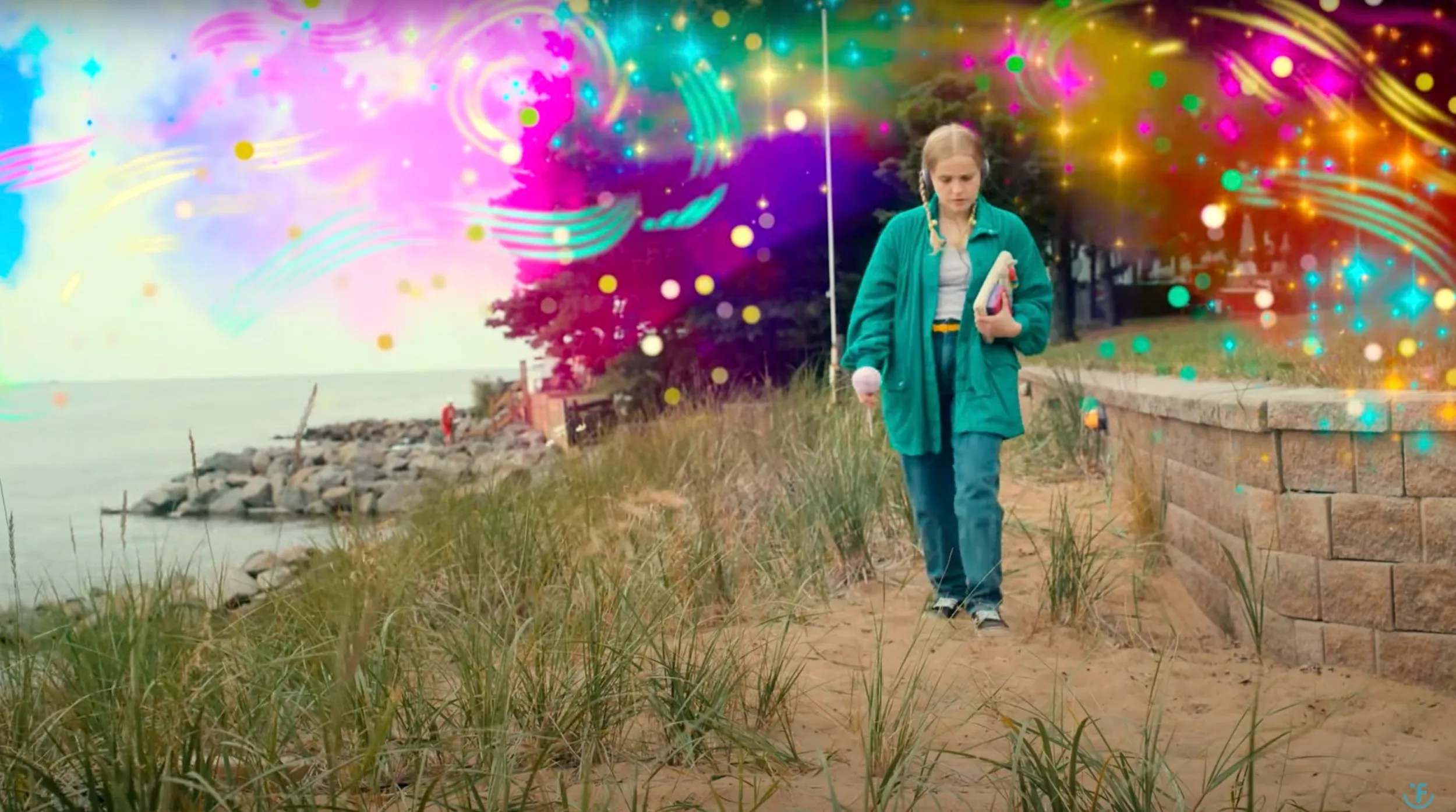
Yet Maggie’s world is uniquely her own. She lives with synesthesia, a condition that creates a private orchestra of color and sound only she can perceive. Emotions have hues and noises create visual patterns. Fearing this makes her irreparably “weird,” she keeps her sensory reality a secret, navigating the already treacherous waters of youth while guarding a profound part of her identity.
The Architecture of a Neurodivergent Mind
The film rests squarely on the shoulders of Shayelin Martin, whose performance as Maggie is a study in quiet authenticity. She projects the character’s shyness and deep-seated internal turmoil without affectation, using her posture and the subtle darting of her eyes to communicate a mind constantly processing a world of overwhelming sensation.
This portrayal is essential because the film presents synesthesia not as a superpower but as a complex, often isolating, reality. The approach is deeply reminiscent of the sensitive handling of dyslexia in the celebrated Indian film Taare Zameen Par (Like Stars on Earth).
Both films share a profound empathy for a young protagonist whose unique way of seeing the world is mistaken for a defect. Where the boy in the Indian film saw letters dance, Maggie sees sounds bloom into light, and both experiences are met with confusion by the world around them.
The film excels in externalizing Maggie’s internal state. When she feels joy or connection, the screen might fill with warm, gentle glows. In moments of anxiety, the sounds of a school cafeteria could manifest as sharp, jagged shards of clashing color.
This visual language is most potent when Maggie looks at her own reflection. Seeing herself as a “hazy, tangled mess” of gloomy, indistinct colors is a powerful visual metaphor for teenage self-loathing, a feeling that transcends any single diagnosis. Her personal development is not a sudden epiphany but a gradual process of discovery.
We see her move from a state of deep alienation, where she actively hides her perceptions, to taking the first tentative steps toward understanding and naming her experience. The diagnosis of synesthesia gives her a vocabulary, a framework to begin making sense of the beautiful chaos inside her head.
The Village of Benevolent Weirdos
A film like this requires a strong support system for its protagonist, and Magnetosphere builds a memorable one, creating a community that feels both specific and universal. This idea of the “village” that nurtures an individual is a narrative staple in many cinematic traditions, from Indian social dramas to Italian neorealism, standing in contrast to more individualistic tales.

Maggie’s family, with her father (Patrick McKenna) helming a wonderfully chaotic community theater production, provides a foundation of gentle eccentricity. Their home is a space where strangeness is normalized, creating fertile ground for Maggie’s eventual self-acceptance. A key figure in her orbit is Gil, the handyman played by the gifted comedian Colin Mochrie.
He is far more than simple comic relief; he is a vital role model. With his bizarre, ever-expanding skill set and utter comfort in his own skin, Gil embodies the film’s message. He is a type of wise eccentric, an archetype found in many cultures, from the wandering dervish in Persian tales to the clever sidekick in Shakespeare. He shows Maggie that adulthood does not require sanding away one’s quirks.
The film also handles Maggie’s infatuation with an older student, Travis (Steven He), with remarkable maturity and grace. In many other films, this subplot would become a source of melodrama or wish fulfillment. Here, it is treated as a poignant, formative experience. Travis is kind and sees Maggie’s fascination with the world, but he does not reciprocate her romantic feelings.
The story uses this to teach a nuanced lesson about the different shapes that love and connection can take. His gentle rejection is not a moment of devastation but a catalyst for growth, helping her to understand friendship and affection beyond a romantic ideal. This mature handling of adolescent emotion grounds the film in a gentle, truthful realism.
Painting with Sound, Composing with Light
The film’s craft is central to its success, and its aesthetic choices are deeply integrated with its thematic concerns. The cinematography by Mathieu Taillefer and the production design work in concert to merge two distinct visual realities: the mundane, slightly faded texture of a 1990s Canadian suburb and the vibrant, fantastical bursts of light that constitute Maggie’s synesthetic perception.

The camera might stay steady and observational in an ordinary scene at home, only to shift to a more fluid, subjective style when Maggie’s senses are triggered, immersing us in her point of view. The 1997 setting is used effectively, creating a nostalgic backdrop that is then electrified by Maggie’s unique internal world. Matthew Reid’s score works not just as emotional underscoring but as a component of the sensory experience itself, sometimes seeming to generate the very colors Maggie sees on screen.
These technical elements are not mere decoration; they are the very language the film uses to articulate its message. By inviting us to see through Maggie’s eyes, the film makes a powerful case for perceptual diversity. The visuals are a constant reminder that beneath a quiet exterior can lie a universe of extraordinary experience.
In our current world, with its intense pressures for conformity, a film that champions authentic, unvarnished selfhood feels more necessary than ever. Its gentle power comes from its sincere belief in its core idea, perfectly captured when a doctor reassures Maggie about her condition by stating simply, “You’re already okay.” It is a quiet but radical declaration of acceptance, a message of kindness that speaks a universal language.
Magnetosphere is a coming-of-age comedy film released in North America on July 22, 2025.
Full Credits
Director: Nicola Rose
Writers: Nicola Rose
Producers: Tierney Boorboor, Rebeka Herron, Drew Martin, Trish Rainone-DiLuzio
Executive Producers: Mark A. Baum, Steven He, William Hui, Nicola Rose, Ian Schulz
Cast: Shayelin Martin, Patrick McKenna, Colin Mochrie, Tania Webb, Steven He, Mikayla Kong, Zooey Schneider, Debra McGrath, Tara Strong, Jordyn Gillis, William C Cole, Bruce Stanfield, Avery O’Brien, Abigail Yaw, Foster Hamilton, Lisa Cromarty, Ian Schulz, Trish Rainone-DiLuzio, Shelley Gold, Ryan Anthony Mauro
Director of Photography (Cinematographer): Mathieu Taillefer
Composer: Matthew Reid
The Review
Magnetosphere
Magnetosphere is a wonderfully kind and visually inventive film that handles its story of neurodivergence with remarkable sensitivity. Anchored by a superb central performance and a charmingly eccentric cast, it trades melodrama for authentic emotion. It is a heartfelt celebration of what it means to be different, reminding us that there is profound beauty in seeing the world through a unique lens.
PROS
- An authentic and deeply felt lead performance by Shayelin Martin.
- A sensitive and insightful portrayal of synesthesia that feels tangible.
- A charming supporting cast of "benevolent weirdos" who enrich the story.
- A visually creative style that effectively blends mundane reality with subjective perception.
- A mature and gentle message about self-acceptance and kindness.
CONS
- The deliberately gentle pace and quirky tone may not connect with all viewers.
- Its independent, low-budget aesthetic might be a barrier for some.
- A few interesting supporting characters feel slightly under-utilized.