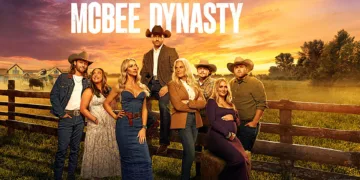













Out on the Missouri plains, where the sky is an indifferent canvas, a kingdom rusts. The McBee Farm & Cattle operation is less a business and more a territory of the soul, a feudal empire built by a patriarch who is now only a ghost. In the second season of The McBee Dynasty, Steve Sr. has vanished, but his absence is a dense, physical presence.
He has left behind not an inheritance but a ruin: a collapsed hundred-million-dollar deal, a mountain of debt, and four sons pinned beneath the weight of his name. Steven Jr., the new CEO, stands in the rubble, tasked with placating the gods of finance while his father’s personal betrayals poison the very soil they work. We are not watching a business being saved; we are watching an exorcism, a desperate attempt by the next generation to expel the specter that built their world only to condemn it.
An Inheritance of Debt
The fight for survival is waged in ledger books, but its roots are in something far older than commerce. A six-million-dollar payment hangs over the McBee enterprise like a blade, a numerical representation of a deeper, moral bankruptcy. The ticking clock is not just financial; it is existential. The brothers, now stewards of this broken legacy, cannot agree on the nature of their salvation.
Their conflict is a philosophical schism played out in acreage and livestock. Steven Jr., the cold pragmatist, sees the future in ranching—in blood and bone and the hard math of meat markets. His plan is a necessary apostasy from the family religion. Cole, the romantic traditionalist, clings to the farm. For him, the soil itself is their identity, a connection to a past he believes can be redeemed. He resists not just a business plan but the surrender of their foundational myth.
This debate feels tragically futile, a whispered argument in a storm. The true arbiter of their fate is a federal court, an institution immune to the poetics of family history. Their father’s plea of guilt for crop insurance fraud is the original sin, a transgression that makes every strategic pivot, every sale of cattle, an attempt to outrun a karmic debt that has already come due.
The business itself is now an accessory, its assets tainted and potentially forfeit. This knowledge casts their struggle in a light of profound futility. When a deal with a barbecue company collapses from a late delivery, it is not a simple operational failure. It is a symptom of the sickness within, proof that the machine is breaking down because the ghosts haunting its operators are far too distracting.
The Geometry of Betrayal
Human relationships here are not webs; they are knots, pulled impossibly tight by grievance and history. The feud between Galyna, the spurned CFO, and Masha, the new woman, is the season’s bleeding heart, a study in the violence of lost connection. For Galyna, an expatriate, Masha was not just a friend but a shard of her former life, a shared language in a foreign land. The betrayal is therefore absolute, a theft of both lover and home, leaving her utterly isolated. Her acts of vandalism—destroying clothes, freeing chickens—are not mere pettiness.
They are a primal scream against erasure, a desperate performance of power in a situation where she has none. The bitter irony, of course, is that Galyna stands on a foundation of another’s heartbreak, having once been the mistress to her predecessor, Kristi. She is caught in a grim cycle, a victim of the very pattern she helped create, forced to see her own history in the face of her replacement.
This recursive misery spreads outward, its toxic ripples fracturing the bonds between the younger women. The feuds between Calah, Kacie, and Alli are pale echoes of the battles fought by their elders. Their disagreements over perceived slights are the small, bitter fruits of a poisoned tree, demonstrations that they are fluent in the family language of transactional loyalty. Into this maelstrom walks the matriarch, Kristi, a figure of quiet stillness.
Is her silence a form of judgment or simply exhaustion? Her presence re-contextualizes the entire drama. She is the original wronged party, the ghost of a past Steve Sr. tried to bury. Her calm observation forces a remembrance of how this chain of pain began, a quiet counterpoint to the frantic, destructive motions of everyone else.
On Performing a Self
What is a person when they are also a product? The series forces this question, blurring the line between an authentic life and a life performed for an audience. The camera is a corrupting agent, its unblinking eye inviting a presentation of self that erodes the genuine article. We watch characters caught in a feedback loop, their actions and reactions shaped by the expectation of being watched.

This creates a hyper-reality where emotions are amplified and conflicts are sculpted for narrative effect. Some moments are so perfectly framed that the artifice becomes the point; we are watching a documentary about people who have forgotten how to live without a script. Yet in the cracks, something real seeps through—a panic attack, a flicker of unvarnished despair—reminding us that the bodies are not props.
One must wonder about the gravitational pull of the McBee fortune. This wealth is not just money; it is a power that distorts all human interaction, a shield against the mundane anxieties of the world. It buys loyalty and manufactures beauty, but it is a gilded shield that isolates. The question is not simply if the partners are present for the financial security, but if anyone in this ecosystem can form a bond uncolored by the immense stakes.
With the patriarch’s throne empty, his sons are left to confront a terrifying possibility. Their quest is Sisyphean, pushing the boulder of their father’s legacy up a hill. The “dynasty” itself may be an illusion, a brand name attached to a hollow core. They may not be preserving an institution, but merely presiding over its slow, televised collapse.
Full Credits
Producers and Executive Producers: Brandon Beck, Christopher Romero, Matthew C. Allyn, Solange Gomez-Smith, Leif Lindhjem, Eric Monsky, Lizette Anaya, Bill Beck, Annie West, Stephanie Boyriven, Russell Jay-Staglik, Jeff Jenkins, Reinout Oerlemans, Ross Weintraub.
Cast: Steve McBee Sr., Steven McBee Jr., Jesse McBee, Cole McBee, Brayden McBee, Galyna Saltkovska, Calah Jackson, Kristi McBee, Alli Ventresca, Kacie Adkison.
Editors: Shelby Bannon, Seung Im, Chris Conway, Christopher de Barros, Svein Mikkelsen, Stephanie Lyra, Wesley Post, Glen Gottlieb.
Composer: Max Beck, Matt Mahaffey, Marcus Meston.
The Review
The McBee Dynasty: Real American Cowboys Season 2
A compelling, if bleak, portrait of a family trapped in the amber of their father's sins. The series functions less as reality television and more as a slow-motion tragedy, examining the decay of an American dream built on a rotten foundation. Its exploration of legacy and futility is haunting, a captivating character study where every victory feels like a beautiful, temporary delay of the inevitable.
PROS
- A deep psychological exploration of family trauma and inherited debt.
- Presents a compelling, tragic narrative structure that questions the nature of success.
- Raises philosophical questions about authenticity versus performance in the age of surveillance.
- The addition of the matriarch, Kristi McBee, introduces a grounding and complex new dynamic.
CONS
- Moments of staged conflict can feel jarring and undermine the show's raw potential.
- The relentlessly bleak and fatalistic tone may not appeal to all viewers.
- The central characters can appear trapped in repetitive, self-destructive cycles.
- The line between genuine emotion and on-camera performance is often uncomfortably blurred.