




























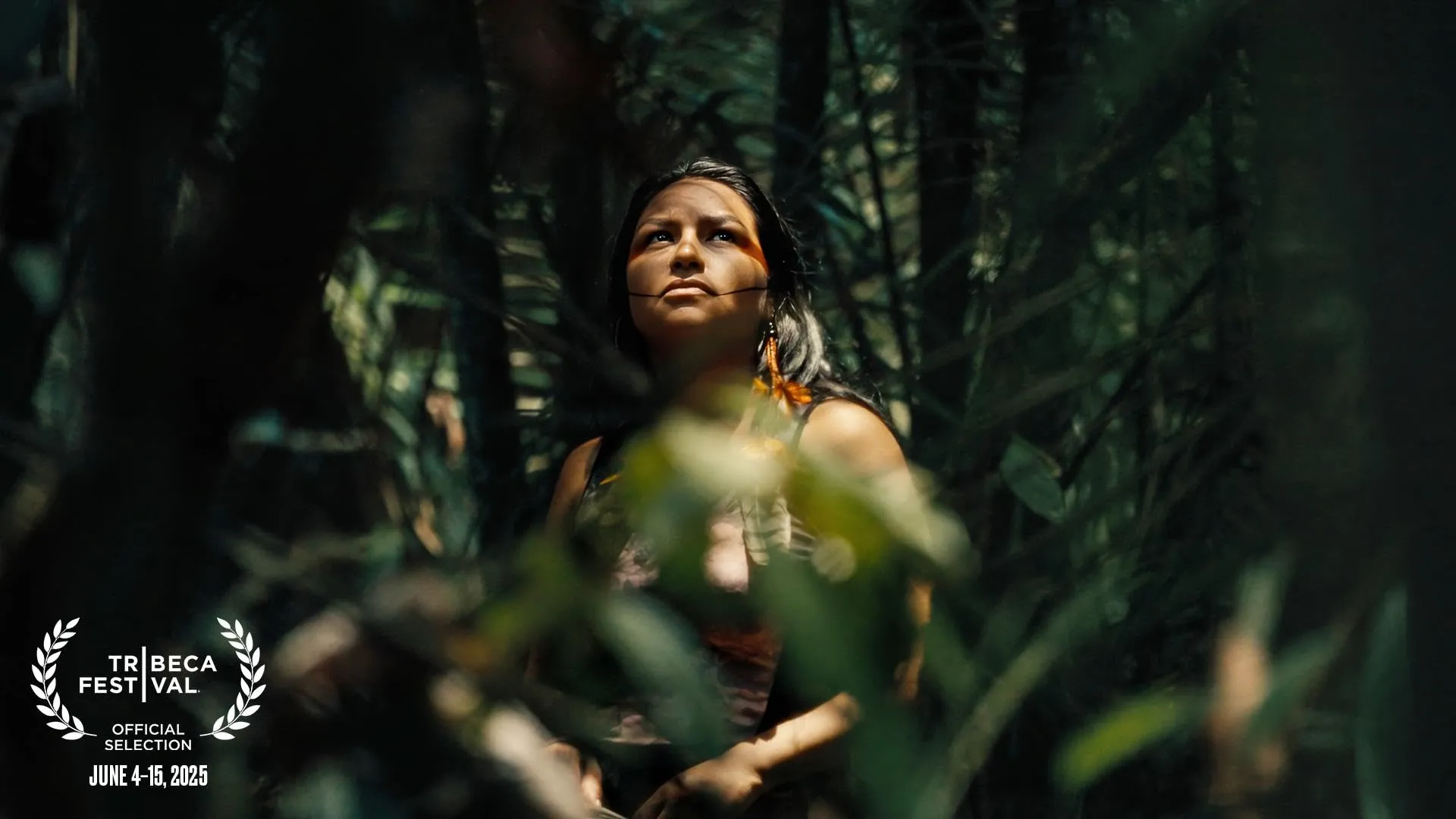

The Amazon is not merely a location in Yanuni; it is a battleground, a verdant labyrinth where moral clarity is devoured by the canopy. In this chaotic theater stands Juma Xipaia, an Indigenous chief whose resolve is the film’s unyielding center.
Director Richard Ladkani frames her struggle not as a simple environmental plea but as an intimate noir, a portrait of one woman’s war against a hydra of political corruption and resource gluttony. Her husband, Hugo Loss, operates as the narrative’s blunt instrument, leading an environmental agency’s armed incursions.
As Brazil’s political tides shift from the overt hostility of one regime to the bureaucratic mire of another, their mission becomes a complex navigation of compromised ideals. The fight is for the land, but the stakes are crystallized in a single name, Yanuni, their daughter and the living symbol of a future that must be wrested from the shadows.
The Chiaroscuro of a Chief
Ladkani’s camera studies Juma Xipaia with an almost unnerving intimacy, rendering her in stark chiaroscuro. We see the brightly lit icon, face painted for battle, a warrior whose early pronouncements of being ready to die for her people echo with the weight of multiple assassination attempts.

The constant threat hums beneath the surface, visible in a sudden glance or a guarded posture that the camera refuses to ignore. Then, the film pivots into shadow, revealing the private woman, the mother whose stoicism cracks when forced to send her children away for their own safety. Her journey is one of chilling evolution, from grassroots activist to a political figurehead grappling with an entirely new form of existential conflict.
The film captures her ascension into the government’s new Ministry of Indigenous Peoples, a move that feels less like a victory and more like a classic noir trap. The System, having failed to eliminate her, invites her in. She is given a seat at the table only to find her hands bound by the very institutional inertia she fought to dismantle.
This is where the film finds its most profound tension: in the portrait of a leader discovering that the most perilous territory is the one between the person she must be and the system she must inhabit. She risks becoming a cog in the machine, and the film quietly questions if true change from within such a structure is ever possible, or if it is merely a more comfortable form of containment.
The Dichotomy of Action
The film’s narrative structure is a deliberate, if occasionally jarring, dichotomy. On one side, we have Hugo’s missions: kinetic, percussive sequences of violent intervention. Ladkani shoots these raids on illegal mining camps with the visceral energy of a military thriller, the camera shaking with the impact of explosions and the frantic urgency of escape.
We see his team frantically trying to survive after their boat is chained to an exploding mining vessel, a moment of pure action cinema. It is a tangible, almost satisfying form of justice. Then, the film cuts back to Juma. Her war is silent, fought in sterile meeting rooms under fluorescent lights where the violence is bureaucratic and soul-crushing.
The structural choice is bold, creating a philosophical friction. Hugo’s war is a Sisyphean cycle of destruction and retribution, while Juma’s is a slow attrition of the soul. This manipulation of pacing has a potent effect on the viewer.
The high-octane raids provide a catharsis, a jolt of clear-cut progress the audience craves. And yet, this focus on Hugo’s explosive work creates an unstable rhythm, pulling the film’s center of gravity away from Juma’s more complex struggle. It feels like a concession, a perhaps necessary nod to our collective appetite for spectacle, yet it distracts from the film’s more vital, quieter heart.
An Expressionist Ecology
The documentary’s aesthetic transcends mere observation; it is an act of expressionistic filmmaking. Ladkani’s lens captures the Amazon with a painterly reverence, employing soaring, god-like aerials that sweep above the canopy, presenting a world of sublime, interconnected life.
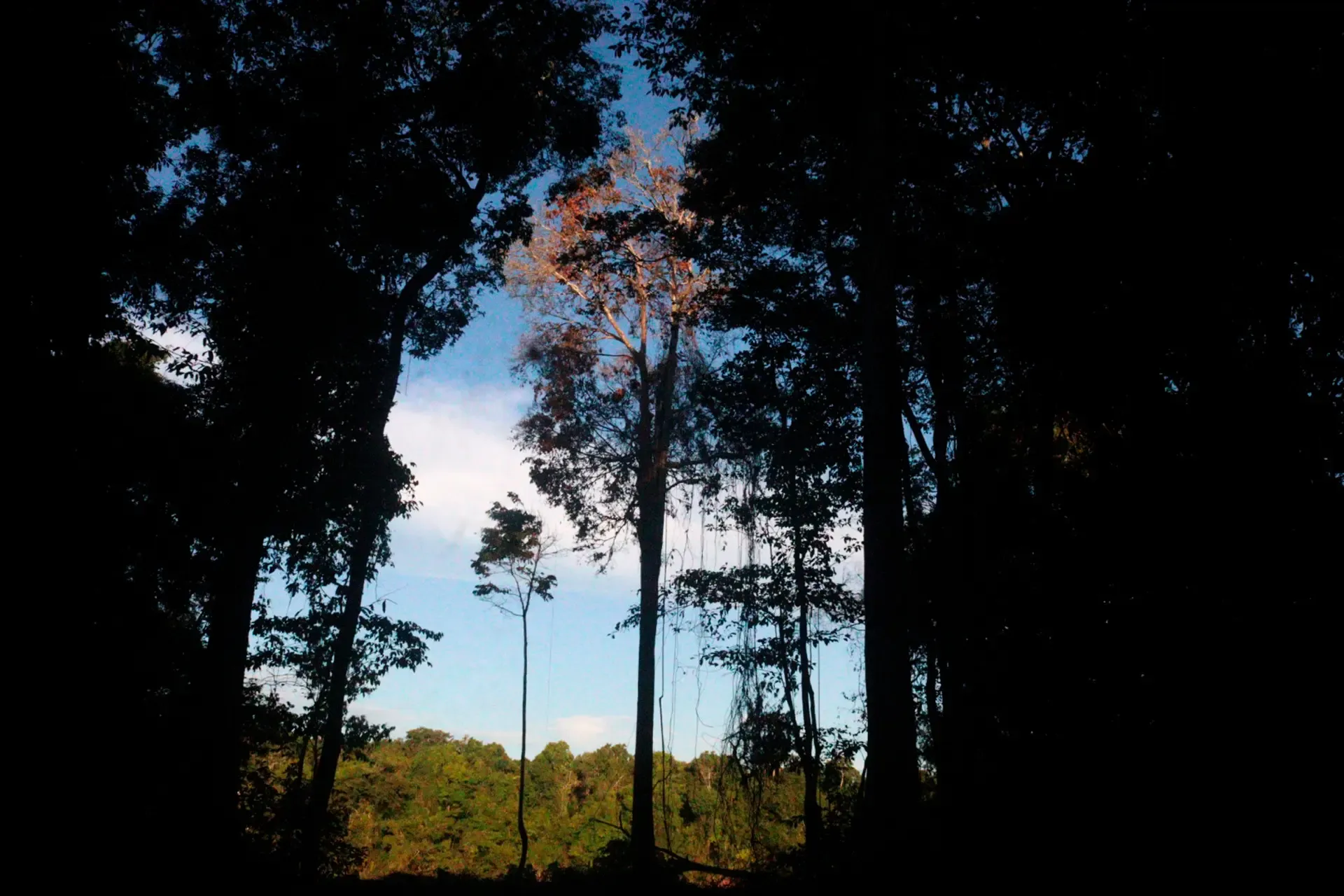
These moments of visual poetry are then violently ruptured by claustrophobic, handheld footage from the ground—the chaos of a protest, the jarring immediacy of a police charge. The lighting itself becomes a narrative tool. Deep shadows in the jungle feel ancient and foreboding, while the harsh, artificial glare of Brasília’s government buildings feels cold and interrogating.
Natural light filtering through the dense leaves can look like cathedral rays one moment and prison bars the next. There is a wry intelligence in this visual language, most potent in its inversion of cinematic tropes. A plume of black smoke rising from the forest, traditionally a symbol of ruin, becomes a beacon of progress—the funeral pyre of an excavator.
The sound design completes the immersion, weaving a tapestry where the delicate symphony of the jungle is torn apart by the mechanical screech of drilling, an auditory violation as profound as the physical one.
For Yanuni
Ultimately, the film’s sprawling political and ecological questions are funneled into a single, human point. The title, Yanuni, is not just a name but the story’s entire justification, the answer to the unspoken question of “Why?”.
The birth of Juma and Hugo’s daughter reframes the narrative, transforming it from a chronicle of loss into a desperate fight for a tangible future. She is the living embodiment of the stakes, the reason to persist in a battle against seemingly abstract forces of greed and systemic apathy.
The documentary shows that the human cost is immense, etching fractures into their family life that may never fully heal. The fight is not clean or glorious. It is a messy, painful, and deeply personal war. The struggle to save a forest is, in the end, reduced to its most elemental form: the fight to protect a family and secure for them a world where their identity and their land remain whole.
Yanuni is a 2025 documentary film that had its world premiere at the Tribeca Festival on June 14, 2025. It is also slated for an international premiere at the Sheffield Doc Fest.
Full Credits
Director: Richard Ladkani
Writers: Richard Ladkani
Producers & Executive Producers: Juma Xipaia, Leonardo DiCaprio, Anita Ladkani, Richard Ladkani, Jennifer Davisson, Phillip Watson, Dax Dasilva, Joanna Natasegara, Laura Nix, Eric Terena, Martin Choroba, Philipp Schall
Cast: Juma Xipaia, Hugo Loss
Director of Photography (Cinematographer): Richard Ladkani
Editors: Georg Michael Fischer
Composer: H. Scott Salinas
The Review
Yanuni
Yanuni is a visually stunning and emotionally resonant documentary, anchored by an unforgettable central figure. It elevates itself beyond the standard environmental film by employing the language of a psychological thriller, creating a portrait of resistance that is both intimate and epic. While its narrative focus occasionally splits, creating a slightly uneven rhythm, the film's profound intelligence and cinematic artistry make it a powerful, essential viewing experience that captures the immense personal cost of a global fight.
PROS
- A complex and deeply compelling portrait of activist Juma Xipaia.
- Breathtaking cinematography that masterfully contrasts natural beauty with man-made destruction.
- An intelligent, genre-bending structure that blends documentary with noir and thriller elements.
- A powerful emotional core rooted in the themes of family and legacy.
CONS
- The narrative feels imbalanced at times, shifting focus heavily to a secondary action-oriented storyline.
- This structural dichotomy can disrupt the film's pacing and flow.







