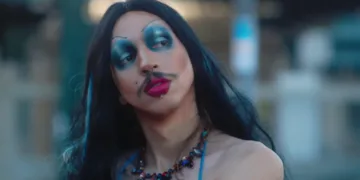































Imagine you’re stuck in Athens traffic. A figure in a nun’s habit approaches your car, but something is off. Through the familiar black cloth, you see fishnet stockings and a bra. She hands you a flyer promoting abortion. This is your introduction to the world of Avant-Drag!, a documentary that follows ten radical drag artists who use their city as a canvas for dissent.
Director Fil Ieropoulos situates us in a version of Athens where ancient history collides with modern friction. This is not a city of serene ruins; it is a battleground of ideas, thick with the influence of the Orthodox Church and staunch nationalism.
The film immediately establishes that this is not drag as entertainment. It’s a raw, necessary response to a society that pushes people to the margins. It is a toolbox for survival, a way to speak when you are expected to be silent.
The Unwilling Stage
Most documentaries about performance art keep you safely inside a club or a studio. Avant-Drag! does the opposite, and this decision is its most powerful cinematic statement. By taking the performances to the streets, director Fil Ieropoulos weaponizes public space.
The art is no longer a show for a paying audience; it becomes an unexpected, often unwelcome, intervention in the lives of ordinary citizens. The film’s camerawork often feels immediate and grounded, placing the viewer right there on the pavement and creating a palpable sense of risk. This technique makes the city’s ancient, conservative architecture and its people into an unwilling stage and an unwitting audience.
The dissonance is the point. Seeing these vibrant, defiant figures against a backdrop of historical monuments and religious iconography creates a stunning visual friction. This is environmental storytelling at its most confrontational. The setting isn’t just a location; it’s a participant in the conflict, representing the very traditions the artists seek to dismantle.
They are not seeking applause. They are confronting the pillars of Greek conservatism head-on, targeting xenophobia, religious dogma, and nationalist pride. One artist, Aurora Paola Morado, paints the Albanian flag over the Greek one—a simple act loaded with immense personal history and political risk. It is a potent piece of performance that clarifies the film’s purpose: this art is designed to provoke a reaction, to force a conversation in a place that would rather not have one.
Avatars of Defiance
The film unfolds as a series of chapters, each a focused portrait of a single artist, giving the narrative a rhythmic, anthology-like feel. This structure allows the audience to appreciate the incredible diversity of thought and style within this community.

We meet these performers exclusively as their personas, a choice that reinforces one of the film’s core ideas: the constructed identity is the truest one. The makeup, wigs, and costumes are not a disguise but an amplification of the self, an armor that grants the freedom to be authentic. This challenges the very notion of a fixed identity, suggesting instead that the self is an act of continuous, courageous creation.
The emotional range of these portraits is staggering. We witness McMorait’s silent, blood-drenched protest in a public square, a living memorial to their murdered friend, Zackie Oh.
The camera holds on McMorait’s stillness as the city bustles around them, forcing the viewer to stop and bear witness to an immense, quiet grief. It is a harrowing piece of cinematic storytelling about trauma turned into public defiance. In sharp contrast, Kangela Tromokratisch’s “superheroine housewife” aesthetic finds subversive humor in the mundane, using found objects from skips to assemble her look.
Her character is a grotesque and funny commentary on domesticity, reclaiming the power of the homemaker as something wild and uncontrollable. Then there is Veronique Tromokratisch, whose doll-like persona creates pockets of childlike play on city pavement. Watching her draw with chalk as local children gather around her is a defiant act of joy in a hostile world, a reclamation of imagination as a political tool.
A Temporary City, but a Loving One
After building its case through these powerful individual vignettes, the film’s pacing and structure shift entirely. All ten artists gather for a meal, and the performative armor is partially lowered for a candid group discussion.

This directorial choice is crucial; it grounds the preceding artistic flights in a frank human reality. The film moves from a “show” mode to a “tell” mode, and the transition feels earned. The conversation reveals that the fight is not just against an oppressive society.
They speak with raw honesty about the economic hardships of being a performer, the fierce “dog eat dog” competition for gigs, and the painful reality of infighting and exclusion within the queer scene itself. They question the value of “pinkwashing” and debate the very nature of their transgression.
Showing these internal fractures prevents the film from becoming a simplistic tribute. It presents a community that is messy, flawed, and real. This nuance makes the documentary’s final sentiment much more potent. The artists may be rivals, they may disagree, but they are also a vital support system for one another.
Theirs is a “temporary city, but a loving one.” In a world determined to erase them, the act of building an identity and a support network is the ultimate form of resistance. The film concludes that survival requires a complex strategy, one that knows how to be tough without losing its tenderness, a model for resistance that is both fierce and compassionate.
Avant-Drag! is a 2024 documentary film that had its world premiere at the International Film Festival Rotterdam (IFFR) on January 27, 2024. The film has garnered significant attention and received numerous festival invitations worldwide. It is available to stream on DocuramaFilms Amazon Channel.
Full Credits
Director: Fil Ieropoulos
Writers: Foivos Dousos
Producers & Executive Producers: Spyros Patsouras, Sebastian Strakowicz
Cast: Cotsos, Lala Kolopi, Er Libido, Thanasis McMorait, Aurora Paola Morado, Sergay Parakatyanov, Parakatyanova, Marisha Triantafyllidou
Director of Photography (Cinematographer): Mihalis Gkatzogias
Editors: Fil Ieropoulos
Composer: Lykourgos Porfyris
The Review
Avant-Drag!
Verdict: Avant-Drag! is more than a documentary; it's a vital, confrontational piece of cinematic activism. It masterfully uses its subjects' art to dissect a society's tensions, offering a portrait of a community that is as intellectually sharp as it is emotionally resonant. A raw and essential viewing experience that champions the power of defiant self-expression in the face of hostility.
PROS
- A powerful and unfiltered look at drag as a form of political protest.
- Compelling and diverse portraits of its central artists.
- Intelligent use of Athens as a confrontational backdrop, creating strong visual storytelling.
- Emotionally resonant and intellectually stimulating.
CONS
- Its raw and provocative imagery may be challenging for some viewers.
- The vignette structure, while effective, might feel episodic to those preferring a single narrative arc.
- The philosophical narration, at times, can feel dense.







