






















A spiritual floats through the still morning air of a leafy Winston-Salem neighborhood, a sound some find a nuisance. For Bill, a quiet patriarch, and his daughter-in-law, Tammy, it is a shared mystery, a gentle hymn to start the day. This quiet appreciation for the unseen defines the world of A Little Prayer, a film that finds its drama in the smallest fractures of domestic life.
Bill, played with immense grace by David Strathairn, is an Army veteran who has built his life and his sheet metal business on a foundation of clear-cut morality. That foundation begins to crack when he discovers his son, David, is having an affair, betraying the daughter-in-law Bill so deeply cherishes.
The knowledge creates a silent crisis for Bill, forcing a confrontation with the limits of his own influence and the painful recognition that he cannot shield his family from their own choices. The film establishes itself not as a story of loud confrontations, but of whispered anxieties and the heavy weight of unspoken truths.
The Weight of Righteousness
Bill’s internal conflict propels the narrative. His staunch, old-school values run directly into the messy, complicated lives of his adult children, and he is left struggling to apply his rigid moral compass to a world of gray. David Strathairn’s performance is a masterclass in physicalizing a contained spirit.
He carries his body with a veteran’s stiffness, the set of his jaw betraying a constant effort to maintain order while his eyes communicate a deep, abiding weariness. He portrays a man accustomed to command who now finds his authority failing him. His attempts to correct the situation are direct and fatherly, yet they reveal a fundamental misunderstanding of the people he seeks to guide.
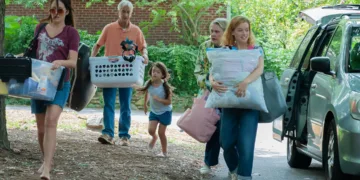
When he confronts David, a man wrestling with the psychic wounds of his own military service, and commands him to “straighten up and fly right,” the military tone is a desperate reach for a language of control that no longer applies. It only widens the gulf between them. The household’s delicate balance is further upset by the sudden arrival of his daughter, Patti, a whirlwind of chaotic energy and poor decisions fleeing her own failed marriage.
Her presence, along with her mostly silent daughter, amplifies Bill’s sense of parental failure. His meddling is born from a sincere, protective love, but his methods are patriarchal and intrusive, based on a conviction that he knows best, a belief the film patiently dismantles piece by piece.
The Kindred Spirit and Her Counterparts
The film’s emotional anchor is the special bond between Bill and Tammy, which feels like a sanctuary for the beleaguered patriarch. Their morning coffees are a quiet alliance, a relationship where he feels seen and successful in a way he does not with his own offspring. Tammy, as portrayed by Jane Levy, is a portrait of serene strength.

Her stillness is a form of active observation; her gentle politeness is a kind of armor, protecting a core of profound resolve that is revealed in the film’s most critical moments. Her quietude stands in sharp contrast to the other women who shape Bill’s world. His wife, Venida, brought to life with wry pragmatism by Celia Weston, is the household’s grounded realist.
Her sharp, often humorous, observations are small punctures in Bill’s self-serious crusade, reminding him of a different kind of love rooted in acceptance instead of intervention. Even more disruptive to Bill’s worldview is Narcedalia, David’s mistress. In a pivotal scene, Bill confronts her, entering with the full force of his moral certainty and expecting contrition.
Instead, Dascha Polanco gives the character a dignity and complex history that defy easy categorization. She is not a simple villain, and her refusal to be judged complicates Bill’s black-and-white perspective. These women reveal the severe limitations of Bill’s perception, forcing him to see the messy realities that exist beyond his moral pronouncements.
The Eloquence of Silence
Writer-director Angus MacLachlan’s filmmaking is defined by its patience and subtle empathy. His camera often holds on a character’s face long after the dialogue has ended, allowing unexpressed emotions to register with unsettling clarity. This refusal of melodrama is a stylistic choice that perfectly mirrors the characters’ own emotional restraint and their cultural tendency to persevere through pain rather than confront it openly.

A Little Prayer consistently sidesteps loud catharsis, choosing to let its most potent moments unfold in quiet observation. Major arguments and emotional reckonings happen off-screen, with the focus instead on the subtle aftershocks and unspoken tensions that ripple through the family. The Winston-Salem setting is more than a backdrop; its quiet streets and established community norms inform the characters’ behavior, making Bill’s intrusions all the more significant.
The film’s final scene, a simple, shared moment between Bill and Tammy, offers no easy answers. Its quietness is its own form of resolution. It signifies a shift in Bill from a man who must act to one who can simply be present. The acceptance is not a surrender but a form of wisdom, a hard-won understanding that some prayers are answered not with intervention but with stillness.
A Little Prayer is a 2023 American drama film that had its world premiere at the Sundance Film Festival on January 24, 2023. After a previous distribution deal fell through, Music Box Films acquired the North American rights. The film is scheduled for a limited theatrical release in the United States on August 29, 2025. Information regarding streaming availability will become clearer after its theatrical run.
Full Credits
Director: Angus MacLachlan
Writers: Angus MacLachlan
Producers and Executive Producers: Max A. Butler, Lauren Vilchik, Angus MacLachlan, Ramin Bahrani, Mark P. Clein, Ethan D. Leder
Cast: David Strathairn, Jane Levy, Dascha Polanco, Will Pullen, Anna Camp, Celia Weston, Ashley Shelton, Billie Roy
Director of Photography (Cinematographer): Scott Miller
Editors: Tricia Holmes
Composer: Greg Danner
The Review
A Little Prayer
A Little Prayer is a beautifully understated drama, anchored by a masterful performance from David Strathairn. It rejects easy answers and loud confrontations, opting instead for a patient, empathetic look at a family’s quiet crisis. With its sharp writing and deeply felt performances, the film is a profound meditation on love, morality, and the wisdom found in acceptance. It is a small, exquisitely crafted piece of cinema.
PROS
- A powerful and deeply textured lead performance from David Strathairn.
- Subtle direction that favors quiet realism over melodrama.
- Strong supporting performances, particularly from Jane Levy as the family's calm center.
- A script that explores complex themes of morality and family with intelligence and empathy.
- The dignified and layered portrayal of its female characters.
CONS
- Its deliberately measured pace may not suit all tastes.
- The character of Patti, while a necessary disruptive force, is less developed than the central figures.