























• Latest
  • Trending
Varlet Review

Varlet Review: All Dressed Up with Nowhere to Go

House of the Dragon Season 3 Episode 4 Review

House of the Dragon Season 3 Episode 4 Review: Daeron Learns the Wrong Lesson

Robert Richardson: The White Devil Review

Robert Richardson: The White Devil Review: Light Cannot Hide the Man

One Piece: Heroines Review

One Piece: Heroines Review: Nami Takes the Runway

We Gotta Go Review

We Gotta Go Review: Toilet Panic Needs Stronger Systems

Chica Checa Review

Chica Checa Review: Kindness Comes Too Easily

The Dark Review

The Dark Review: Fear Watches from the Window

Off Campus

‘Off Campus’ Creator Denies Gender Pay Gap Reports Among Cast

1 day ago
Sacha Baron Cohen

Sacha Baron Cohen’s Ali G Resurfaces at Wimbledon Final

1 day ago
Cristó Fernández

‘Ted Lasso’ Star Cristo Fernández Makes Real-Life Pro Soccer Debut

1 day ago
Moana

Disney’s Live-Action ‘Moana’ Sinks With $43M Opening Weekend

1 day ago
Love Island USA

‘Love Island USA’ Crowns Trinity and Bryce Season 8 Winners

1 day ago
Dwayne Johnson Kevin Hart

Dwayne Johnson Says He Almost Brought Kevin Hart to Broadway

1 day ago
  • Home
  • Privacy Policy
  • Terms and Conditions
  • Gazettely Review Guidelines
Tuesday, July 14, 2026
GAZETTELY
  • Home
  • Movie and TV News
    House of the Dragon Season 3 Episode 4 Review

    House of the Dragon Season 3 Episode 4 Review: Daeron Learns the Wrong Lesson

    Off Campus

    ‘Off Campus’ Creator Denies Gender Pay Gap Reports Among Cast

    Sacha Baron Cohen

    Sacha Baron Cohen’s Ali G Resurfaces at Wimbledon Final

    Cristó Fernández

    ‘Ted Lasso’ Star Cristo Fernández Makes Real-Life Pro Soccer Debut

    Moana

    Disney’s Live-Action ‘Moana’ Sinks With $43M Opening Weekend

    Love Island USA

    ‘Love Island USA’ Crowns Trinity and Bryce Season 8 Winners

    Dwayne Johnson Kevin Hart

    Dwayne Johnson Says He Almost Brought Kevin Hart to Broadway

    Josh Grisetti

    Josh Grisetti, Broadway’s ‘Something Rotten!’ Star, Dies at 44

    Mayfair Witches

    ‘Mayfair Witches’ Season 3 Teaser Reveals Salem Setting and New Cast

  • Movie and TV Reviews
    Robert Richardson: The White Devil Review

    Robert Richardson: The White Devil Review: Light Cannot Hide the Man

    One Piece: Heroines Review

    One Piece: Heroines Review: Nami Takes the Runway

    Chica Checa Review

    Chica Checa Review: Kindness Comes Too Easily

    The Dark Review

    The Dark Review: Fear Watches from the Window

    The Sentinels Review

    The Sentinels Review: Super Soldiers Sink Into the Mud

    Chainsmoker Cat Review

    Chainsmoker Cat Review: The Sad Cat Beneath the Stench

    Ikka Review

    Ikka Review: Tillotama Shome Deserves a Better Trial

    The Floaters Review

    The Floaters Review: Misfits Find Their Voice Between Missing Scenes

    Crossing Review

    Crossing Review: Strategy Moves Faster Than Emotion

  • Game Reviews
    We Gotta Go Review

    We Gotta Go Review: Toilet Panic Needs Stronger Systems

    Ascend to ZERO Review

    Ascend to ZERO Review: Every Second Becomes a Weapon

    DOOM: The Dark Ages | Revelations Review

    DOOM: The Dark Ages | Revelations Review: The Slayer Learns to Fly Again

    Moldwasher Review

    Moldwasher Review: Pixel Grime Meets Lo-Fi Calm

    Last Flag Review

    Last Flag Review: Capture the Flag Finds a Clever New Hiding Place

    Echoes of Aincrad Review

    Echoes of Aincrad Review: SAO Finally Finds a Better Player Character

    Assassin's Creed: Black Flag Resynced Review

    Assassin’s Creed: Black Flag Resynced Review: The Jackdaw Rules the Seas Again

    Granblue Fantasy: Relink - Endless Ragnarok Review

    Granblue Fantasy: Relink – Endless Ragnarok Review: Summons Make Every Fight Bigger

    EA SPORTS College Football 27 Review

    EA SPORTS College Football 27 Review: Great Football Buried Under Busywork

  • The Bests
No Result
View All Result
  • Home
  • Movie and TV News
    House of the Dragon Season 3 Episode 4 Review

    House of the Dragon Season 3 Episode 4 Review: Daeron Learns the Wrong Lesson

    Off Campus

    ‘Off Campus’ Creator Denies Gender Pay Gap Reports Among Cast

    Sacha Baron Cohen

    Sacha Baron Cohen’s Ali G Resurfaces at Wimbledon Final

    Cristó Fernández

    ‘Ted Lasso’ Star Cristo Fernández Makes Real-Life Pro Soccer Debut

    Moana

    Disney’s Live-Action ‘Moana’ Sinks With $43M Opening Weekend

    Love Island USA

    ‘Love Island USA’ Crowns Trinity and Bryce Season 8 Winners

    Dwayne Johnson Kevin Hart

    Dwayne Johnson Says He Almost Brought Kevin Hart to Broadway

    Josh Grisetti

    Josh Grisetti, Broadway’s ‘Something Rotten!’ Star, Dies at 44

    Mayfair Witches

    ‘Mayfair Witches’ Season 3 Teaser Reveals Salem Setting and New Cast

  • Movie and TV Reviews
    Robert Richardson: The White Devil Review

    Robert Richardson: The White Devil Review: Light Cannot Hide the Man

    One Piece: Heroines Review

    One Piece: Heroines Review: Nami Takes the Runway

    Chica Checa Review

    Chica Checa Review: Kindness Comes Too Easily

    The Dark Review

    The Dark Review: Fear Watches from the Window

    The Sentinels Review

    The Sentinels Review: Super Soldiers Sink Into the Mud

    Chainsmoker Cat Review

    Chainsmoker Cat Review: The Sad Cat Beneath the Stench

    Ikka Review

    Ikka Review: Tillotama Shome Deserves a Better Trial

    The Floaters Review

    The Floaters Review: Misfits Find Their Voice Between Missing Scenes

    Crossing Review

    Crossing Review: Strategy Moves Faster Than Emotion

  • Game Reviews
    We Gotta Go Review

    We Gotta Go Review: Toilet Panic Needs Stronger Systems

    Ascend to ZERO Review

    Ascend to ZERO Review: Every Second Becomes a Weapon

    DOOM: The Dark Ages | Revelations Review

    DOOM: The Dark Ages | Revelations Review: The Slayer Learns to Fly Again

    Moldwasher Review

    Moldwasher Review: Pixel Grime Meets Lo-Fi Calm

    Last Flag Review

    Last Flag Review: Capture the Flag Finds a Clever New Hiding Place

    Echoes of Aincrad Review

    Echoes of Aincrad Review: SAO Finally Finds a Better Player Character

    Assassin's Creed: Black Flag Resynced Review

    Assassin’s Creed: Black Flag Resynced Review: The Jackdaw Rules the Seas Again

    Granblue Fantasy: Relink - Endless Ragnarok Review

    Granblue Fantasy: Relink – Endless Ragnarok Review: Summons Make Every Fight Bigger

    EA SPORTS College Football 27 Review

    EA SPORTS College Football 27 Review: Great Football Buried Under Busywork

  • The Bests
No Result
View All Result
GAZETTELY
No Result
View All Result
Varlet Review

Mother Review: The Saint as a Work of Fiction

A Little Prayer Review: David Strathairn’s Silent Strength

Home Games Reviews Games

Varlet Review: All Dressed Up with Nowhere to Go

Mahan Zahiri by Mahan Zahiri
11 months ago
in Games, PC Games, Reviews Games
Reading Time: 5 mins read
A A
0
Share on FacebookShare on TwitterShare on PinterestShare on WhatsAppShare on TelegramSummarize with ChatGPTSummarize with Perplexity

Varlet presents itself as a turn-based, Japanese role-playing game with a heavy emphasis on school-life simulation. Its influences are immediately apparent to anyone familiar with the genre.

The game is set in Kousei Academy, a futuristic school where student life revolves around a virtual reality social network called “Johari.” Players take on the role of a transfer student who is quickly positioned as the leader of the Student Support Services club, or SSS.

The central conflict involves the SSS investigating “Glitches,” which are otherworldly dungeons created from the unchecked desires of students. Inside these spaces, the team battles monsters known as “Desires.” The game immediately establishes a strong, anime-inspired visual style and signals its focus on character-driven drama.

An Exercise in Futility

The social simulation half of Varlet is structured around the daily activities of the SSS club, a gameplay loop that unfortunately proves to be the game’s lowest point. The primary task outside of the main story is to roam the same plaza and hallways of Kousei Academy day after day, performing a set of recurring chores. Using a “Sonar” function, which prompts an AI companion to repeatedly announce its use, you scan the environment for interactive objects.

The main activities consist of finding Lost Items, reading students’ public Augmented Reality notes, and placing AR advertisements to promote the club. The stated purpose of these tasks is to collect “Likes” for the SSS. Accumulating a certain number of Likes fills a meter and eventually raises the club’s rank.

On paper, this appears to be a standard system for a school-life RPG. The execution, however, is hollow. The daily tasks become a tedious grind almost immediately, and the rewards for engaging with them are practically nonexistent. Raising the SSS rank provides trivial benefits, such as a barely perceptible increase to the Sonar’s range.

Also Read

  • Best Christmas Movies
    30 Best Christmas Movies to Watch This Holiday Season
  • best 2025 games
    Gazettely's 30 Best Video Games of 2025
  • Best Horror Movies
    30 Best Horror Movies: The Horror Hall of Fame
  • 30 Best Drama Movies
    30 Best Drama Movies to Watch Before You Die
  • Mado Monogatari: Fia and the Wondrous Academy Review
    Mado Monogatari: Fia and the Wondrous Academy…
  • Star Trek: Starfleet Academy Review
    Star Trek: Starfleet Academy Review: Growing Pains…

There are other minor activities to fill the day, like listening to scripted student conversations, completing requests that are just recycled SSS chores, or entering bite-sized pocket dungeons. You can also make “Triad Judgement” choices, which are simple moral questions that raise one of six social stats: morality, sympathy, altruism, Machiavellianism, psychopathy, and narcissism.

These systems add a layer of mechanical complexity that amounts to nothing. The social stats have no discernible impact on dialogue, character interactions, or combat. The system can also feel arbitrary; one choice intended to show familial affection might inexplicably raise a stat for narcissism, creating a disconnect between player intent and outcome.

This entire gameplay segment feels disconnected from the rest of the game’s design. Games that successfully merge daily life with dungeon crawling, most notably the Persona series, ensure that every social action has a clear and tangible purpose, directly impacting combat abilities or unlocking new story paths.

In Varlet, the SSS activities, the social stats, and even a compendium of student facts you fill out are all dead ends. They do not feed into the combat or narrative in any meaningful way. A player can choose to skip these daily chores entirely with almost no penalty, which makes a significant portion of the game feel like purposeless filler.

A Solved Equation for Combat

Varlet’s combat is a turn-based affair that uses an on-screen timeline to display the action order for your party and its enemies. Different abilities require a specific number of “steps,” which dictates how quickly they execute in a round. Stronger attacks typically take more steps, leaving a character vulnerable to being damaged or having their action canceled before it can resolve.

Varlet Review

This system initially suggests a strategic layer where players must manage the turn order effectively. A particularly interesting design choice is the complete absence of an MP gauge or a similar resource system, meaning characters can theoretically use their most powerful skills at any time. While this could have led to unique tactical thinking, it is instead the foundation for a fundamentally broken combat experience.

The game’s difficulty is completely nullified by a single mechanic. The party’s healer, Aruka, learns a skill early on that heals the entire party for 40% of their maximum health. This ability is not only one of the fastest skills in the game, but because there is no MP cost, it can be used every single turn without limit. This single design choice makes it functionally impossible for the player to fail in combat.

Resource management is a core pillar of the RPG genre; the challenge is often about reaching a goal before your resources are depleted. By providing an infinite, free, and fast party-wide heal, Varlet removes all tension, strategy, and sense of danger.

The game is effectively “solved” the moment Aruka joins the party. It is possible to beat the final boss on its hardest difficulty setting by simply programming her to use this one move while other characters attack, a process that requires no thought from the player.

The dungeons, called “Glitches,” do little to redeem the combat. They are monotonous, visually repetitive areas composed of wide rooms connected by indistinct hallways. While simple environmental puzzles are introduced, such as colored platforms and moving paths, they never evolve into complex challenges. This repetition is made worse by an extreme lack of enemy variety.

There are only about six standard enemy types in the entire game. Later dungeons simply reuse these same models with a different color palette. Consequently, every fight plays out identically; you use the same skills to break and stun enemies from the first chapter to the last.

Even boss fights are mechanically indistinguishable from normal encounters, lacking unique strategies to defeat them. This shallow design is reinforced by the absence of an equipment system. In most RPGs, finding or buying new gear is a primary motivation for exploration and earning money. Here, money can only be spent on consumable items, which are made completely useless by Aruka’s infinite healing spell.

Narrative Promise and Polished Presentation

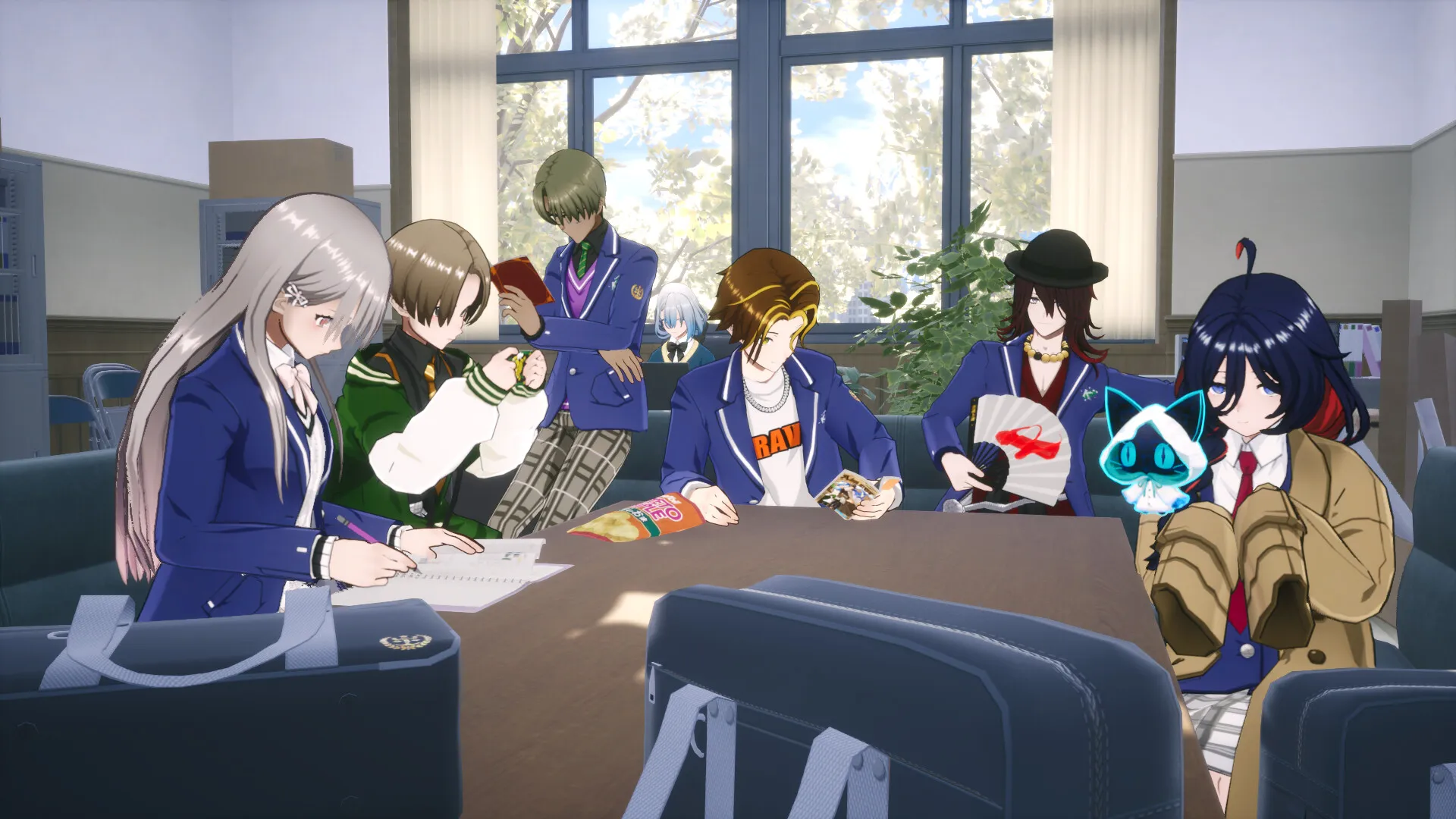
Where the core gameplay systems fail, the narrative and artistic elements offer some redeeming qualities. The story attempts to explore themes relevant to modern teenagers, examining the pressures of social media, online identity, ambition, and jealousy in a world dominated by a virtual network.
Varlet Review

The plot is delivered in a rigid chapter structure, with each segment focusing on the personal conflict of a different party member. This approach gives the story a predictable rhythm: a problem is discovered, a Glitch is investigated, and the desire is resolved. The pacing can be slow, and the plot often forces the player character to follow along with the party’s incorrect theories long after the truth of a mystery is obvious.

Character progression is handled through “Character Episodes,” which function as the game’s version of social links. These story events are integrated into the main plot, and choosing to spend time with a party member earns “Trust Points” used to unlock skills on their personal skill tree.

This is the one area where the game successfully connects its social and combat halves, as your choices directly impact which characters become more powerful. A limitation that you cannot view every character’s full story in a single playthrough adds a small amount of replay value.

The cast is a definite high point. While the initial party members fall into familiar archetypes, such as the delinquent best friend and the tomboy girl, later additions are written with more nuance. Characters like a mean-spirited pop idol and an annoyingly confident filmmaker have sharp edges and believable flaws, making them feel more like genuine high schoolers.

However, the writing sometimes stumbles, particularly with a forced romantic interest in one female character, where the game reveals her internal thoughts and makes the protagonist reciprocate regardless of player choice.

Artistically, the game is quite strong. The character portraits are crisp, expressive, and feature excellent designs that give the world a distinct personality. The Japanese voice acting is also performed at a high level of quality, effectively selling the story’s emotional moments.

The English localization makes some odd choices, such as using only first names in the text, creating a disconnect with the spoken Japanese audio that uses honorifics and last names. The script also occasionally relies on dated internet slang that feels out of place. These elements of polish are commendable. They are consistently held back by the deeply flawed combat and the tedious, unrewarding social simulation that form the game’s foundation.

The Review

Varlet

4 Score

Varlet is a game of frustrating contradictions. It presents a stylish world, high-quality character art, and a cast with genuine personality. These strengths, however, are anchored to a foundation of flawed gameplay. The social simulation is a tedious and unrewarding grind, while the combat is rendered completely devoid of challenge by a single, broken healing mechanic. The game’s aesthetic appeal cannot overcome its critically underdeveloped core systems.

PROS

  • Excellent character art and expressive designs.
  • High-quality Japanese voice acting.
  • Some characters are well-written with believable flaws.

CONS

  • Combat is broken by an unlimited healing mechanic.
  • Social simulation gameplay is repetitive and unrewarding.
  • Extremely low enemy variety.
  • Dungeons and puzzles are monotonous.

Review Breakdown

  • Overall 0

Tags: FeaturedFURYU CorporationRPGVarlet
Previous Post

Mother Review: The Saint as a Work of Fiction

Next Post

A Little Prayer Review: David Strathairn’s Silent Strength

Try AI Movie Recommender

Gazettely AI Movie Recommender

This Week's Top Reads

  • Rogue Trooper Review

    Rogue Trooper Review: Duncan Jones Finds Pulp Life on Nu Earth

    0 shares
    Share 0 Tweet 0
  • The Westies Review: Hell’s Kitchen Serves Another Cold-Blooded Crime Saga

    1 shares
    Share 0 Tweet 0
  • I’m Not Afraid Review: Childhood Pays for Adult Desperation

    1 shares
    Share 0 Tweet 0
  • Black Box Review: Flight 298 Loses Contact With Reason

    0 shares
    Share 0 Tweet 0
  • Is This Seat Taken? Review: A Satisfying Mental Workout

    1180 shares
    Share 0 Tweet 0
  • Alpha Review: YRF Finds New Heroes, Then Repeats Old Habits

    1 shares
    Share 0 Tweet 0
  • Evil Dead Burn Review: French Severity Meets Deadite Carnage

    1 shares
    Share 0 Tweet 0

Must Read Articles

House of the Dragon Season 3 Episode 4 Review
TV Shows

House of the Dragon Season 3 Episode 4 Review: Daeron Learns the Wrong Lesson

9 hours ago
The Dark Review
TV Shows

The Dark Review: Fear Watches from the Window

24 hours ago
Chainsmoker Cat Review
TV Shows

Chainsmoker Cat Review: The Sad Cat Beneath the Stench

2 days ago
Smoking Behind the Supermarket with You Review
TV Shows

Smoking Behind the Supermarket with You Review: Romance Takes a Cigarette Break

2 days ago
The Ghost in the Shell Review (2)
TV Shows

The Ghost in the Shell Review: Motoko Gets Her Mischief Back

2 days ago
Loading poll ...
Coming Soon
Which of Alfred Hitchcock's 1960s thrillers is your all-time favorite?

Gazettely is your go-to destination for all things gaming, movies, and TV. With fresh reviews, trending articles, and editor picks, we help you stay informed and entertained.

© 2021-2026 All Rights Reserved for Gazettely

What’s Inside

  • Movie & TV Reviews
  • Game Reviews
  • Featured Articles
  • Latest News
  • Editorial Picks

Quick Links

  • Home
  • About US
  • Contact Us
  • Advertise with Us
  • Review Guidelines

Follow Us

Facebook X-twitter Youtube Instagram
No Result
View All Result
  • Home
  • Movies
  • Entertainment News
  • Movie and TV Reviews
  • TV Shows
  • Game News
  • Game Reviews
  • Contact Us

© 2024 All Rights Reserved for Gazettely