




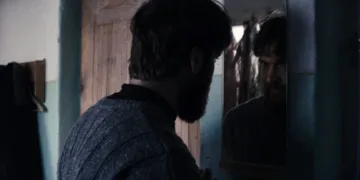











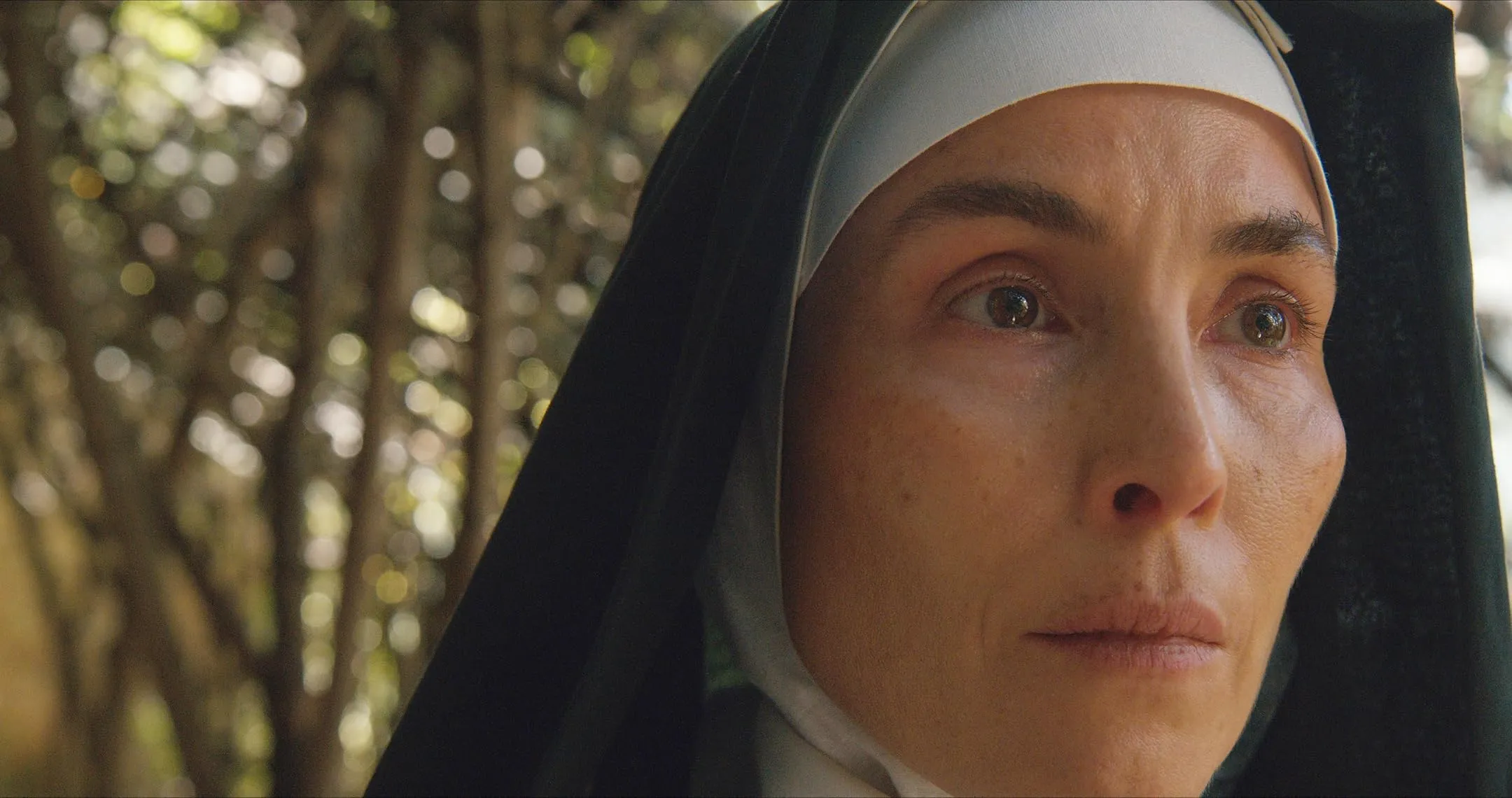

Sainthood is not a state of grace one inhabits, but a structure one builds against the chaos of the self. Mother understands this architectural impulse. It discards the sweeping timeline of biography for the intense compression of seven days, a single week in 1948 Calcutta where a life’s meaning hangs in the balance.
Here we find a 37-year-old Teresa, not yet an icon, but a woman of formidable will, waiting for a letter from Rome that will either release her into her destiny or keep her caged. The film’s interest is in the anatomy of this will, the spiritual ambition that drives a person to remake the world in the image of their faith.
The convent is a pressure cooker, hot with expectation, and into this sealed environment comes a fracture. A crisis born of the flesh threatens to bring the entire sacred project crashing down, revealing the fragile human foundation upon which divine aspirations are so often built.
A Portrait in Granite
The film carves its Teresa from granite, a figure of terrifying self-possession. Her convent is not a sanctuary of spiritual reflection but a machine of her own design, a system of existential control where the soul’s messiness is scoured away by rigid routine. She imposes a chilling order, one where sisters are identified by number and comfort is a sin to be vanquished by the constant, restless rearranging of furniture.

This is piety as a form of warfare against the softness of being, a philosophical refusal to be at ease in the world. Noomi Rapace embodies this spiritual severity with a coiled physical tension that is almost painful to watch. Her body is a fortress, her face a mask of placid authority that barely conceals the furious engine of purpose within. Every clipped word and deliberate movement communicates a soul straining against its own mortal container, a spirit so focused on a distant heaven it wages a quiet war on the earth around it.
Is this devotion, or is it a will to power sublimated into the language of God? The film offers no easy answer, suggesting her ambition is a force of nature that has merely found its most effective channel in religion. What does it mean when the self is annihilated for a mission that is, itself, the ultimate extension of the self?
Her intense, difficult bonds with the gentle Sister Agnieszka and the weary Father Friedrich become dangerous variables in this equation. They are not merely people. They are conduits for the very human frailty she seeks to transcend, introducing the chaotic element of love into her rigid calculus of faith and drawing her back toward a world she is desperate to conquer.
Hymns of Dissonance
The world of the cloister is ruptured by the film’s abrasive, anachronistic style. This is a story told in a fever, scored to the sound of a psyche under siege. An electric guitar shrieks where a church organ should sound, a blast of hard rock that is less a soundtrack and more a symptom. It is the violent eruption of the profane into a sacred space, the scream of the individual will against the silent chorus of conformity.

Director Teona Strugar Mitevska employs a cinematic language of psychological distress, plunging Teresa into surreal, nightmarish dream sequences. These are not mere interludes; they are descents into a subconscious where the clean lines of dogma blur into a terrifying landscape of doubt, where God and devil are indistinguishable figures in the shadows of her mind. This formal restlessness is meant to mirror Teresa’s own spiritual state, her inability to find peace even within the walls of her own making.
The cinematography reinforces this sense of entrapment. The camera stalks the holy corridors, its claustrophobic framing turning a sanctuary into a prison. Stark lighting carves figures out of the darkness, suggesting a Manichaean worldview where every soul is caught between damnation and grace. This aesthetic aggression is a high-risk choice.
At times, it brilliantly externalizes the inner turmoil, translating a spiritual crisis into a visceral, unsettling experience. In other moments, the effort is apparent. The stylistic flourishes feel like a barrier, creating a distance that makes Teresa an object of intellectual study rather than a subject of empathy, leaving one to question if the film truly reveals her soul or simply decorates its surfaces.
The Price of a Mission
The pregnancy of Sister Agnieszka is the film’s philosophical core, a crucible that forces an impossible choice between two forms of creation. The dilemma is not simply moral but existential. It stages a conflict between a deontological imperative—the absolute, divine rule against abortion—and a frighteningly consequentialist ambition: the greater good that her future mission promises.

Teresa must weigh one life, a tangible soul here and now, against the abstract salvation of millions. The film finds its unnerving power in this ambiguity, refusing to sanctify its protagonist’s decision or provide her with a clean conscience.
Her struggle reveals the unsettling reality that a great historical will often operates beyond simple morality, demanding sacrifices that cannot be easily justified. What is she sacrificing Agnieszka to? To God, or to the abstract idea of her own legacy? The film provocatively suggests the two may have become the same.
What remains is not the portrait of a saint but of a force. She is a woman carved from the crooked timber of humanity, a person whose immense faith provides no easy refuge from a worldly calculus. Her path was forged through compromises that blur the line between divine inspiration and ruthless determination.
The film ultimately leaves us to ponder the nature of greatness itself, suggesting it may be born from the same dark, fertile soil as tyranny: an unshakeable belief in one’s own righteousness. The portrait is not of a woman who found God, but of a woman who willed herself into a vessel for a concept she called God.
Mother is a 2025 drama directed by Teona Strugar Mitevska, making it her English-language feature debut. The movie, which stars Noomi Rapace, tells the story of Mother Teresa. The film had its world premiere in the Orizzonti section of the 82nd Venice International Film Festival on August 27, 2025.
Full Credits
Director: Teona Strugar Mitevska
Writers: Teona Strugar Mitevska, Goce Smilevski, Elma Tataragić
Producers and Executive Producers: Yanna Buryak, Ludovic Henry, Raymond van der Kaaij
Cast: Noomi Rapace, Sylvia Hoeks, Nikola Ristanovski, Marijke Pinoy, Labina Mitevska
Director of Photography (Cinematographer): Liza Popova
Editors: Vladlena Sandu
The Review
Mother
Mother is a philosophically ambitious and formally aggressive portrait of sainthood as an act of will. Propelled by a formidable performance from Noomi Rapace, the film is a fascinating, if sometimes overwrought, exploration of faith, power, and the unsettling nature of a world-shaping ambition. It succeeds as a challenging character study, even when its stylistic choices threaten to overwhelm its substance.
PROS
- A powerful and physically intense central performance from Noomi Rapace.
- A bold, unconventional approach that avoids standard biopic tropes.
- Raises complex, challenging questions about faith, ambition, and morality.
- The focused, seven-day narrative structure creates a tense, claustrophobic atmosphere.
CONS
- Stylistic choices, like the hard-rock soundtrack and surreal sequences, can feel heavy-handed and distracting.
- The script occasionally struggles to fully explore the psychological depth it gestures toward.
- The film's aggressive tone can create an intellectual distance, making it difficult to connect with the characters emotionally.