






























In a world populated by animals with a fixation on auto racing, a young mouse named Edda harbors a great passion. She dreams of speed and victory, looking up to the famous and conceited four-time champion, Ed. Her personal ambitions, however, are set against a backdrop of familial duty. Her father’s amusement park, the family’s livelihood, is facing financial ruin.
This classic conflict between personal aspiration and family responsibility provides the emotional core of the story, a dilemma frequently explored in Indian family dramas where the individual must often weigh their dreams against the needs of the collective. The narrative is set in motion by a moment of recklessness.
An unfortunate incident leaves the star driver Ed with an arm injury, an impairment that would mean immediate disqualification from the Grand Prix of Europe. This circumstance presents Edda with an opportunity. She must secretly take Ed’s place, racing under his identity to win the prize money needed to save her father’s park.
Drivers in Development: From Mascot to Character
The film’s central relationship is between the determined Edda and the arrogant Ed. Edda is a capable driver, yet her impulsive nature often guides her actions. This recklessness is presented as both youthful confidence and a character flaw, creating an internal conflict that mirrors coming-of-age stories across cultures.
Her motivation is twofold: a genuine desire to prove her skill and a deep-seated need to rescue her family. Ed, on the other hand, begins as a conceited sports star, his vanity a thin shield for insecurities rooted in a lonely childhood. This archetype of the proud hero humbled by circumstance is a familiar figure in global cinema.
His arc is particularly reminiscent of the modern Bollywood hero, who often begins with a self-centered worldview before being redeemed by a determined female protagonist and the values of community. Through his forced collaboration with Edda, Ed slowly learns about trust and teamwork. The voice work gives these figures life.
Gemma Arterton voices Edda with spirit, while Thomas Brodie-Sangster effectively captures Ed’s specific mix of athletic self-importance and practiced, media-trained speech. Supporting characters, like Edda’s father voiced by Lenny Henry, add a layer of warmth.
Still, the primary characters sometimes struggle to feel like fully realized individuals. They lack a compelling interiority, making them appear more like theme park mascots performing a story than beings with genuine depth.
The Racetrack as Spectacle
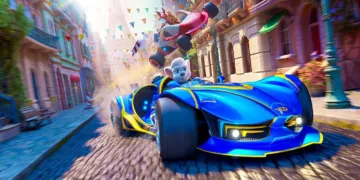
Visually, the film is bright and energetic, with a color palette clearly designed to appeal to its young target audience. The animation is clean and the action moves at a frantic speed, especially during the racing set pieces. The film’s animated cinematography during these moments uses low angles and quick cuts to mimic the intensity of a live sports broadcast.

The sound design, filled with roaring engines and cartoonish crash effects, further enhances the spectacle. Yet, the world-building is where the production shows its limits. The races, set in various European nations, miss the chance to offer any real cultural texture.
Instead of using the tour to create a rich visual tapestry—the architectural charm of Paris, the alpine beauty of Switzerland—the film opts for generic signifiers. A landmark might appear in the background, but the track itself is interchangeable.
This approach is reminiscent of how song-and-dance “item numbers” function in some commercial Indian films. They are self-contained spectacles, visually elaborate and existing to provide a burst of kinetic energy. They entertain in the moment, but they often pause the emotional development of the plot. The focus is on the thrill, not on how the event shapes the characters’ inner worlds.
Story Execution and Thematic Messages
The story champions themes of courage, perseverance, and the superiority of teamwork over individual ego. While these are worthy messages, the narrative structure that delivers them is highly predictable, following a standard underdog sports formula.

The plot’s strong resemblance to established films like Pixar’s Cars highlights a reliance on a successful but unoriginal template. The script’s primary weakness is its tendency to rush past important emotional developments. For instance, Edda’s pivotal choice to race for her father is handled with a few lines of dialogue and a brief musical cue.
A more patient film, perhaps in the vein of Indian parallel cinema, might have dedicated an entire scene to her internal conflict and the weight of her decision. Instead, the narrative prioritizes forward momentum over emotional depth. A sabotage mystery is woven into the plot, serving as a low-stakes narrative engine to move from one race to the next.
Its resolution is simple, reinforcing the film’s uncomplicated moral universe where villains are easily identified. The film’s ultimate purpose feels less narrative and more commercial; it exists to reinforce the brand identity of its associated theme park. This explains the script’s reluctance to take risks or explore complexity. The story serves the brand, not the other way around.
The German-British animated sports comedy film Grand Prix of Europe was released in Germany on July 24, 2025, and is scheduled for release in the United Kingdom on August 22, 2025, distributed by Kazoo Films. In the United States, Viva Pictures is distributing the film, with a release date of August 29, 2025.
Full Credits
Director: Waldemar Fast
Writers: Kirstie Falkous, Jeffrey Hylton, John T. Reynolds, Ben Alexander Safier
Producers and Executive Producers: Michael Mack (producer), Lars Goldenbogen, Ralph Kamp, Tobias Mundinger (executive producers)
Cast: Thomas Brodie-Sangster, Gemma Arterton, Hayley Atwell, Lenny Henry, Rob Beckett, Colin McFarlane
Editors: Björn Teubner
Composer: Volker Bertelmann
The Review
Grand Prix of Europe
While Grand Prix of Europe offers a visually energetic and simple diversion for very young viewers, its narrative engine runs on a familiar formula. The film prioritizes fast-paced spectacle over emotional depth, resulting in a story with characters that feel more like brand mascots than developed personalities. It is a cheerful, harmless, but ultimately forgettable race that never quite reaches top gear.
PROS
- Bright, energetic, and colourful animation suitable for children.
- Strong voice performances from the main cast.
- A simple, easy-to-follow story for a very young audience.
- Maintains a consistently cheerful and harmless tone.
CONS
- The plot is highly predictable and follows a standard formula.
- Key emotional moments are rushed and lack dramatic weight.
- Characters feel underdeveloped and more like mascots.
- The world-building is generic, and the story feels like a commercial.