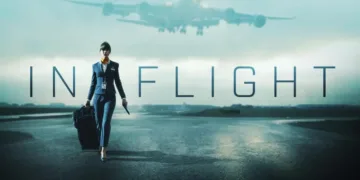
























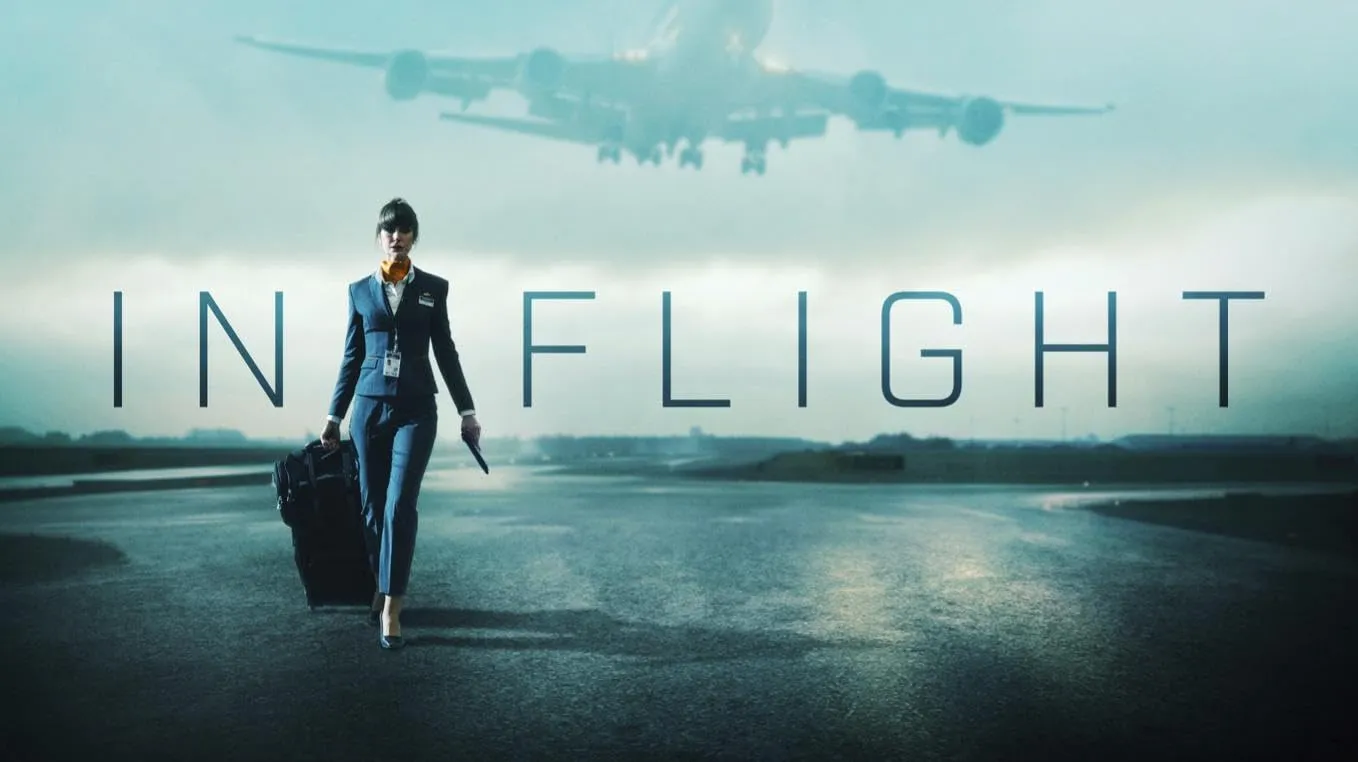

There is a particular flavor of modern anxiety reserved for the working parent, a low-grade panic that hums beneath the surface of school runs and quarterly reports. In Flight takes this ambient dread and amplifies it into a full-blown shriek. We are introduced to Jo Conran, a flight attendant whose competence is her armor.
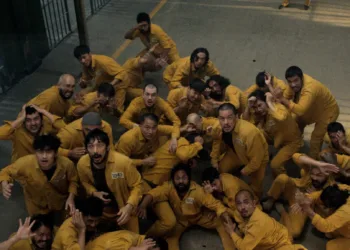
Played by Katherine Kelly, Jo navigates the world with a practiced calm that is about to be systematically dismantled. Her life enters a state of moral freefall when her son, Sonny, is handed a 15-year sentence in a grim Bulgarian prison for a murder he swears he did not commit.
This is not a simple miscarriage of justice. It is a trap. Before Jo can fully process the situation, she is approached by Cormac, the face of a criminal network with an unrefusable offer. She will use her trusted position to courier drugs.
In exchange, her son receives protection inside the prison’s walls. If she declines, Sonny’s life is forfeit. The series thus posits a chilling thesis: in our interconnected world, vulnerability is a commodity, and parental love is the ultimate form of leverage. An ordinary person is pushed into an extraordinary, illegal life.
The Non-Place as Purgatory
The show’s primary achievement is its masterful cultivation of tension, a specific sort of transit-terror born from the very environments meant to signify passage and escape. The thriller mechanics are executed with a harrowing precision. We are with Jo through every security checkpoint, our own breath held as she navigates customs with a suitcase full of contraband.
The near-misses are relentless, from a sudden bag search to the frantic hiding of evidence in the sterile confines of an airplane lavatory. The sound design is a critical component of this experience; the indifferent drone of the engines, the sharp, authoritative click of a suitcase latch, the disembodied calm of a gate change announcement—all become instruments in a symphony of paranoia. These are the mundane sounds of travel, re-contextualized into portents of doom.
The atmosphere is aggressively claustrophobic, a feeling deepened by its philosophical underpinnings. This is achieved by weaponizing what the anthropologist Marc Augé famously termed the “non-place.” The airports, the chain hotels, the shuttle buses—these are spaces of profound anonymity, defined by their transience and lack of organic social life.
The show uses their sterile, characterless nature to amplify Jo’s isolation and reflect her dissolving identity. As she is forced deeper into her criminal role, she becomes as placeless as her surroundings, a ghost haunting the infrastructure of global travel. The flight attendant uniform, a potent symbol of order and public trust, becomes a cruel piece of irony. It is a costume of normalcy, a mask that grants her access while simultaneously making her a conspicuous pawn in a game she cannot comprehend.
This constant state of being watched is central to her ordeal. The narrative brilliantly externalizes her internal panic into the very architecture of her world. Every CCTV camera feels like a personal accuser. Every security scan feels like a violation aimed directly at her. Is she being monitored by the cartel, the authorities, or simply the indifferent, algorithmic gaze of the modern security state?
The show provides no easy answers, suggesting they have all merged into a single, oppressive system. Her ordeal strips the glamour from air travel, revealing its reality as grueling, precarious labor. This connects her specific crisis to a wider societal condition, where economic instability makes ordinary people exploitable. Jo’s desperation is not just personal; it is a symptom of a world where security is a luxury and loyalty is a liability.
The Human Element in a Systems Thriller
In a story built from the cold mechanics of a thriller plot, the performances provide the necessary warmth, or at least the friction that generates heat. The entire series rests on the shoulders of Katherine Kelly, and she carries the immense weight magnificently. Her performance is a masterclass in contained panic.
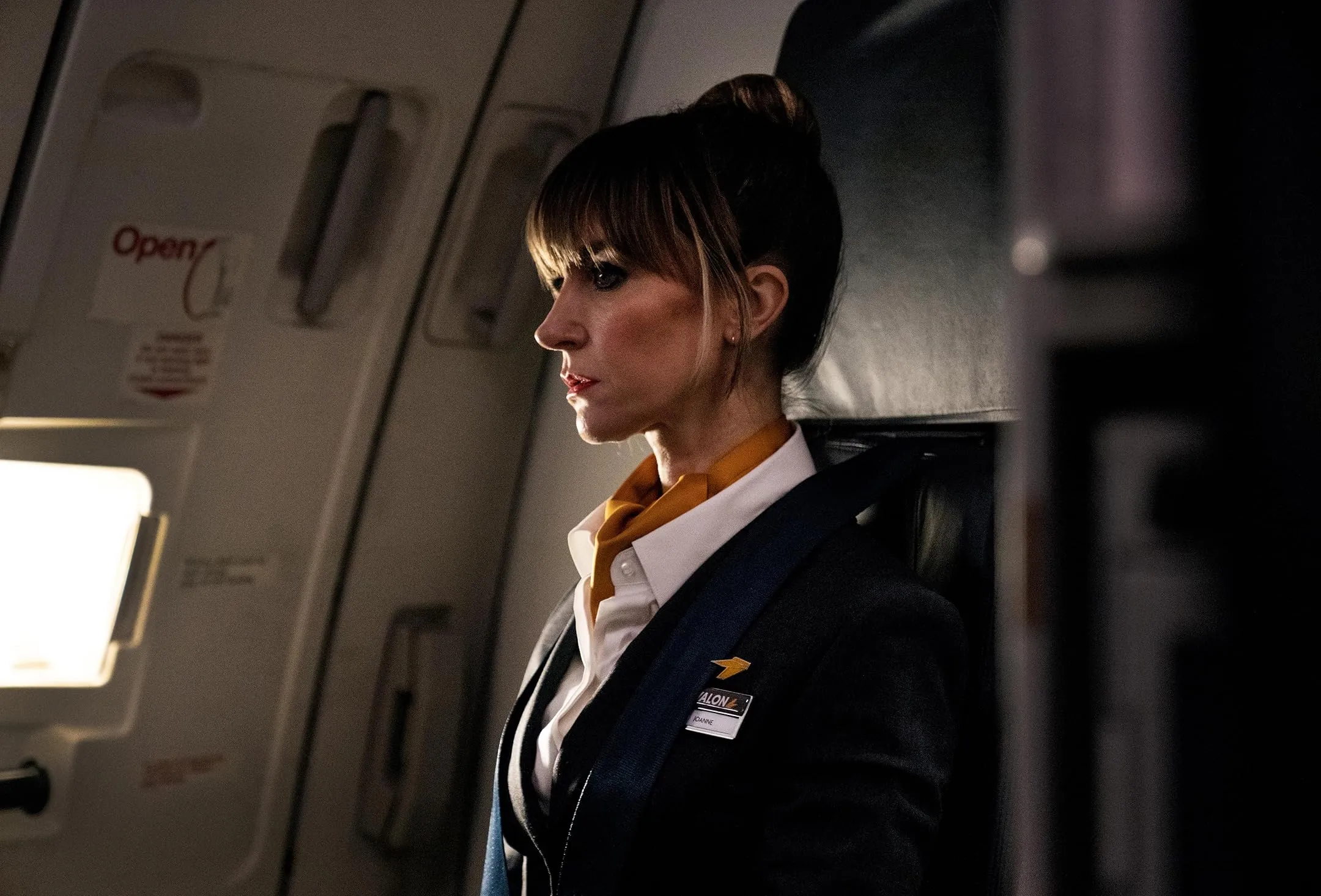
It is a physical creation, visible in the rigid set of her shoulders as she walks through the terminal, the slight tremor in her hand as she serves a drink, the darting glances that betray a mind racing through catastrophic possibilities. We witness the immense effort of her compartmentalization. The shift from her public-facing professional persona to the private terror of a hotel room is stark and devastating. She is the show’s anchor, and her portrayal of grit, fear, and maternal ferocity makes the often-outlandish plot feel emotionally true.
The forces acting upon her are personified with equal, if chilling, skill. Stuart Martin’s Cormac is a chillingly modern villain. He is not a theatrical monster but a calm, business-like functionary of a vast criminal enterprise. He embodies a certain banality of evil, discussing threats to human life with the detached air of a manager reviewing quarterly losses. This makes him far more frightening than a simple thug. He represents the impersonal, corporate nature of organized crime, a system that treats people as assets and liabilities. His menace is found in his politeness.
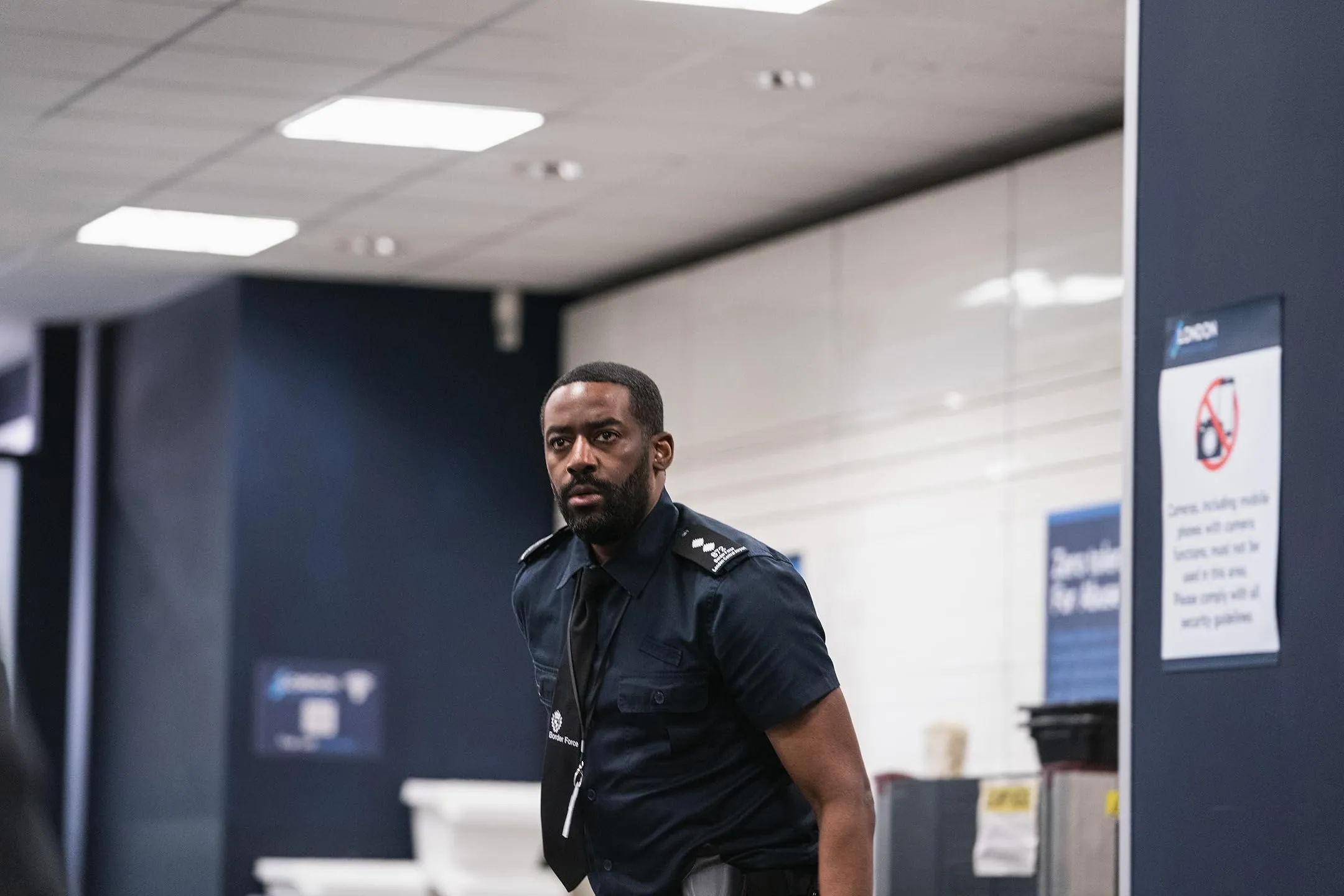
Then there is Dom, the ex-lover and customs officer played by Ashley Thomas. He is a walking, breathing conflict of interest, a human embodiment of the story’s central moral chaos. He represents the profound difficulty of the bystander. How much is he willing to see before his willful ignorance becomes active complicity? His internal struggle between a past loyalty to Jo and his sworn professional duty is a compelling subplot.
He is a man desperately trying to cling to the wreckage of a “normal life,” and his presence constantly questions whether clear-cut morality is even possible in a world of such desperate compromises. His character forces a difficult question: what is the greater sin, the act of a desperate person, or the inaction of a comfortable one?
This dynamic is further complicated by the core question of Sonny himself. The show wisely keeps his absolute innocence in a state of slight ambiguity, suggesting that Jo’s unwavering belief is the true engine of the plot, an emotional truth that persists independent of any objective reality. Her faith is the story, not the verdict.
When the Plot’s Baggage Exceeds the Carry-On Limit
A thriller so tightly wound is bound to have a few loose threads, and In Flight is no exception. For all its visceral tension and psychological realism, the narrative occasionally leans on a degree of convenience that threatens to snap the audience’s suspension of disbelief. Cormac’s preternatural ability to appear at precisely the most inopportune moments can feel less like menacing omnipresence and more like a writer’s contrivance.
Jo’s knack for finding last-minute solutions, while necessary for the plot to continue, sometimes strains the logic of the world the show has so carefully constructed. The series also suffers from a mild case of what might be termed narrative bloat, a common affliction of modern television. It introduces story arcs, most notably Dom’s vaguely defined health problems, that feel extraneous.
These subplots seem to exist to pad the runtime or create false stakes, distracting from the incredibly effective core of Jo’s psychological torment. They are decorative additions to a narrative machine that runs best when it is lean and focused.
These are minor quibbles, however, compared to the show’s most significant misstep, a structural flaw that surfaces late and significantly alters the story’s chemical composition. The introduction of Kayla, Sonny’s heretofore unmentioned and conveniently pregnant girlfriend, is a decision so baffling you almost have to admire its audacity.
Her character feels less like an organic development and more like a narrative device airlifted into the plot. Her backstory is sketched with such haste that her monumental decision to abandon her entire life feels entirely unearned. She is a classic deus ex gravida, a character whose primary function is to solve a plot problem and soften an impending difficult conclusion.
This choice fundamentally disrupts the show’s central theme. The raw, powerful story of singular, maternal sacrifice—the idea that a mother will do anything for her child—is diluted, replaced by a more conventional and far less interesting tale of young love triumphing against the odds. It is a failure of narrative nerve. After six episodes of brutal honesty and unflinching depictions of desperation, the show swerves toward a sentimental resolution it had seemed determined to avoid.
The ending, in which Sonny’s freedom is secured but his name is never cleared, should be a moment of profound, bittersweet ambiguity. Kayla’s smiling presence sanitizes this moment, lessening the impact of Jo’s immense sacrifice and making the conclusion feel altogether too neat. It is a shame, because it represents a retreat from the story’s initial, challenging premise into something safer, and ultimately, much less memorable.
In Flight is a British television crime thriller drama series, starring Katherine Kelly. The series premiered on Channel 4 in the UK on August 12, 2025. The series is produced by Buccaneer Media and filming took place in Belfast, Northern Ireland.
Full Credits
Director: Chris Baugh
Writers: Mike Walden, Adam Randall
Producers & Executive Producers: Brendan Mullin, Anna Burns, Tony Wood, Richard Tulk-Hart, Rebecca Dundon, Simon Judd, Mike Walden, Adam Randall, Chris Baugh
Cast: Katherine Kelly, Stuart Martin, Ashley Thomas, Bronagh Waugh, Harry Cadby, Corinna Brown, Ambreen Razia
Editors: Rickard Krantz, David Nordén, Hans Perk
The Review
In Flight
In Flight is a gripping, high-altitude thriller powered by a phenomenal lead performance from Katherine Kelly. It masterfully creates an atmosphere of claustrophobic tension, turning the anonymous spaces of modern travel into a personal purgatory. However, its powerful engine of maternal desperation is ultimately throttled by an over-reliance on plot conveniences and a late-stage narrative choice that trades brutal honesty for a contrived, unsatisfying landing. It is a compelling watch that just misses true greatness.
PROS
- A powerful and compelling lead performance by Katherine Kelly.
- Masterfully crafted tension and a claustrophobic atmosphere.
- Intelligent use of the airline setting as a "non-place" to amplify paranoia.
CONS
- The plot relies on implausible conveniences.
- The narrative is cluttered with underdeveloped subplots.
- A forced, late-game character introduction weakens the story and its conclusion.