
























![Kingdom Hearts Collection [I-III] Review](https://gazettely.com/wp-content/uploads/2026/10/Kingdom-Hearts-Collection-I-III-1-360x180.webp "Kingdom Hearts Collection [I-III] Review: KHII Holds Steady as Newer Entries Fluctuate 37")





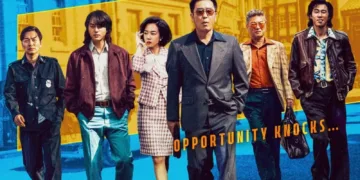
In the ever-expanding universe of Korean streaming content, where polished romances and high-concept fantasies often dominate, Low Life arrives as a potent dose of unvarnished reality. It turns its lens away from the gleaming towers of modern Seoul to the dust and grime of 1977 South Korea, a nation in the throes of authoritarian-led economic development.
The series introduces its central premise not as a thrilling adventure but as an act of profound desperation. A fabled treasure of priceless ceramics, lost to a 14th-century shipwreck, becomes the final hope for uncle Oh Gwan-seok and his nephew Oh Hee-dong. They are not suave masterminds; they are low-level hustlers, men left behind by a national “miracle” that feels distant and unattainable. Their pursuit of this sunken fortune is less a heist and more a grim calculus for survival.
The show makes it clear from the beginning: this is a raw, character-driven examination of what ordinary people will sacrifice when glory is an unaffordable luxury and getting by is a victory in itself. The story is not about finding treasure, but about the conditions that make such a gamble necessary.
The Unravelling Social Contract
The salvage operation in Low Life presents a masterful microcosm of a society whose social contract is fraying under the immense pressure of state-driven capitalism. The team is a fractured alliance, its foundation built on mutual suspicion, functioning as a bleak commentary on the erosion of collective trust.
At its center is the complicated, compelling bond between the cynical, world-weary Gwan-seok and the impulsive, hot-headed Hee-dong. Their dynamic is more than a simple crime partnership; it is a manifestation of a generational and philosophical clash shaped by economic precarity. Gwan-seok’s weary pragmatism speaks to an older Korea, one that has seen idealism crushed by hardship and understands the system is rigged.
Hee-dong’s reckless energy reflects a younger generation’s frustration, a desperate desire to smash through the barriers his uncle has learned to navigate with cunning. Their loyalty is the story’s fragile emotional anchor, constantly strained by the promise of individual gain that capitalism dangles before them.
Surrounding this central duo are the power brokers who represent the untouchable upper echelon of this new social order. The antique dealer Song Ki-taek is a slippery middleman, embodying the transactional opportunism that thrives in the gaps between the rich and the desperate. The truly formidable figures are Chairman Cheon, an illiterate but immensely powerful tycoon, and his sharp, calculating wife, Yang Jung-sook. Their relationship is a fascinating study in shifting power dynamics.
The Chairman represents old-world authority built on brute force and intuition, while Jung-sook symbolizes a newer form of power rooted in education, intellect, and strategic manipulation. Her character is a significant piece of representation, a portrait of nascent female agency in a deeply patriarchal society. She is a woman who uses her sharp business acumen as a weapon and a shield, navigating a world of dangerous men by being smarter and colder than any of them.
Her complicated history with her right-hand man, Jeon-chul, adds another layer of intrigue, hinting at a past where her choices were even more constrained. The crew is a collection of rivals forced into a dangerous proximity, with spies planted by each faction to ensure their interests are protected. This structure is a perfect metaphor for a hyper-competitive society where trust is a liability and betrayal is an anticipated, even logical, outcome.
The suspense is generated less by external threats and more by the sociological friction within the group, an exploration of what happens when the very idea of a common good has been replaced by a Darwinian struggle for personal survival.
The Aesthetics of Authenticity
The series’ production design is a political statement, consciously rejecting the sanitized, export-friendly version of Korean history for something far more textured and honest. The world of Low Life is tangible; the unpolished grime of the rural port towns, the shabby authenticity of the period clothing, and the weathered faces of its characters all create an atmosphere of lived-in hardship.

This is not nostalgia; it is a meticulous reconstruction of an era’s oppressive weight, set against the backdrop of Park Chung-hee’s authoritarian regime. While the politics are not overt, the constant sense of surveillance and the characters’ fear of authority permeate the story, grounding their illegal activities in a specific historical reality where stepping out of line had severe consequences. This commitment to verisimilitude is a powerful choice, giving the narrative a depth that a more generic period setting would lack.
The deliberate pacing, a hallmark of director Kang Yun-seong’s confident style, is another crucial element. In an age of content engineered for short attention spans, Low Life makes a bold claim for the power of the slow burn. The narrative unspools with patience, investing significant time in establishing character motivations and the intricate web of deceit before the central heist even begins.
This approach, perfectly suited for the binge-watching model of streaming platforms, allows for a different kind of audience engagement. It fosters immersion and contemplation, trusting viewers to appreciate the nuances of character over the immediate gratification of plot twists.
This contemplative rhythm stands in stark contrast to much Western television and signals a growing trend in global storytelling that prioritizes atmospheric depth. The direction and cinematography work in concert to reinforce these themes. The camera frequently frames the characters as small figures dwarfed by their environment, whether it is the indifferent expanse of the sea or the encroaching industrial landscapes.
The color palette is muted, dominated by earthy browns, grays, and damp blues, effectively draining the world of any romanticism. The underwater sequences are especially masterful, edited to be tense, disorienting, and claustrophobic. They serve as a potent visual metaphor for the social and economic confinement the characters feel on land, a suffocating pressure from which they are trying to break free.
Excavating the Human Condition
Ultimately, the priceless sunken ceramics in Low Life are a classic MacGuffin, a plot-driving object whose true function is to excavate the moral bedrock of its characters. The treasure hunt becomes a vehicle for a profound critique of the human cost of unchecked ambition.

The irony is potent: these men, positioned at the very bottom of the social ladder, are driven to plunder their own national heritage for a chance at a future. This dynamic offers a subtle commentary on how history and culture can be stripped of their meaning and commodified in the relentless pursuit of capital. The quest for wealth becomes a crucible that tests every value the characters profess to hold, threatening to dissolve the familial bond between Gwan-seok and Hee-dong and corrupting everyone who comes near the prize.
The series anchors this exploration in the specific context of South Korea’s “Miracle on the Han River,” a period of explosive economic growth that came with immense social and human sacrifices. The show poses a difficult question: what parts of one’s soul must be traded away to climb out of poverty?
The series operates almost exclusively in a moral gray area, a narrative choice that reflects a mature and complex worldview. It refuses to categorize its characters as simple heroes or villains. Instead, they are presented as flawed products of their environment, individuals whose actions are shaped by a mix of understandable desperation, raw greed, and a compromised sense of loyalty.
Their choices feel tragically rational within the context of a system that has offered them few legitimate paths to dignity. This commitment to moral ambiguity is challenging and reflects a storytelling confidence that is becoming a signature of the best international television. Low Life signals an important shift in Korean drama, a move toward more introspective, socially critical narratives that are willing to engage in difficult self-examination.
It represents a confidence to tell stories that are resonant globally because of, not in spite of, their cultural and historical specificity. The show suggests that the “low life” of its title is not merely a state of economic deprivation.
It is a condition of moral decay, a spiritual poverty fostered by the very systems that promise material prosperity. The final, lingering takeaway is that the greatest danger is not the unforgiving sea or the threat of destitution, but the darkness that the pursuit of wealth awakens within the human heart.
Low Life is a South Korean period drama series, premiering on Disney+ internationally and Hulu in the United States on July 16, 2025. The series, comprising 11 episodes, aired its finale on August 13, 2025.
Full Credits
Director: Kang Yoon-sung
Writers: Kang Yoon-sung, Ahn Seung-hwan
Producers & Executive Producers: Four Entertainment, Heungbu Nebak Cine, Playgram, YWorks Entertainment, Production SLL
Cast: Ryu Seung-ryong, Yang Se-jong, Lim Soo-jung, Rich Ting, Chase Kim, Leonard Wu, Yuuki Luna, Jonathon Ha, Victoria Grace
Composer: Yoon Il-sang







