
























![Kingdom Hearts Collection [I-III] Review](https://gazettely.com/wp-content/uploads/2026/10/Kingdom-Hearts-Collection-I-III-1-360x180.webp "Kingdom Hearts Collection [I-III] Review: KHII Holds Steady as Newer Entries Fluctuate 37")




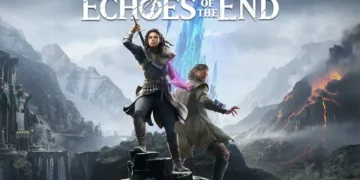
Echoes of the End presents itself with the confidence of a top-tier blockbuster. It is a third-person cinematic action-adventure aiming to stand with giants, built on sweeping vistas and a dramatic, personal story. Players take control of Ryn, a powerful magic-wielder known as a Vestige, living in a world scarred by past conflicts.
Her relative peace is shattered when her brother, Cor, is abducted by an invading force, setting her on a desperate quest across the beautiful but dangerous land of Aema. The experience is framed around three pillars: wielding supernatural abilities against hostile foes, solving ancient environmental puzzles, and following a narrative that tests Ryn’s hardened, distrustful nature.
It carries the appearance and ambition of a prestige title, an experience designed to be both visually arresting and emotionally resonant. The central question is whether its underlying systems can support this grand presentation.
A Familiar Tale of Rescue and Ruin
The narrative of Echoes of the End follows a well-trodden and entirely linear path. After her brother’s capture, Ryn joins forces with Abram, a scholar with ties to her past, to track the enemy across Aema. The plot is a straightforward “rescue the family” mission that slowly escalates into a “stop the world-ending threat” scenario, offering the player no choices to influence its direction or outcome.
It relies heavily on conventional fantasy tropes, from a shadowy empire to a prophesied power, and its pacing is sluggish in the opening hours, taking considerable time to build momentum. The story rarely deviates from its predictable trajectory. The game’s narrative strength lies not in its plot but in its central relationship. Ryn begins as a classic archetype, the hardened veteran defined by childhood trauma and a deep-seated distrust of others. Her evolution is the most successful part of the story.
Through her constant dialogue and shared struggles with Abram, she gradually learns to open up and rely on someone else. This dynamic provides an emotional anchor that the main plot lacks, serving as the glue for the entire experience. This character focus is necessary because the world-building is sparse. Key concepts, like the nature of a Vestige, are introduced without sufficient explanation, leaving the player to piece together the rules of the world from context clues.
In-game journal entries offer some lore, but they fail to create a cohesive or deep history for Aema. The player is often left feeling like an outsider, observing events without a firm grasp of their significance. This sense of detachment is amplified by the voice acting. With the exception of Ryn’s more grounded performance, the delivery from the supporting cast is frequently flat and devoid of emotion, turning potentially heartfelt scenes into hollow script readings.
The main antagonist, Aurick, speaks in such a quiet tone that subtitles become essential, while Cor’s voice feels tonally mismatched with his character. This weakness is most apparent during key dramatic moments, where the unconvincing delivery drains scenes of their intended weight and makes it difficult to invest in the stakes.
A World of Breathtaking Beauty
If there is one area where Echoes of the End excels without reservation, it is in its visual presentation. The world of Aema is consistently stunning, a clear showcase of the developer’s artistic talent. From sun-drenched forests where light shafts pierce the canopy to cavernous ruins and war-torn villages, the environments are rendered with impressive detail.

The lighting engine creates a powerful sense of atmosphere, casting long shadows and illuminating particles in the air to bring each scene to life. The texture work on natural formations like rock and foliage is particularly noteworthy, creating vistas that demand a moment of pause to simply take them in. The art direction successfully establishes a moody, painterly world that feels vast and ancient, often evoking a sense of lonely grandeur. This visual splendor is not flawless.
A careful eye might spot an occasional low-resolution texture on a minor object, though this is a small complaint. A more persistent issue is the facial animation during cutscenes. The character models themselves are detailed, but their expressions are stiff and disconnected from the dialogue.
This creates a strange puppet-like effect, where a character might deliver an emotional line with a blank, lifeless stare. This disconnect between the beautifully rendered static world and the awkwardness of its inhabitants detracts from the otherwise cinematic presentation and pulls the player out of the moment.
The Puzzler’s Paradise
Players expecting a combat-heavy action game may be surprised to find that the core of Echoes of the End’s gameplay loop is puzzle-solving. Environmental challenges are the main activity separating one narrative beat from the next, making it feel closer to a puzzle-platformer than a traditional action title. Fortunately, this is the most polished and well-designed mechanical system in the game.

The puzzles are consistently clever, requiring a thoughtful approach to the environment instead of pure reflex. They revolve around a satisfying interplay between Ryn’s and Abram’s abilities. Ryn can use her Vestige powers to move large objects or manipulate ancient machinery, while Abram can freeze objects or structures in place. The game introduces new gimmicks and mechanics at a steady pace, preventing the puzzles from feeling repetitive.
The difficulty curve is expertly managed. Most challenges hit a “Goldilocks” spot where the solution is not immediately obvious but can be figured out through experimentation and observation, avoiding the kind of frustration that leads players to seek a guide. However, the game frequently undermines its own strong puzzle design with aggressive hand-holding.
Moments after entering a puzzle room, Abram will often state the solution aloud or give a very direct hint, such as, “Look, Ryn, that crank over there must move the platform!” If the player still hesitates, a large on-screen prompt will offer further guidance. This design choice shows a lack of trust in the player’s intelligence and actively conditions them to wait for instructions instead of thinking critically.
It robs them of the satisfaction of discovery and makes solving the puzzle feel like following a checklist. The feeling is made worse when, on occasion, companion AI will simply bypass a puzzle by teleporting or phasing through an obstacle the player must painstakingly solve. It makes the challenge feel artificial, a temporary roadblock rather than an integrated part of the world.
An Unrefined Blade
Where the puzzle design is sharp and rewarding, the combat is disappointingly dull and unrefined. On paper, the system has promise, blending standard sword combos with a suite of magic attacks and special moves commanded by your companion. It evokes games like the modern God of War but lacks any of the responsiveness or tactical depth that makes those systems work. Combat encounters feel stiff, unreliable, and more like a chore than a thrilling test of skill.

The core problem is a fundamental lack of responsiveness. The window for parrying enemy attacks is inconsistent, and Ryn’s dodge feels sluggish, often failing to get her out of harm’s way in time. These issues are compounded by other mechanical flaws. Ryn is locked into her attack animations, meaning you cannot cancel a combo to block an incoming strike.
This forces a hesitant, defensive playstyle that feels restrictive. Most enemies lack a proper stagger system, allowing them to continue their own attack animations even while you are hitting them. The lock-on for Ryn’s magic powers is unreliable, frequently causing her to hurl an attack at empty space instead of the intended target.
Enemy attacks that can be parried are sometimes marked with a visual cue, but the rule is applied inconsistently, making it difficult to read threats effectively. The character progression system does little to improve this foundation. While Ryn has multiple skill trees for her sword and magic abilities, the upgrades feel inconsequential. New moves add little to your strategic options, and the core feel of combat remains unchanged from start to finish, making leveling up feel like a hollow exercise.
On higher difficulties, these mechanical failings make encounters artificially punishing. The challenge comes not from clever enemy design but from fighting the controls. This clumsiness extends to the platforming. Traversal is functional, but Ryn’s movement feels floaty, with a sense of momentum that makes precise jumps aggravating. This often leads to cheap deaths, a problem made worse by an unpredictable camera that can wrest control away at the worst possible moments.
Cracks in the Foundation
Beneath the beautiful visuals and solid puzzle design, Echoes of the End suffers from a significant lack of technical polish. The game’s performance on PC is a major issue that actively hinders gameplay. Even on hardware that exceeds the recommended specifications, players can expect severe frame rate drops, especially in busy combat encounters or when loading into a new area.

A sudden drop during a fight can easily cause a missed parry, leading directly to a frustrating death. Stuttering is common, as is asset and enemy pop-in, which breaks the otherwise seamless presentation with hard loading screens. These technical hitches constantly undermine the game’s stunning art direction. For those hoping to play on the go, the game is currently unplayable on the Steam Deck, unable to maintain a stable frame rate even on the lowest possible settings.
Beyond raw performance, a collection of smaller issues further erodes the experience. The checkpoint system is often punishing, placing you far from where you failed a segment and forcing a tedious run-back. This is especially frustrating after a cheap death during a platforming or combat sequence and discourages exploration.
Other immersion-breaking elements are frequent. Companions will unnaturally teleport across large gaps to catch up with you, players can get stuck inside the world’s geometry, and the camera will sometimes snap to a new position without warning. These may seem like minor grievances, but their cumulative effect points to a game that needed more time for refinement and creates a feeling of fatigue.
The Review
Echoes of the End
Echoes of the End is a game of frustrating contradictions. It presents a world of breathtaking beauty and fills it with cleverly designed puzzles that are a genuine joy to solve. However, these considerable strengths are shackled to a clumsy and unresponsive combat system, a generic story, and a host of technical issues that disrupt the experience. It is an ambitious project with a gorgeous surface, but its core mechanics lack the necessary polish to support its grand vision.
PROS
- Phenomenal graphics and a stunningly realized art direction.
- Consistently clever and well-constructed environmental puzzles.
- The evolving relationship between the two main characters provides a solid emotional core.
- Puzzle difficulty is perfectly balanced, challenging without being frustrating.
CONS
- Combat is stiff, unresponsive, and mechanically flawed.
- The main story is predictable and held back by weak voice acting.
- Severe technical performance problems, including frame drops and stuttering.
- Aggressive hints and hand-holding undermine the satisfaction of puzzle-solving.
- Clunky platforming and an unrewarding character progression system.







