


























A child’s world is an exercise in solipsism. For young Willie, existence possessed a clean, linear trajectory toward a defined purpose: to join his father in the noble, uncomplicated work of law enforcement. His universe was a stable diorama of filial piety and heroic ambition.
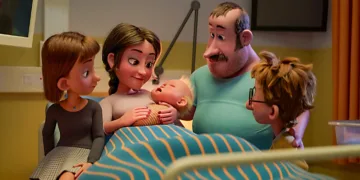
This structure is shattered by the arrival of an interloper, the infant Charlie. The camera frames Willie in wider shots, suddenly smaller in rooms he once dominated, the soft lighting of his former life giving way to compositions where he is pushed to the periphery.
The family unit, once his anchor, becomes a closed circuit of attention from which he is excluded. Then comes the revelation. The baby is not merely a usurper; it is a vessel of inexplicable power. In a classic noir turn, this existential threat becomes a dark opportunity. Willie sees not a brother but an instrument, a raw, amoral force he can leverage to reclaim his own narrative.
The Tyranny of the Innocent
The film’s psychological engine is Willie’s dethronement, a quiet tragedy of perceived obsolescence. His jealousy is rendered not as a simple tantrum but as a profound crisis of identity, the first recognition that his place in the world is not guaranteed. We witness his attempts to “train” Charlie, a perverse form of pedagogy where heroic ideals are twisted into a script for personal gain.
This dark mentorship explores a chilling dialectic of power: Willie has the intellect and intent, but Charlie possesses the raw, untamed force. Charlie’s innocence becomes its own form of tyranny. He is an unwitting despot whose biological needs and random bursts of power dictate the family’s reality, bending the world to his whims without any understanding of the consequences. His very presence dismantles the household’s established order.
This dynamic finds its petrified form in the film’s antagonists, Inferio and Anton. Their relationship is a case study in what happens when this fraternal pathology is allowed to fester for decades, ossifying into a rigid hierarchy of master and servant. They are the ghost of Willie and Charlie’s future, a grim forecast of where the exploitation of power can lead.
The film wisely anchors our perspective to Willie’s compromised subjectivity. It is through his eyes that we experience the injustice, formulate the morally dubious plan, and grapple with the consequences. The audience is made complicit in his struggle for relevance, a journey far more unsettling and relatable than the phenomenology of being a telekinetic baby.
An Unsettlingly Bright Noir
Visually, the film offers a fascinating contradiction, functioning as a kind of brightly lit noir. Its world is saturated with the cheerful, uncomplicated palette of a candy store, a visual scheme that stands in stark opposition to the protagonist’s simmering dread. This choice acts as a deliberate subversion, a placid surface that barely conceals the psychological turmoil beneath.

Even in the brightest domestic scenes, the cinematography employs subtle noir techniques. Characters are frequently framed within doorways or against windowpanes, their bodies segmented by architectural lines, creating visual prisons within the seemingly safe home environment.
The digital animation carries a peculiar texture, a faint, almost subliminal stutter that recalls stop-motion. This haptic dissonance prevents full immersion, a constant, low-grade reminder of the world’s artificiality.
The film’s most explicit nod to its psychological underpinnings is a brilliant sequence invoking German Expressionism. Figures on a superhero poster are not merely animated; they erupt from the flat plane into the three-dimensional space of Willie’s bedroom. This Brechtian irruption is a literal projection of his fractured psyche, a visual analog to the splintered sets of The Cabinet of Dr. Caligari.
The heroic figure and his sidekick are framed as warring parts of his consciousness, their stark, two-dimensional forms a perfect representation of a mind reduced to a simple, desperate moral equation. Compared to this moment of genuine invention, the requisite superhero spectacle, with its floating trucks and laser beams, feels almost obligatory.
The Anxious Object of Children’s Cinema
The film’s narrative architecture suffers from a significant structural schism. It is torn between two distinct modes of storytelling: the intimate, psychologically dense family drama and the formulaic, externalized conflict of the superhero plot.

The editing cross-cuts between Willie’s quiet desperation and the villains’ loud machinations, but instead of creating a compounding tension, the strategy often diffuses the energy of both threads. The emotional weight of Willie’s dilemma is lightened each time we cut away to a scene of cartoon villainy, and the villains’ threat never feels fully imminent because we are repeatedly pulled back into the domestic sphere. This bifurcation leaves the narrative feeling stretched and, at times, tonally incoherent.
The intended recipient of this bifurcated object is the young viewer, who is subjected to a peculiar manipulation of perception. The film oscillates between presenting a relatable emotional problem and offering spectacular, consequence-free action. It never fully commits to the emotional depths of its premise, nor does it provide the pure escapism of a simpler adventure.
The result is a state of mild narrative limbo. It is a competently assembled artifact, a piece of cinematic flat-pack furniture that follows its instructions to the letter. It functions as a delivery system for its core ideas, successfully introducing complex notions of envy and ethical compromise to an audience still mastering basic arithmetic. It tells its story effectively, yet its refusal to resolve its own internal contradictions makes it a far more anxious and interesting object than it might initially appear.
Super Charlie is an animated family adventure film based on the popular children’s book series by Camilla Läckberg. The film follows 10-year-old Wille, whose dreams of superheroics are challenged by the arrival of his baby brother, Charlie, who turns out to have actual superpowers. The movie premiered in Swedish theaters in December 2024 and is being released in several European markets throughout 2025. It was released in UK and Irish cinemas on August 15, 2025. The film is available on JustWatch which lists Netflix, Amazon Prime Video, and Amazon Video among the top 5 providers, although availability may vary by region.
Full Credits
Director: Jon Holmberg
Writers: Jon Holmberg, Camilla Läckberg
Producers & Executive Producers: Gustav Oldén, Anders Mastrup, Christian Ryltenius, Karsten Kiilerich, Camilla Läckberg, Anna Croneman, Charlotta Denward, Michael Ekblad, Anne Kokbøl Jørgensen, Rasmus Krogh, Calle Marthin, Julie Lærke Mossling, Joakim Rang Strand, Henrik Zein
Cast: Orlando Wahlsteen, Silas Strand, Sven Björklund, Ulla Skoog, Tuva Novotny, Johan Rödin, Lucy Smith, Alex Kelly, Paul Tylak, Brendan McDonald
Editors: Rickard Krantz, David Nordén, Hans Perk
Composer: Jonas Wikstrand
The Review
Super Charlie
Super Charlie presents a compelling paradox. It is a children's film by design, yet it operates with the thematic core of a domestic psychological thriller. Its narrative structure is fractured, torn between a nuanced character study and a generic villain plot. However, its visual intelligence and surprisingly sharp analysis of sibling obsolescence make it a far more fascinating artifact than its cheerful surface suggests. It is an anxious, inventive, and unexpectedly complex piece of animation that says more through its compositions than its dialogue.
PROS
- A visually inventive style that employs sophisticated framing and a unique 2D animation sequence.
- A complex and psychologically deep exploration of sibling rivalry and jealousy.
- The protagonist's emotional journey provides a relatable and compelling core.
- Successfully creates a distinct mood that contrasts its bright colors with darker themes.
CONS
- A divided narrative structure that creates tonal inconsistency and uneven pacing.
- The conventional villain storyline feels underdeveloped and distracts from the stronger family drama.
- The film's momentum often drags due to juggling too many disparate plot elements.
- It may lack the straightforward humor and emotional catharsis many expect from family animation.