

























The small German town of Sangerhausen exists in a state of quiet contradiction. It is a place of quaint historical buildings and picturesque landscapes, yet it is perpetually watched over by an enormous slag-heap from its mining past, a man-made mountain of industrial residue.
This is the setting for Julian Radlmaier’s Phantoms of July, a film that explores a different kind of residue: the persistent human feeling of longing. The original German title translates to “Longing in Sangerhausen,” and that sense of Sehnsucht for another life or a deeper connection infuses every frame.
Radlmaier constructs a gentle, absurdist fable that drifts between time periods and realities. The story follows a handful of the town’s inhabitants, each navigating their own distinct dissatisfaction with a blend of melancholic humor and dreamlike whimsy.
Portraits in Patience
The film resists a conventional narrative drive, opting instead for a patient, chapter-based structure that introduces its players as separate, orbiting satellites of loneliness. This storytelling choice is a deliberate risk; the slow tempo asks the viewer to invest in mood over plot, a demand that may test some.

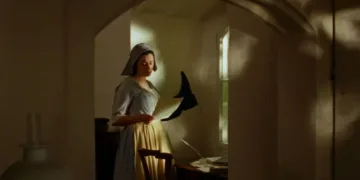
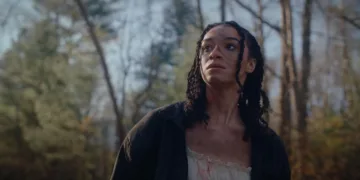
The story begins in the 18th century with Lotte (Paula Schindler), a maid whose dreams of escape from drudgery provide a historical echo for the modern characters’ anxieties. We then meet Ursula (Clara Schwinning), a woman in present-day Sangerhausen whose life is a cycle of thankless jobs. Schwinning’s performance is a study in quiet desperation, capturing a fatigue that is both physical and spiritual.
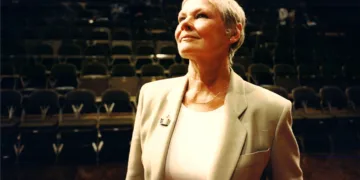
Her world is briefly electrified by an encounter with a visiting musician, Zulima, a phantom-like figure who represents a different, freer existence before vanishing. The film also introduces Neda (Maral Keshavarz), an Iranian refugee attempting to build a life as a travel influencer.
Keshavarz portrays her with a blend of resilience and vulnerability, her broken arm a physical manifestation of her precarious situation. These lives are established with care, moving at a deliberate pace. The structure ensures that when their paths finally converge, orchestrated partly by a Korean tour guide named Song-nam (Kyung-Taek Lie) and his minibus, the union feels earned instead of engineered.
A Painterly Critique
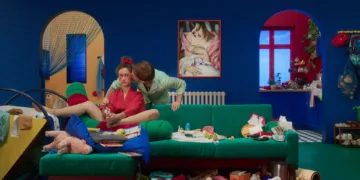
Director Julian Radlmaier constructs his film with a meticulous, almost painterly style that allows him to layer social critique within a whimsical frame. Faraz Fesharaki’s cinematography, shot on 16mm film, gives the images a timeless, grainy texture that softens the edges of a harsh reality.
The opening scenes with Lotte feel like Vermeer paintings brought to life, creating a visual link between past and present struggles. This formal elegance is playfully undercut by touches of the absurd. A herd of camels appears without explanation, and a pair of naked ramblers stroll through a scene with an accordion.
These surreal flourishes serve a specific narrative function, providing a dryly humorous counterpoint to the film’s serious undercurrents while perhaps reflecting the characters’ own mental escapes. We hear right-wing populist rhetoric on the radio, a choice that frames this ideology as ambient, insidious background noise in daily life.
A recurring blue stone, found by different women across the eras, acts as a physical link and a symbol of a deeper, unspoken desire for transcendence. Even the landscape becomes mystical, with Toru Takemitsu’s flute piece ‘Air’ transforming the slag-heap from an industrial scar into a place of strange mystery. The film’s commentary is therefore delivered not through direct statements, but through its carefully composed atmosphere.
The Solidarity of Strangers
After spending much of its runtime cultivating isolation, the film’s final act finds its power in convergence. The disparate threads following Ursula, Neda, and Song-nam are finally woven together, and the characters form an unlikely, impromptu community.
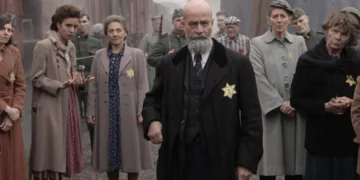
Radlmaier leans into coincidence, using Song-nam’s tour bus as a narrative device that feels appropriate within the story’s fable-like logic. Here, the “phantoms” of the title reveal their broader meaning. They are the ghosts of the past that haunt the nearby mountains, the half-formed connections like Ursula’s, and the spectral nature of hope itself in a difficult world.
The film wisely avoids offering grand solutions to the systemic issues it raises; it does not pretend that xenophobia or economic hardship can be easily fixed. Instead, it proposes a smaller, more achievable form of grace: the empathy found between strangers.
Phantoms of July is a peculiar and moving work that fits into a growing trend of films that prioritize atmosphere over plot. It suggests that in a world propagating division, the most meaningful act of resistance might be the simple, unplanned formation of a friendship, a small pocket of harmony against a hostile backdrop.
Phantoms of July is a German drama-comedy film that premiered in 2025 and was invited to the Locarno Film Festival’s International Competition. It has also been showcased at the Sarajevo Film Festival. Produced by Blue Monticola Film GmbH, the movie is a blend of drama and comedy, telling the story of an East German waitress and an Iranian YouTuber who embark on a ghost hunt in the mountains.
Full Credits
Director: Julian Radlmaier
Writers: Julian Radlmaier
Producers and Executive Producers: Julian Radlmaier, Kirill Krasovski
Cast: Clara Schwinning, Maral Keshavarz, Henriette Confurius, Paula Schindler, Ghazal Shojaei, Kyung-Taek Lie
Director of Photography (Cinematographer): Markus Koob
Editors: Magdolna Richter, Julian Radlmaier
The Review
Phantoms of July
Phantoms of July is a patient and beautifully crafted fable that rewards a viewer's investment. Its slow, episodic structure may deter those seeking a strong plot, but its gentle humor, painterly visuals, and heartfelt examination of loneliness make for a strange and moving cinematic experience. The film finds its ultimate strength not in grand statements, but in its quiet, optimistic belief in the power of human connection to pierce through modern alienation. It is a thoughtful, if meandering, piece of filmmaking.
PROS
- The 16mm visuals create a timeless, painterly quality that is consistently beautiful.
- The film offers a nuanced exploration of loneliness, longing, and the challenges of class and immigration.
- A unique tone is successfully established, blending dry, absurdist humor with gentle melancholy.
- The cast delivers grounded and believable portrayals of quiet desperation and hope.
CONS
- The narrative moves at a very relaxed tempo, which could feel meandering or inaccessible to some viewers.
- The focus on character vignettes and mood comes at the expense of a strong, driving plot.
- Some of the surreal or symbolic aspects, like the blue stone, remain ambiguous.