


























The documentary North South Man Woman opens a window into a peculiar cottage industry born from geopolitical fracture: a matchmaking agency in Seoul that pairs South Korean men with female defectors from the North. Our guide is the agency’s founder, Yujin Han, a defector herself whose pragmatic determination grounds the entire film. Her business, Lovestorya, caters to a collision of fantasies.
The southern men arrive seeking partners they imagine to be unspoiled by capitalism, describing them with an otherworldly reverence as “like fairies.” The northern women, having risked everything for freedom, hope to find traditional, gentlemanly providers who can offer the stability they have never known.
The film immediately establishes its central inquiry, examining what happens when these carefully constructed romantic ideals are tested by the friction of daily life and deep-seated cultural differences. It sets a course to explore the human heart’s search for connection against a backdrop of immense political tragedy.
The Reality of Cross-Border Relationships
The film probes the domestic lives of its subjects, revealing that the reality of marriage is far from any fairytale. Yujin’s own relationship with her South Korean husband, Yurok, is a central study in contrasting energies. As she builds a small empire, juggling her matchmaking service with a guesthouse and a winter business making bean paste, he appears content to cultivate a minor following as a YouTuber.
The camera captures his charming but passive demeanor, which creates an unspoken friction with his wife’s relentless drive. A similar dynamic appears with Hyoju and Jaewu. Their playful arguments often reveal his genuine bafflement at her assertive nature and her visible frustration with his more relaxed worldview.
His surprise at her directness points to a cultural gap; her unfiltered communication was forged by survival, while his expectations were shaped in a more traditionally patriarchal society. This pattern subverts the initial premise of the matchmaking.
The North Korean women, far from seeking a simple life as homemakers, emerge as the resilient economic and emotional anchors of their families. This reflects a narrative seen in contemporary global cinema, including many Indian web series exploring urban relationships, where female economic empowerment forces a renegotiation of traditional marriage roles.
Balancing Present Lives with Past Traumas
The documentary masterfully handles its sharp tonal shifts, moving from the light comedy of domestic life to the grim realities of the women’s pasts. These stories of escape, trafficking through China, and immense family loss are often recounted with a startling, matter-of-fact calmness.

This understated delivery, a common feature in cinema that respects the gravity of trauma, makes their testimony immensely powerful. The directors wisely avoid sensationalism, letting the weight of these experiences settle through quiet observation. This psychological burden finds expression in a recurring visual motif: small, wedding-cake-style dolls are placed in symbolic peril, dwarfed by a rushing train or a torrent of water.
This artistic choice acts as a potent metaphor for their past fragility and the lingering shadows of their history. The film grounds these metaphors in stark reality, opening with a funeral for a defector who failed to adapt and later showing the women shouting across the sea toward the families they left behind.
Yujin’s stated disinterest in dwelling on the past feels less like denial and more like a necessary survival strategy. It is resilience shown not as the absence of pain, but as the relentless forward motion required to build a new life on the foundations of a shattered one.
A Portrait of Connection and Division
Directors Morten Traavik and Sun Kim construct their narrative with a dynamic, almost restless energy that mirrors their subjects’ lives. The editing in the early stages feels quick and choppy, perhaps reflecting the disorienting process of cultural assimilation.
As the women become more settled, the film’s pacing calms, allowing for longer scenes of intimate testimony. Traavik’s position as a Norwegian filmmaker offers an “amused outsider” perspective that captures the quirks of the situation with an even-handed lens.
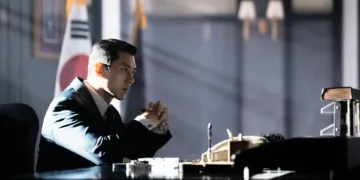
The directors’ most clever device is the inclusion of clips from a classic 1993 North Korean romantic comedy, Urban Girl Comes to Get Married. This state-approved fantasy of simple, rustic love serves as a constant, ironic counterpoint to the messy and complicated relationships on screen.
Seeing the idealized on-screen courtship rituals of the past juxtaposed with the real-life financial arguments of the present creates a powerful commentary on the gap between propaganda and lived experience. North South Man Woman presents a deeply human perspective on a conflict often reduced to headlines. It leaves the viewer contemplating the intricate ways love, money, and trauma are intertwined in the search for a stable life.
North South Man Woman is a documentary that premiered at the Sheffield DocFest on June 20, 2025. The film is a co-production between Norway’s Remont Films, Latvia’s VFS Films, and South Korea’s Mirror & Story. It chronicles the journey of Yujin Han, a North Korean defector who runs a matchmaking agency in South Korea that pairs female refugees from the North with South Korean men.
Full Credits
Director: Morten Traavik, Sun Kim
Writers: Morten Traavik, Sun Kim
Producers and Executive Producers: Verona Meier, Anna Krasztev-Kovacs, Uldis Cekulis, Gary Byung-seok Kam
Cast: Yujin Han, Hyoju Han, Jaewu Jeong
Director of Photography (Cinematographer): Valdis Celmiņš, Jānis Šēnbergs
Editors: Gatis Belogrudovs, Uģis Olte
Composer: Eric Vapnargard
The Review
North South Man Woman
North South Man Woman is an insightful and deeply human documentary that looks beyond political posturing to examine the messy reality of love, marriage, and survival. It succeeds by focusing on the incredible resilience of its female subjects, whose ambition and strength challenge every stereotype. While its outsider perspective and rapid pacing can sometimes create distance, the film's blend of humor, heartbreak, and clever filmmaking provides a memorable look at how personal lives are irrevocably shaped by national division. It is a powerful story about rebuilding a life from the ground up.
PROS
- Offers an intimate and humanizing look at a complex geopolitical conflict.
- Highlights the agency and resilience of the North Korean female defectors.
- Effectively uses archival footage and visual symbolism to add depth.
- Balances humorous everyday situations with serious subject matter.
CONS
- The fast-paced editing may feel jarring to some viewers.
- Sudden shifts in tone can be abrupt.
- The directorial perspective sometimes feels like that of an observer rather than an insider.