
























![Kingdom Hearts Collection [I-III] Review](https://gazettely.com/wp-content/uploads/2026/10/Kingdom-Hearts-Collection-I-III-1-360x180.webp "Kingdom Hearts Collection [I-III] Review: KHII Holds Steady as Newer Entries Fluctuate 37")




Six films have taught audiences far too much about a place that was frightening because nobody understood it. The Further once functioned like a dark spiritual blank, a realm barely mapped by the living and populated by entities whose motives felt unknowable. Insidious: Out of the Further inherits a different version. There are classifications, abilities, recurring guides, crossing procedures and supernatural loopholes. Mystery has slowly become infrastructure.
That problem hangs over writer-director Jacob Chase’s film from its earliest scenes. The Lambert family, whose story appeared finished in Insidious: The Red Door, is absent. Chase instead follows Gemma (Amelia Eve), a dental hygienist raising her nine-year-old daughter Maya (Island Austin) in the same house where Gemma experienced the defining horror of her childhood.
The prologue establishes that history with unusual force. A young Gemma watches her mother succumb to terrifying behavior before repeatedly smashing her head against a shower wall. Chase stages the death without the theatrical pleasure usually attached to an Insidious scare. The scene resembles domestic catastrophe, an event a child cannot process and therefore carries forward as damaged memory.
Twenty years later, Gemma has built her adulthood around avoiding repetition. She hides the truth of her mother’s death from Maya, encourages her daughter’s eccentric habits and works hard to provide the emotional safety she never had. Then the nightmares begin. Strange elderly figures appear around the neighborhood. Gemma discovers that sleep takes her into the Further, and that returning home can bring unwanted passengers with her.
The new idea has genuine promise. Gemma is a “Courier,” capable of transporting entities across the border separating the dead from the living. The franchise finally turns its famous red doorway into a two-way problem. The difficulty is that Out of the Further introduces this possibility after five films have already made crossing dimensions look alarmingly routine.
Mothers, Daughters and Inherited Fear
The strongest writing stays close to Gemma and Maya, where supernatural inheritance mirrors the less exotic ways fear passes between generations. Gemma remembers her mother as unstable, neglectful and frightening. Her adult life has been shaped by refusing that identity. When Maya builds enclosed tunnels from couch cushions, Gemma indulges her imagination.
When the girl becomes frightened, Gemma tries to remain composed. Amelia Eve makes the effort visible. Watch the moments where Gemma holds a reassuring expression slightly too long, as though calmness has become another domestic chore she refuses to neglect.
That performance gives the film a useful tension once Gemma’s nightmares intensify. She begins behaving in ways that echo the mother she has spent years trying to escape. From Maya’s position, the distinction between supernatural persecution and parental instability barely matters. A frightened child experiences the behavior first and its explanation later.
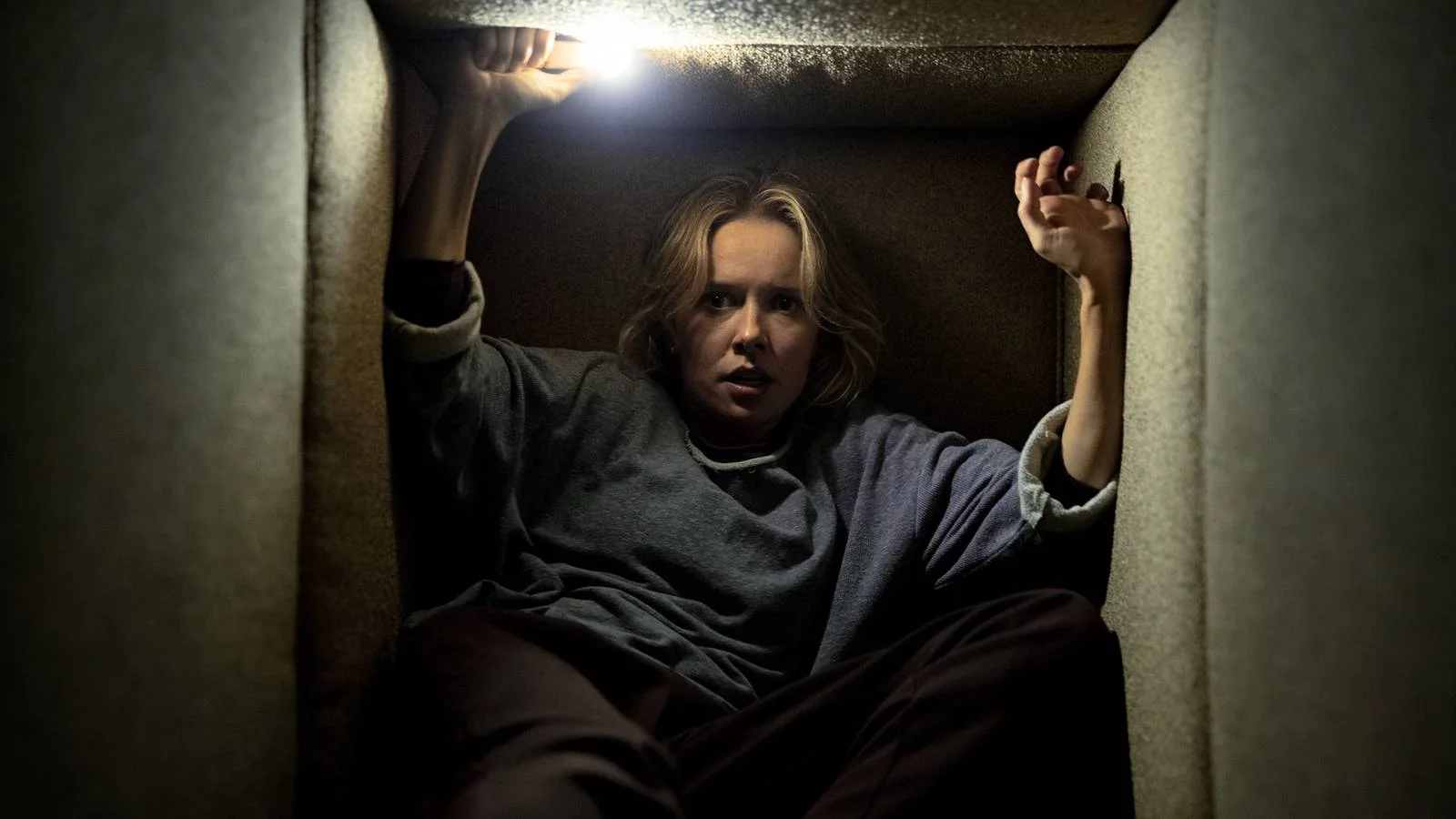
Island Austin plays Maya without turning precociousness into a collection of cute reactions. Her attachment to homemade crawl spaces becomes particularly valuable because Chase later weaponizes it. The familiar cushion fort expands inside the Further into a network of thin beige corridors, stripping a childhood refuge of its safety. The sequence works through scale and spatial confusion. Soft furniture becomes architecture. The route back disappears. Maya’s imagination, previously encouraged by Gemma, suddenly looks like another opening through which terror can enter.
Brandon Perea has a quieter function as Nick, Gemma’s supportive police-officer boyfriend. He sensibly suggests leaving the house once Gemma’s condition worsens. Horror characters are rarely rewarded for proposing the obvious. Here, his solution would fail anyway. Gemma carries the haunting with her. That distinction gives the film one of its sharper ideas about family trauma. Houses can be sold. Memories are less cooperative.
The later revelation that Gemma’s mother faced similar supernatural forces changes the meaning of the opening without erasing its brutality. The mother Gemma judged as a child becomes legible as another woman crushed by forces she could neither name nor explain. It is one of the screenplay’s few expansions of Insidious mythology that deepens a character rather than merely preparing another franchise rule.
Teeth, Cushions and Better Nightmares
Chase is far stronger at constructing isolated horror sequences than servicing the mythology connecting them. The dental appointment is the clearest example. One of the sinister elderly figures sits in Gemma’s chair with a mouth full of decaying teeth, food residue and something worse. Gemma begins cleaning. Chase keeps the camera close enough to make every scrape uncomfortable. Then she starts pulling a long strand of hair from beneath a rotting molar.
It is disgusting. It is also specific, which counts for a great deal in a franchise increasingly dependent on familiar darkness. Gemma’s profession stops being biographical decoration and becomes a source of horror. The scene reverses the usual dental nightmare too. She has the tools, the light and the professional authority, while the patient controls the encounter. The balance shifts without requiring a complicated piece of lore.
The pillow-fort sequence works for similar reasons. Chase understands that a recognisable domestic object can become frightening through alteration rather than replacement. The cushions stretch into airless corridors. Sound drops away. Joseph Bishara’s score, often associated with the series’ aggressive musical shocks, retreats long enough for the confined space to produce its own pressure. Those moments point toward the film Out of the Further might have been: smaller, stranger and rooted in Gemma’s specific life.
Too often, Chase returns to the franchise’s standard vocabulary. A figure crosses the background. A light reveals somebody standing where nobody stood seconds earlier. Fog gathers across the floor. A character approaches darkness. The soundtrack prepares the audience for impact.
David Garbett’s cinematography and Nick Bassett’s production design remain polished, yet the Further has suffered from repetition. Its black expanses and mist once suggested that the human world had ended and something unknowable had begun. Here, the realm can resemble a black-box stage waiting for the next performer in elaborate makeup.
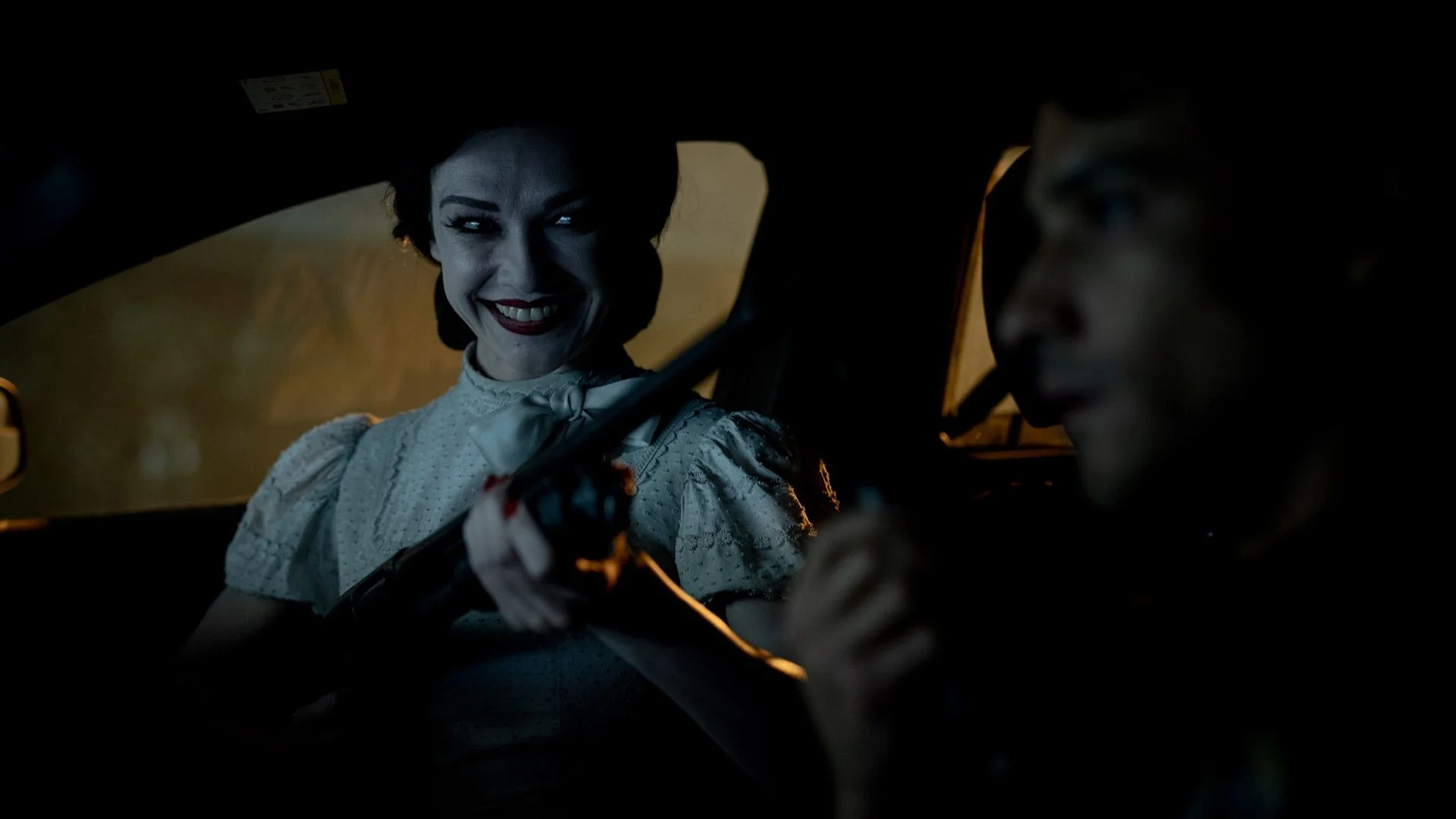
The makeup artists have at least given those performers character. The elderly Acolytes possess the exaggerated decay of figures from old nightmare illustrations, their faces sitting somewhere between human age and theatrical decomposition. Their physical presence frequently proves creepier than the digital spectacle waiting later.
Elise and the Franchise Machine
Lin Shaye remains the franchise’s most valuable recurring presence, which raises an awkward industrial question: how long can a horror series depend on a character it killed in its first film?
Elise Rainier once gave Insidious its eccentric warmth. Shaye could explain astral projection, confront demons and move through ridiculous material with such calm conviction that the mythology acquired a strange emotional credibility. Death has barely interrupted her employment.
Here, Elise patrols the Further with her lantern and assists Gemma from the other side. Shaye still brings the same unforced authority, particularly when Elise treats supernatural danger like unpleasant work that somebody has to do. Yet her return also exposes the film’s reluctance to release any piece of recognisable franchise identity.
Maisie Richardson-Sellers enters as Claire, a tattoo artist and medium who can communicate with Elise through an elaborate process involving headphones and physical restraint. She occupies some of the narrative territory previously held by Specs and Tucker, though the comic chemistry of those characters has disappeared.
Claire’s strangest contribution involves explaining Elise’s plan through tattooed citrus fruit. The sequence seems designed to turn supernatural mechanics into an accessible visual aid and instead becomes a perfect miniature of the franchise’s current condition. When a mythology requires marked grapefruits to make the rules clearer, the rules may have won.
Then there is Cyrus, played by Sam Spruell, a deceased cult leader seeking passage into the living world with his followers. A trio of Acolytes stalks Gemma’s neighborhood, converting suburban normality into something resembling an occupied territory. Spruell gives Cyrus an appropriately poisonous presence, yet the character remains less interesting than the concept surrounding him. A dead cult leader trying to colonise reality should carry disturbing implications about authority surviving its own destruction. The screenplay mostly needs him to organize the third act.
This is where the Courier idea begins producing the same burden that weakened earlier sequels. Every solution requires another explanation. Every explanation creates another exception. The Further has become a bureaucracy with fog.
A Franchise Haunted by Itself
The first Insidious arrived with the scrappy confidence of filmmakers rediscovering how much could be done with a house, a few grotesque faces and an absurd metaphysical idea played completely straight. James Wan and Leigh Whannell drew from haunted-house cinema, astral projection stories and the cheerful ghost-hunting machinery of Poltergeist and Ghostbusters. Its silliness helped the fear.
Out of the Further treats much of the same material with heavier seriousness. Chase occasionally finds the old playfulness in a dental chair, an expanding pillow fort or Elise clobbering supernatural trouble with her lantern. Those sparks are surrounded by a story working very hard to preserve franchise continuity while pretending to begin again.
Removing Patrick Wilson’s Josh Lambert and Rose Byrne’s Renai gives Gemma and Maya room to exist without becoming extensions of another family’s story. The pair deserves that space. Their relationship also suggests a workable future for the series, particularly if Gemma’s Courier ability remains tied to parenthood, memory and inherited fear rather than becoming another supernatural gadget.
The larger franchise question is harder to solve. Returning spirits, Elise’s intervention, the red doorway and brief reminders of earlier monsters keep pulling the film backward. The series wants new protagonists while retaining every recognisable piece of its mythology. Horror franchises often reach this stage, where continuity stops being history and becomes inventory.
The crowded climax makes that tension visible. The threat finally spills toward the physical world, entities run loose, plans are improvised and the clean emotional line between Gemma and Maya competes with supernatural logistics. The sequence is louder than the cushion maze and larger than the dental encounter. It is also less frightening.
The film has already shown where its remaining life sits. It is in Gemma staring into a stranger’s ruined mouth. It is in Maya crawling through a fort that refuses to end. It is in a daughter discovering that the mother she feared may have been frightened too. The Further itself no longer needs another rule. It needs to become unknowable again.
Insidious: Out of the Further was released theatrically on August 21, 2026, by Sony Pictures Releasing. The supernatural horror entry follows a young mother who discovers she can travel into the purgatorial realm known as The Further and possesses the unique capability to bring its entities back into the physical world.
Where to Watch Insidious: Out of the Further (2026) Online



Full Credits
Title: Insidious: Out of the Further
Distributor: Sony Pictures Releasing
Release date: August 21, 2026
Rating: PG-13
Running time: 1 hour 46 minutes
Director: Jacob Chase
Writers: Jacob Chase, David Leslie Johnson-McGoldrick, Leigh Whannell
Producers and Executive Producers: Jason Blum, Oren Peli, James Wan, Leigh Whannell, Steven Schneider, Ryan Turek, Brian Kavanaugh-Jones
Cast: Amelia Eve, Brandon Perea, Maisie Richardson-Sellers, Lin Shaye, Sam Spruell, Island Austin, Laura Gordon
Director of Photography (Cinematographer): Dave Garbett
Editors: Gregory Plotkin
Composer: Joseph Bishara
The Review
Insidious: Out of the Further
Insidious: Out of the Further finds its best horror whenever Jacob Chase escapes the franchise handbook. Maya’s expanding pillow fort, Gemma scraping hair from a patient’s rotten molar, and the brutal childhood prologue have a tactile ugliness the Further itself has gradually lost. Gemma and Maya give the film an emotional foothold, while Amelia Eve brings real fear to the idea of inherited damage. Yet six films of accumulating supernatural rules have transformed mystery into administration. Lin Shaye still lends Elise warmth, but even she cannot make every new doorway feel necessary.
PROS
- Excellent pillow-fort sequence
- Disturbing dental body horror
- Strong Gemma-Maya relationship
- Amelia Eve’s grounded performance
- Lin Shaye remains magnetic
CONS
- Increasingly convoluted mythology
- Familiar jump-scare rhythms
- Underdeveloped Cyrus
- Cluttered final act
- The Further has lost its mystery







