


















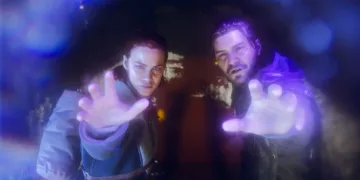



Some films present a problem to be solved. Michael Yammine’s Reset presents a condition to be endured. Its protagonist is Lucas, a man so thoroughly hollowed out by loss he is practically a silhouette. We meet him after his daughter has been taken by some unknowable, otherworldly power, an event that has fractured his reality into a nightmare state.
He is no longer in his world, but in a surreal dimension where he must battle a monstrous foe to get her back. This is not a simple rescue mission. It is a desperate, looping ordeal against an enemy that may be from the stars or from the deepest part of his own psyche. The premise establishes a situation less about heroic action and more about the sheer, grinding persistence required to exist when existence itself has become a torment.
Grief as a Hostile Dimension
Science fiction has always been a useful laboratory for externalizing internal states, from the body horror of Cronenberg to the temporal paradoxes of Nolan. Reset firmly places itself in this tradition, using the machinery of genre to map the impossible landscape of sorrow.
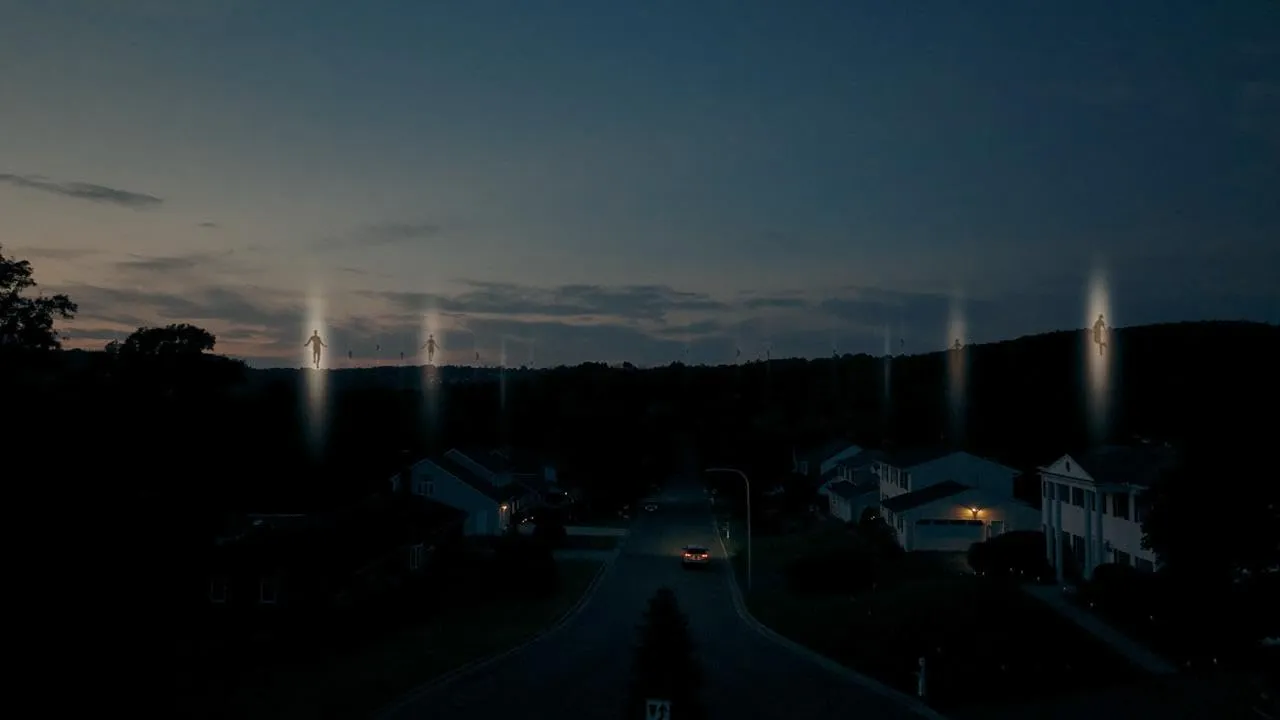
The film’s central conceit, a repeating loop of torment, is a brutally effective metaphor for the way grief traps the mind, forcing it to endlessly relive its trauma. This is not just a plot device; it is the film’s entire philosophical engine.
Lucas is stuck, and the film’s strange physics—its distortions of time and the hostile emptiness of its primary location—are merely the objective correlative of his fractured mental landscape.
In an age of unprocessed collective trauma, where societies seem doomed to repeat historical errors, Lucas’s personal hell feels uncomfortably familiar. He is a man caught in a feedback loop, a perfect symbol for a culture that often prefers to replay its tragedies rather than move past them.
The monstrous entity he battles feels less like a simple antagonist and more like a psychic antibody, a grief-golem, born from his own obsession and pain. Is it an alien invader, or is it the shape of his own inability to let go, given horrifying form?
The film wisely refuses to give a simple answer. Yammine’s direction skillfully walks this tightrope, keeping the human drama from being consumed by the high-concept mechanics. The sci-fi hijinks make the bleakness watchable, turning a story of profound suffering into a tense, thought-provoking puzzle box where the solution might be to simply stop trying to solve it.
One Man’s Face Against the Void
A film this reliant on atmosphere and metaphor would drift into abstraction without a human anchor. Adam Holley, as Lucas, is that anchor. He is the ballast that keeps the entire enterprise grounded in painful reality. His performance is a raw nerve of desperation and obsessive focus, conveying a man pushed far past any conventional breaking point.

It is a deeply physical portrayal; you see the toll of the fight and the repetition not just in his eyes but in the slump of his shoulders and the exhaustion in his movements. In a looping narrative, the actor’s greatest challenge is to show change within stasis. Holley excels here, subtly altering Lucas’s approach with each new cycle, moving from terror to tactical resolve to utter despair and back again. Without his conviction, the film would be a collection of fascinating ideas. With him, it becomes a devastating character study.
The supporting cast functions with grim efficiency, their primary role being to sharpen the focus on Lucas’s isolation. A local waitress, pulled into his nightmare, is especially effective. She serves as an audience surrogate, her understandable terror acting as a baseline of sanity against which we can measure how far Lucas has traveled from the normal world.
She is what happens when an ordinary person stumbles into an existential abyss. Her presence highlights that Lucas is not just visiting this hell; he lives there now. The ensemble’s strong work ensures these secondary figures feel like more than simple plot devices; they are fellow ghosts in a shared purgatory.
Cosmic Horror on a Shoestring
Let’s be frank: most independent films with this level of conceptual ambition look cheap, their ideas betrayed by their budget. Reset does not have this problem. There is an impressive, almost jarring level of technical polish here.

This is not merely a well-shot film; it is a meticulously designed aesthetic experience. The cinematography uses a muted color palette and disorienting angles to create a genuinely unnerving and dreamlike mood, visually communicating the protagonist’s internal state. The production values are absurdly high, especially the special effects.
The creature design is a triumph of visceral, tangible horror, a grotesque thing of flesh and fury that feels threateningly real. When it is damaged, the effect is gruesome and impactful, a far cry from the weightless digital monsters that populate many blockbusters.
Yammine achieves a sense of immense, cosmic scale while working within what appears to be a mostly contained location. This constraint becomes a strength, turning the familiar fields and farmhouses into a psychological prison.
The terror comes not from the unknown but from the horribly, endlessly known. This achievement makes Reset a quiet manifesto for resourceful filmmaking. It is a powerful counter-narrative to the bloated excess of modern studio pictures, arguing that the most unsettling universes are not built with billions of dollars, but with a singular vision, a committed cast, and the courage to stare directly into the abyss.
Reset is a science fiction horror film directed by Michael Yammine, released on digital platforms and Video On Demand (VOD) on August 12, 2025. It is available to rent or purchase on platforms like Amazon Prime Video, Apple TV, and Fandango at Home.
Full Credits
Director: Michael Yammine
Writers: Michael Yammine
Producers: Michael Yammine
Cast: Adam Holley, Caitlin Westfall, Lorelai Brown, Tim O’Hearn, Reese Ravencraft
The Review
Reset
Reset is a demanding, intelligent piece of science fiction horror. It uses its high-concept premise not for empty spectacle, but as a chillingly effective metaphor for the inescapable loops of grief. Anchored by a harrowing lead performance from Adam Holley and crafted with a visual polish that belies its independent origins, the film is a thought-provoking and deeply unnerving exploration of loss. It is a puzzle box with a human heart beating bleakly at its center.
PROS
- An intelligent script that uses genre tropes to explore profound themes of loss and obsession.
- A powerful, physically and emotionally demanding lead performance from Adam Holley.
- Exceptionally high production values, including impressive creature effects and atmospheric cinematography, for an independent film.
- Skillful direction that balances abstract ideas with tense, human drama.
CONS
- The narrative’s bleak tone and intense emotional focus may be too draining for some viewers.
- Its abstract, looping structure could frustrate those seeking a more conventional plot.
- Supporting characters are intentionally secondary, serving more as thematic functions than fully developed individuals.