

























![Kingdom Hearts Collection [I-III] Review](https://gazettely.com/wp-content/uploads/2026/10/Kingdom-Hearts-Collection-I-III-1-360x180.webp "Kingdom Hearts Collection [I-III] Review: KHII Holds Steady as Newer Entries Fluctuate 37")





Springsteen: Deliver Me From Nowhere rejects the familiar architecture of the music biopic. It is not a grand survey of a legendary career. The film instead offers a spare, concentrated examination of Bruce Springsteen during a pivotal moment of crisis. The year is 1981, and after the triumphant The River tour, he stands at the precipice of global fame.
Instead of taking the leap, he pulls back. The story depicts an artist exhausted, overwhelmed by the machinery of stardom, and sinking into a deep depression. It reframes a cultural icon as a man haunted by his past, using his forced solitude in his native New Jersey to create the stark album Nebraska. The film operates as a psychological study, where the creation of a record becomes a lens into a fracturing mind.
The Lo-Fi Manifesto
The creative process depicted is one of profound isolation. Springsteen secludes himself in a rented house in Colts Neck, a self-imposed exile that becomes an incubator for his bleakest work. His influences are telling; he immerses himself in the dark Americana of Terrence Malick’s film Badlands and the gothic stories of Flannery O’Connor.
These works, with their focus on outcasts and morally ambiguous figures adrift in a harsh landscape, provide a direct thematic line to the characters he begins to write about. The film carefully documents the technical means of this creation: a simple four-track TEAC cassette recorder. This choice of a lo-fi medium is a quiet rebellion against the polished, expansive sound expected of a rock star.
It is a deliberate limitation, an artistic choice to favor immediacy over perfection, echoing similar movements in global cinema where filmmakers used minimal equipment to capture a more authentic reality. The resulting demos are raw and unvarnished, a quality lost when he attempts to re-record them with the full E Street Band in a sterile studio. The film presents the making of Nebraska as an act of personal necessity, an involuntary catharsis that placed artistic truth above commercial appeal and studio polish.
The Performance of Interiority
Jeremy Allen White’s portrayal of Springsteen is a masterful work of evocation, not imitation. He captures the singer’s internal state through a constrained, tormented physicality. His hunched shoulders, downcast eyes, and hesitant speech convey a man weighed down by an invisible burden, deconstructing the energetic public persona for a global audience unfamiliar with the icon.

It is a performance centered on vulnerability. The supporting cast provides the external pressures and anchors for his turmoil. Jeremy Strong plays Jon Landau as a fiercely protective manager, a figure of paternal concern who must mediate between the fragile artist and the corporate demands of the record label. His anxiety is palpable as he champions a work he knows is commercial poison.
Odessa Young appears as Faye, a composite romantic interest whose presence underscores Springsteen’s profound emotional unavailability. Their scenes are marked by a poignant sense of missed connection. In stark black-and-white flashbacks, Stephen Graham delivers a haunting performance as Springsteen’s father. These sequences are not mere backstory; they are intrusive, fragmented visions that interrupt the present, showing how childhood trauma functions as a persistent and disruptive force in adult life.
The Grammar of Despair
Director Scott Cooper’s filmmaking mirrors the album at the story’s center. The film’s tone is consistently somber and deliberate, avoiding dramatic crescendos for a sustained mood of quiet introspection that aligns with traditions in contemplative world cinema.
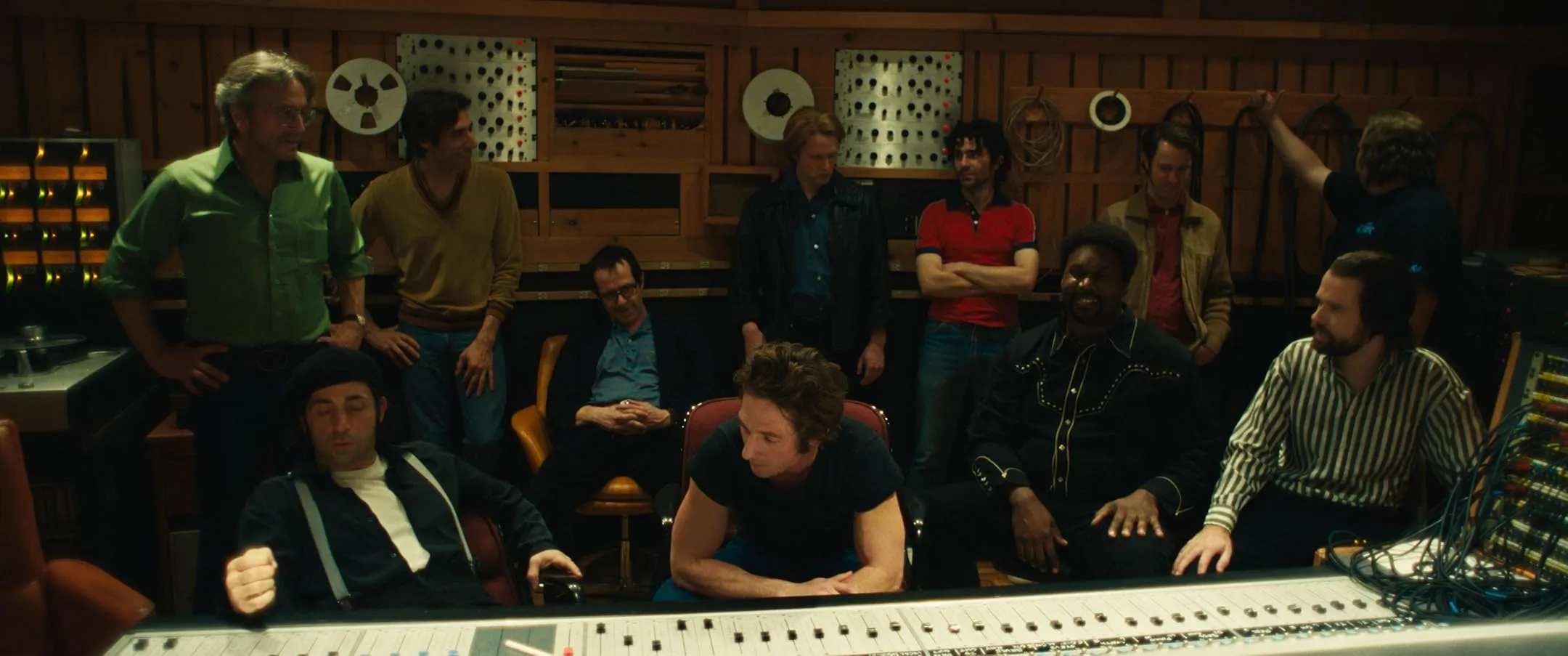
The visual language reinforces this, with the naturalistic, muted color palette of the present-day scenes creating a feeling of oppressive stillness. This contrasts sharply with the high-contrast black-and-white of the flashbacks, which gives those painful memories a startling and unwelcome clarity.
The sound design is particularly effective, weaving Springsteen’s nervous tics and sharp intakes of breath into the audio landscape to create a sense of psychological claustrophobia. Silence is used as a tool, deepening the sense of isolation. This bleak, quiet approach is the film’s core argument; its form perfectly reflects the raw, unpolished spirit of the Nebraska recordings.
By focusing on a fragile human being instead of a rock god, the movie transforms a specific chapter of American music history into a universal statement on the difficult, often painful, relationship between art and survival. The album becomes an act of exorcism, a necessary step for personal preservation.
Springsteen: Deliver Me From Nowhere is a biographical drama film about Bruce Springsteen’s 1982 album, Nebraska. The film premiered at the Telluride Film Festival on August 29, 2025. It is scheduled for a theatrical release in the United States on October 24, 2025. It will be released for streaming on Disney+ at a later date, and possibly other platforms like Netflix and Amazon Prime Video.
Full Credits
Director: Scott Cooper
Writers: Scott Cooper, Warren Zanes
Producers and Executive Producers: Scott Cooper, Ellen Goldsmith-Vein, Eric Robinson, Scott Stuber (Producers), Tracey Landon, Jon F. Vein, Warren Zanes (Executive Producers)
Cast: Jeremy Allen White, Jeremy Strong, Paul Walter Hauser, Stephen Graham, Odessa Young, David Krumholtz, Gaby Hoffmann, Marc Maron, Grace Gummer, Matthew Pellicano, Harrison Sloan Gilbertson, Johnny Cannizzaro
Director of Photography (Cinematographer): Masanobu Takayanagi
Editors: Pamela Martin
Composer: Jeremiah Fraites
The Review
Springsteen: Deliver Me From Nowhere
A stark and moving portrait, Springsteen: Deliver Me From Nowhere is a successful anti-biopic. It trades the genre’s typical bombast for a quiet, piercing look at a man’s confrontation with his own demons. Anchored by Jeremy Allen White’s deeply internalized performance and Scott Cooper’s restrained direction, the film finds a universal story of artistic survival within a specific, dark chapter of American music. It’s a somber, challenging film that thoughtfully mirrors the raw, unpolished spirit of the album it depicts, rewarding viewers with its psychological depth and solemn integrity.
PROS
- A powerful and nuanced lead performance from Jeremy Allen White.
- The focused narrative intelligently avoids standard biopic clichés.
- Atmospheric direction and cinematography that perfectly match the film's somber tone.
- A deep, resonant exploration of depression, trauma, and the creative process.
CONS
- Its deliberate, slow pacing may feel stagnant to some viewers.
- The relentlessly bleak mood can be emotionally demanding.
- Fans seeking a celebration of Springsteen's stage persona will find little of it here.







