























![Kingdom Hearts Collection [I-III] Review](https://gazettely.com/wp-content/uploads/2026/10/Kingdom-Hearts-Collection-I-III-1-360x180.webp "Kingdom Hearts Collection [I-III] Review: KHII Holds Steady as Newer Entries Fluctuate 37")





There is a specific feeling that comes with reading an R. L. Stine book for the first time. It is a safe kind of scare, a spooky adventure designed to thrill without causing actual nightmares. Goosebumps: Terror in Little Creek attempts to capture that exact feeling. The game drops you into a new story set within that familiar world. We find ourselves in the small town of Little Creek, a place silenced by a strict curfew.
Whispers of monster sightings have put everyone on edge. You play as Sloane Spencer, a curious girl who, along with her friends, cannot resist a good mystery. They decide the only way to get answers is to break the rules and explore the town after dark. Their adventure begins with a simple question about the curfew, but they soon discover the monster stories are very real.
A Town of Locked Doors and Slow Feet
The rhythm of Terror in Little Creek quickly settles into a predictable, almost comfortable loop. Your time is divided between the quiet, cerebral work of exploration and the sudden, heart-thumping demands of stealth. One moment, you are examining a strange marking on a church wall; the next, you are diving behind a hedge as a grotesque creature shuffles past.
This shift between contemplation and reaction forms the game’s core structure. The town of Little Creek is presented not as an open world, but as an intricate puzzle box. Its design philosophy feels reminiscent of early survival horror titles, where progress is measured in newly acquired keys and unlocked doors. At the start, your path is tightly controlled, funneling you from the library to the graveyard, teaching you the basic mechanics of interaction.
Soon, with a pair of bolt cutters in hand, a previously impassable gate swings open, and the map expands. This slow unfurling of the environment provides a steady sense of accomplishment. Each new key or tool feels like a tangible victory, granting access to the theater or the museum, places that were previously just names on a map.
The puzzles themselves are rooted in a familiar logic. They rarely demand abstract leaps of thought, focusing instead on careful observation and using the right item in the right place. You might find a series of coins that need to be placed on a gargoyle in a specific order, a sequence hinted at by a note found earlier. Another challenge involves rotating statues to align them, revealing a hidden number needed for a combination lock.
The satisfaction comes from that simple click of understanding, of seeing how the pieces fit together. To flesh out the world, you can find old newspapers and diary entries that offer slivers of backstory about the town’s curse, building a sense of history and dread.
A magic spellbook introduces another layer of interaction. After finding symbols hidden in the world, you trace their patterns in your book to cast spells, effectively turning the magic system into another form of key for specific environmental locks. This approach keeps the challenges grounded and accessible, preventing the frustration that more obtuse puzzles can create.
This deliberate design, however, is undercut by a critical issue with pacing. Your character’s movement, whether walking or running, is noticeably slow. When the solution to a puzzle requires an item from the other side of town, the journey back can feel like a chore. The game asks you to backtrack through the same streets and alleys repeatedly. What was once a tense exploration of a monster-filled area becomes a mundane commute on the third or fourth pass.
This robs the environment of its menace and can stall the narrative’s momentum, turning a thrilling investigation into a series of errands. The game’s structure also has a habit of showing you locked doors and unsolvable puzzles long before you have the means to interact with them. While this can encourage mental note-taking, it more often leads to confusion, as you spend time trying to solve a puzzle that is, for the moment, impossible. These elements combine to create friction in the experience, weighing down an otherwise engaging adventure with moments of tedious repetition.
Slingshots Against the Shadows
When you are not poring over cryptic notes, you are avoiding the town’s monstrous residents. The game’s approach to stealth is simple and direct. Enemy creatures patrol defined routes, and your goal is to stay out of their line of sight. Designated hiding spots, like trash bins and overturned tables, offer perfect immunity. As long as you are hidden, you are safe.

The experience of holding your breath while a creature’s shadow passes over your hiding spot can be effective, relying on sound design and claustrophobic camera angles to build a palpable sense of dread. These moments channel the vulnerability that is essential to the horror genre. You feel weak, hunted, and entirely dependent on your wits to survive.
The game gives you tools to manage these encounters without direct confrontation. A slingshot can be used to fire noisemakers, drawing a creature’s attention to a specific spot so you can slip past unnoticed. Smoke pellets can create a screen for a quick escape. These mechanics support the stealth fantasy, empowering the player through cleverness rather than strength.
This carefully constructed tension, however, is almost immediately dismantled by another function of the slingshot. You have access to an infinite supply of basic pebbles, and these pebbles do damage. It does not take long to realize that you can stand your ground and chip away at a monster’s health until it dissolves. The creatures are not particularly aggressive or fast, so kiting them around an object while peppering them with stones becomes a viable, and often optimal, strategy.
This single design choice fundamentally alters the emotional texture of the game. The core feeling of horror, that of powerlessness, evaporates. You are no longer prey; you are a hunter with unlimited ammunition. The game’s attempt to be a stealth horror experience is in direct conflict with a mechanic that encourages action. The developers seem aware of this, as enemies have a surprisingly large amount of health, but this only makes the brute-force method more tedious, not less tempting.
The majority of the standard monsters you encounter are not very bright. Their patrol patterns are simple, and their awareness is limited. It is often possible to walk just behind them without being detected. This makes many stealth sections feel less like a dangerous puzzle and more like a waiting game. The experience changes dramatically when one of the three main “title monsters” appears. These encounters are scripted set pieces that function like boss battles.
The music swells, the stakes are raised, and your opponent is faster and more perceptive. The Phantom or the Mummy will actively hunt you, forcing you to run, hide, and use your tools under pressure. In these moments, the game recaptures its sense of threat. You are no longer casually dispatching foes; you are scrambling for survival. These sequences provide welcome spikes of intensity and are where the game’s horror ambitions are most fully realized, creating memorable climaxes for each major section of the narrative.
Reader Beware, You’re in for a Treat
Terror in Little Creek is a fascinating exercise in translation, adapting the specific tone of a book series for an interactive medium. It successfully creates a “kid-friendly” horror atmosphere, a delicate balance that is difficult to achieve.
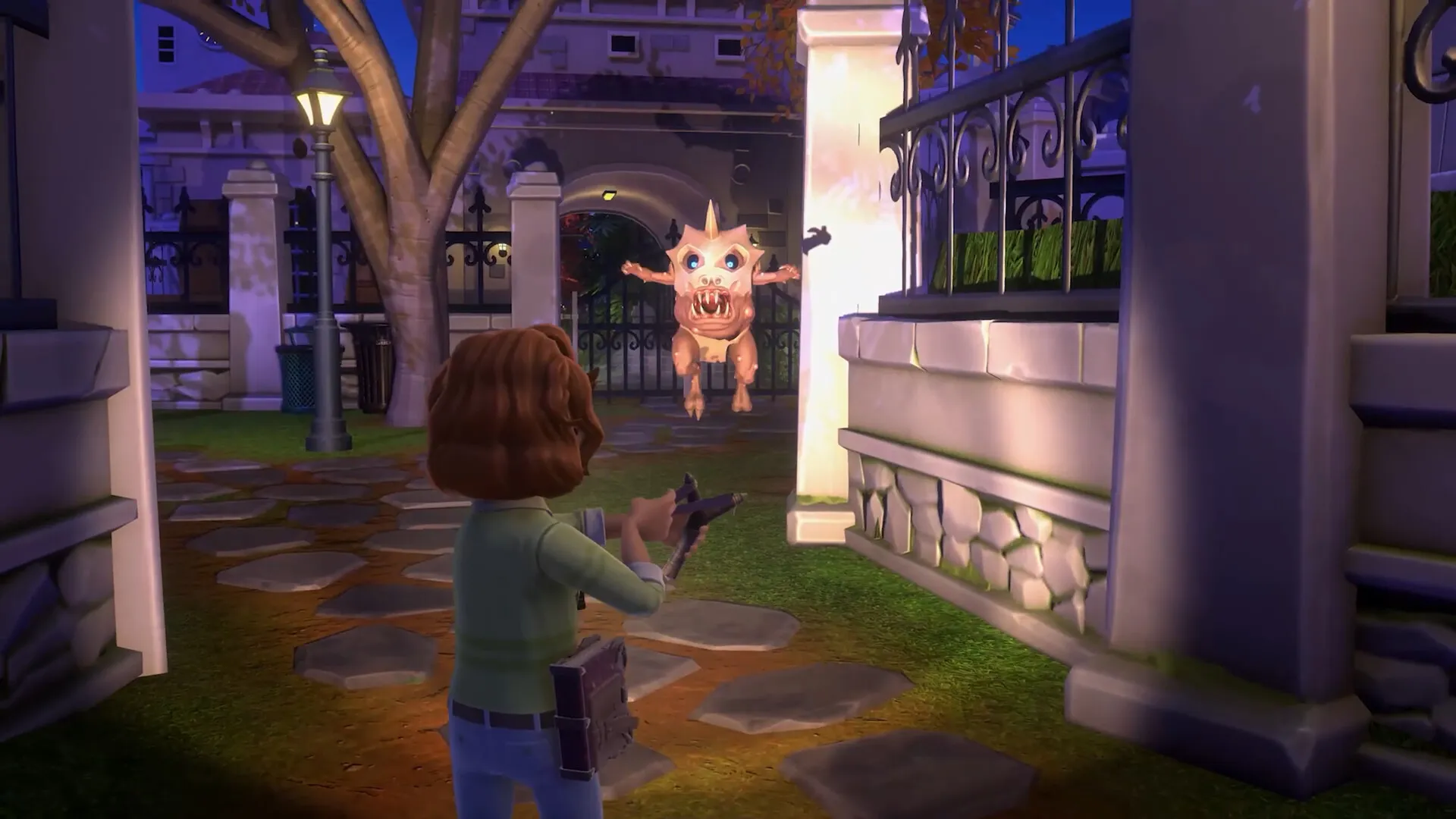
The goal is to be spooky, not traumatizing. The game accomplishes this by keeping its monster designs somewhat cartoonish and its themes focused on mystery and adventure over genuine peril. It shares a creative space with works like the film Coraline or the television show Gravity Falls, media that introduces younger audiences to horror conventions in a controlled way.
The lighthearted and often funny dialogue between Sloane and her friends is a key part of this balancing act. Their presence provides a constant source of companionship, preventing the player from feeling true isolation, which is a common tool for building fear in more mature horror games. Their banter serves to ground the supernatural events, making the whole experience feel like a group of kids on an exciting, if scary, escapade.
The game is built for two distinct audiences, and it serves both quite well. For younger players, it is a thrilling adventure and a perfect introduction to the mechanics of survival horror without the genre’s usual intensity. The simple puzzles and forgiving combat system ensure that they can see the story through without hitting a wall of difficulty.
For adults, the game is a powerful dose of nostalgia. It feels like playing through a lost Goosebumps book from childhood. The aesthetic, the character archetypes, and the story structure all evoke the feeling of turning those familiar paperback pages.
The short five-hour playtime is a strength in this regard. It mirrors the brevity of the books themselves, delivering a complete and satisfying narrative arc without demanding a huge time investment. It is a focused experience that tells its story and then ends, a refreshing change from many modern games.
Ultimately, the game is a charming product with noticeable quirks. The conflict between its stealth and combat systems is a significant design flaw, and the slow pacing caused by backtracking can test one’s patience. Yet these issues do not completely derail the experience.
The game succeeds because it understands its purpose. It set out to be a playable Goosebumps story, and it has achieved that goal with confidence. The adventure is engaging, the town is fun to explore, and the story is filled with the kind of lighthearted spookiness that made the series a cultural touchstone. It even sticks the landing with a classic R. L. Stine twist ending, a final narrative wink that leaves you with a shiver and a smile. It is an earnest and heartfelt tribute to its source material.
The Review
Goosebumps: Terror in Little Creek
Goosebumps: Terror in Little Creek is a heartfelt and charming adventure that brilliantly captures the spooky-fun spirit of its source material. It serves as a perfect entry-level horror game for younger audiences and a wonderful nostalgic trip for longtime fans. The experience is held back by slow character movement that makes backtracking tedious and a combat system that unfortunately undermines the game's own stealth-based tension. It is a successful tribute whose mechanical flaws keep it from being truly great, but it delivers on its promise of a playable R. L. Stine story.
PROS
- Perfectly captures the authentic Goosebumps atmosphere.
- Charming story and character interactions.
- Accessible puzzles and stealth for younger players.
- Serves as a great piece of nostalgia for fans.
CONS
- Very slow character movement and tedious backtracking.
- Combat system feels at odds with the horror elements.
- Simplistic AI for standard enemies.
- Pacing can feel frustratingly slow.