








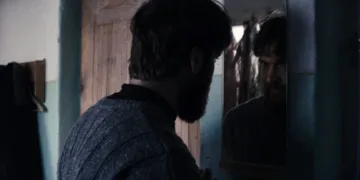












A life can become a closed room, its doors sealed by the slow accumulation of years. Ed Saxberger, played by Willem Dafoe, inhabits such a space. His days are measured by the rhythms of the postal service, a quiet, orderly existence in a Manhattan that has forgotten his name.
Decades ago, in a city of grit and frantic energy, he was a poet. His book, Way Past Go, was a brief flare in the downtown literary scene of the 1970s before it was extinguished by the practical demands of living. That life is a ghost story he no longer tells.
The film begins when a young man, Meyers, materializes on his street corner, speaking of Ed’s forgotten book as if it were a sacred text. Ed, a man who has made peace with his own anonymity, is suddenly confronted by the phantom of his youth, summoned back into a world he thought had vanished forever. The past re-emerges not as a gentle memory, but as a disquieting presence.
The Curators of Ruin
Meyers belongs to a circle calling themselves “The Enthusiasm Society,” a collection of privileged, aspiring artists who fetishize a past they never knew. They perform their seriousness, calling each other by surnames and scorning the digital ephemera of their peers from the comfort of parent-funded apartments.
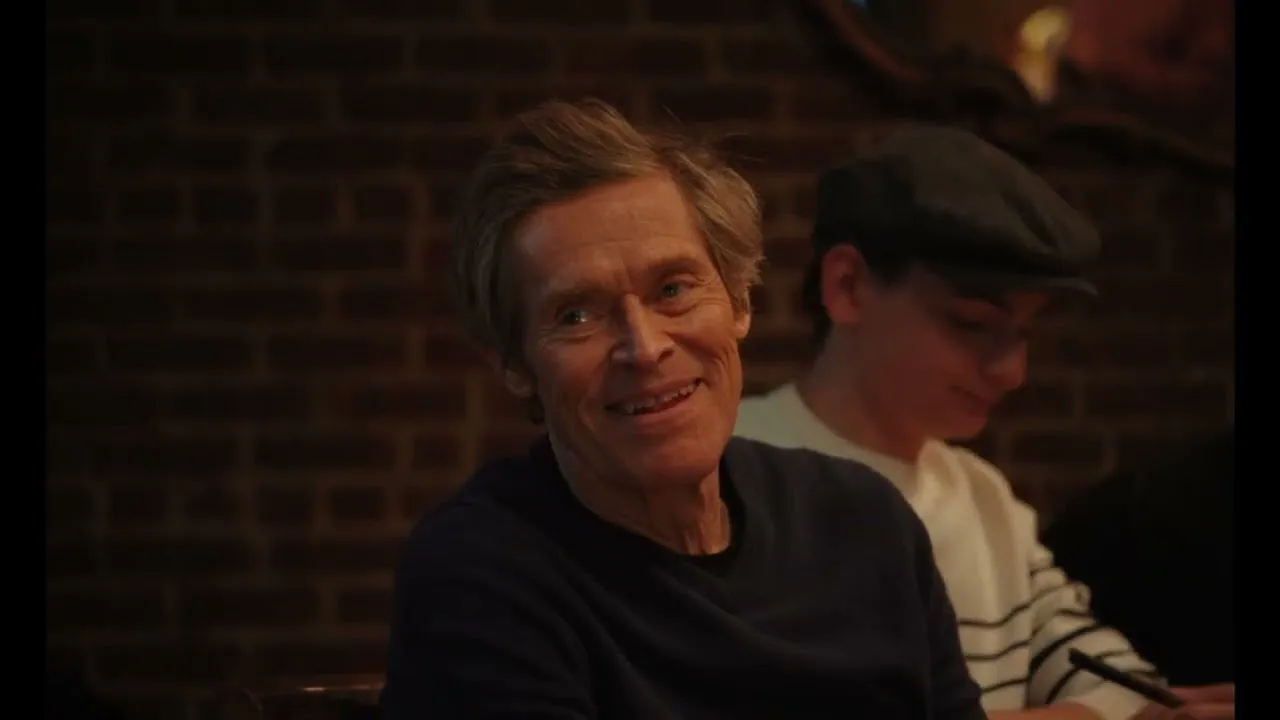
Their passion for art is a curated aesthetic, a way of being in the world that they have adopted without understanding its cost. Meyers himself, played by Edmund Donovan, is a specimen of formal sincerity, a young man who speaks in precise, declarative sentences about the sanctity of language. He sees Ed as a holy relic, a figure of pure authenticity to be revered.
Herein lies the film’s quiet, devastating tension. Ed is the artifact of a struggle the Society can only simulate. His life was shaped by necessity; theirs is shaped by choice. Their reverence for him is a kind of high-minded vampirism, an attempt to absorb the substance of a life they can only appreciate as style.
Masks of Flesh and Spirit
The film’s soul resides in two figures locked in different orbits of performance. Willem Dafoe gives Ed a face etched with the topography of a long, quiet life. His expressions register the slow, geologic shift within a man confronting a self he had buried.

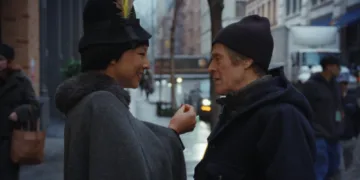
The flattery he receives is mixed with a deep, weary caution. It is not the simple joy of rediscovery, but the painful exhumation of a former being. Opposite him is Greta Lee’s Gloria, an actress whose entire existence feels like a piece of theater. She is a magnetic, flamboyant creature, both desperate and defiant.
She understands the transactional nature of the artistic world in a way her younger companions do not. Her electrifying performance of “Surabaya Johnny” in a dive bar is a moment of terrifying honesty, the raw pain of a life lived on the edge breaking through the polished artifice.
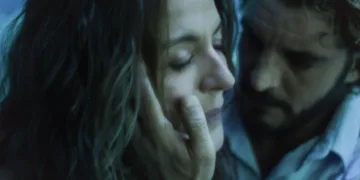
Ed and Gloria are kindred spirits, not in romance, but in their shared recognition of the masks they wear. They are two survivors who wordlessly acknowledge the exhausting performance of survival itself.
The City as Palimpsest
Kent Jones directs with the patient gaze of an archeologist. His camera is not merely an observer; it feels like an instrument of excavation, brushing away the dust of the present to reveal the bones of the past. The New York City of the film is a palimpsest, where the raw, black and white footage of Ed’s youth bleeds through the clean, moneyed surfaces of contemporary SoHo.
The city is a living graveyard of memory and capital. The film explores the unnerving question of what art becomes when it is detached from the conditions that created it. Can a work born of poverty and struggle be truly understood by a generation defined by privilege?
Ed’s journey is circular. He passes through this strange revival only to return to the quietude of his former life. His retreat is not a failure, but a choice. He affirms the reality he has constructed for himself over the illusion offered to him. The film leaves us with a bittersweet meditation on what remains when the echoes of an old life finally fade.
Late Fame is a 2025 American drama film directed by Kent Jones. It had its world premiere in the Orizzonti section of the 82nd Venice International Film Festival on August 30, 2025, and is also scheduled to screen at the 2025 New York Film Festival. Netflix has scheduled a theatrical release for October 17, 2025, in the US, before the film becomes available on the streaming platform approximately three weeks later. The runtime for the movie is 96 minutes.
Full Credits
Director: Kent Jones
Writers: Samy Burch, Arthur Schnitzler
Producers and Executive Producers: Pamela Koffler, Christine Vachon, Mason Plotts, Danny Roberts, H.S. Naji, Jackie Langelier, Ethan Lazar, Taylor Shung, Martin Scorsese (Executive Producer), Kyle Owens (Executive Producer), Austen Rydell (Executive Producer), Billie Lourd (Executive Producer), Naia Cucukov (Executive Producer)
Cast: Willem Dafoe, Greta Lee, Edmund Donovan, Jake Lacy, Clark Johnson, Tony Torn, Graham Campbell, Sandra Hüller
Director of Photography (Cinematographer): Wyatt Garfield
Editors: Mike Selemon
Composer: Don Fleming
The Review
Late Fame
Late Fame is a quiet, intelligent, and deeply humane film that meditates on the ghosts of art and self. It is a character study of profound depth, anchored by masterful performances from Dafoe and Lee. While its contemplative pace may not suit all viewers, it offers a beautifully rendered portrait of a man confronting the echoes of a life he left behind, questioning what is authentic in a world obsessed with performance. It is a rare film that trusts silence as much as dialogue to convey its bittersweet wisdom.
PROS
- Willem Dafoe's subtle and deeply felt lead performance.
- A magnetic, complex supporting turn from Greta Lee.
- Kent Jones's patient and observant direction.
- A thoughtful, layered exploration of authenticity, memory, and art.
- The evocative depiction of New York City as a site of constant change.
CONS
- Its meditative, quiet pace may feel uneventful for some viewers.
- The focus on character over plot might leave those seeking a strong narrative arc wanting.
- The satire of the younger generation, while effective, could feel underdeveloped in its final moments.