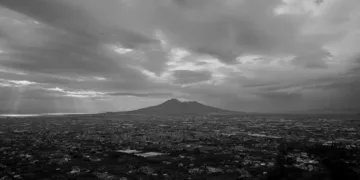















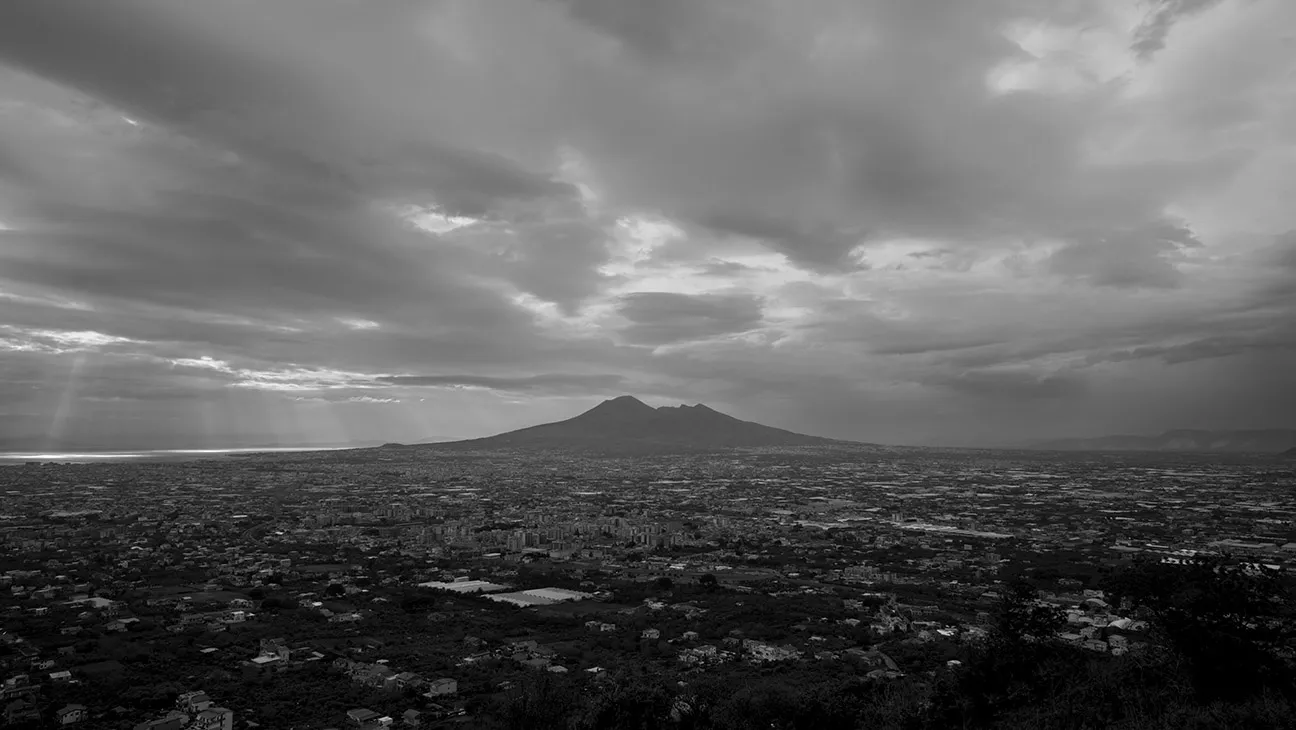

“Vesuvius makes all the clouds in the world,” Jean Cocteau once remarked, and in Gianfranco Rosi’s documentary Below The Clouds, this is less a poetic flourish than a statement of atmospheric fact. The film introduces a Naples drained of its postcard effervescence, rendered in a severe, high-contrast monochrome that feels less like a choice and more like a premonition.
This is not the city of sun-drenched chaos found in countless crime dramas or romantic escapades. It is a purgatorial space, a city of ghosts where the living seem to be temporary tenants. The past is not buried here; it is simply the lower level of the present, its foundations exposed and crumbling.
The ever-present cone of Vesuvius looms, a quiet, brooding landlord over the entire region. Its physical dominance translates into a deep psychological weight, a kind of suspended sentence hanging over every inhabitant. Rosi’s method is one of patient, almost forensic observation.
He offers no narration, no guiding interviews, just a sequence of carefully framed vignettes. This approach can be described as a form of cinematic pointillism. Individual dots of experience—a shard of pottery, a panicked phone call—only resolve into a coherent image when viewed from a distance. The film presents its evidence and trusts its audience to assemble the mosaic. For those accustomed to having a story explained to them, this might feel like work. It is.
Chronological Vertigo
The film’s central preoccupation is a kind of temporal collapse, a state of chronological vertigo where millennia separating events feel tissue-thin. History here is not a linear progression; it is a layered geological dig, and Rosi’s camera is the archaeologist’s brush.
We witness the excavations at Pompeii, where plaster casts of the dead from 79 A.D. serve as history’s most grim statues. These are not just artifacts; they are a public performance of death, an eternal tableau of the moment a city was frozen. What does it mean for a modern society to live adjacent to such a perfect monument of its own potential annihilation?
This meticulous preservation is set against its grubby inverse: the tombaroli, or tomb robbers. Firefighters navigate the illicit tunnels these thieves have dug, a grimy art market wormhole burrowed beneath civilization. Their actions are a form of anti-archaeology, a deliberate privatization of the collective past for profit. In a moment of profound visual poetry, Rosi captures Ukrainian grain pouring into the cavernous hold of a cargo ship.
The cascade of life-giving material, arriving from the besieged port of Odessa, disturbingly mimics the volcanic ash that once brought death. The cycle of creation and destruction is now globalized, linking an ancient catastrophe with a modern one. This sense of living history is found in the museum’s storeroom, where a lone curator speaks to centuries-old statues as if they are colleagues. Her whispered conversations are a rejection of the idea that these objects are inert. For her, they are the city’s true residents, and the living are merely temporary guests.
Answering the Apocalypse Hotline
If the past provides the film’s bass note, the present is a frantic, anxious melody played out in the city’s emergency call center. This sterile office, with its incessant beeping and the weary, steady voices of its operators, is the modern Naples’s nervous system. The calls create a composite sketch of humanity in all its absurdity.
The operators are the unflappable confessors of a secular city, fielding harrowing reports of domestic violence and arson alongside panicked fears of an earthquake tremor. Then, without missing a beat, they placate a lonely old man who calls repeatedly just to ask for the time. The sequence is a startling reminder that while the city fears a grand, geological violence from Vesuvius, a more intimate, human violence happens daily behind closed doors. The volcano is a hypothetical threat; a person’s rage is immediate.
The film then offers a masterclass in perspective by turning its gaze to the Syrian sailors aboard the grain ship. Their quiet discussions of war in their homeland, and the new one they sail toward in Ukraine, reframe the local dread. Their lived experience with immediate, man-made destruction makes the Neapolitans’ fear of the volcano feel like a kind of existential luxury.
Their calm is not resignation but a professional adaptation to constant peril. Rosi places their quiet dignity next to the city’s ambient anxiety, and the contrast is deafening. Elsewhere, an elderly teacher reads Les Misérables to a group of children, a small act of cultural preservation that mirrors the work of the archaeologists on a different scale. He is arming them with stories, a fragile defense against the chaos outside.
A Poetic and Spectral Vision
Rosi’s decision to shoot in black and white is the film’s defining artistic stroke, a move that is thematic before it is stylistic. It unifies the disparate elements on screen—ancient stone, modern steel, human skin, falling grain—into a single, ghostly texture.
The monochrome palette is a visual equalizer, preemptively coating the city in a fine layer of ash and making the present look like a memory in the making. His observational style is a form of curatorial filmmaking; he lays out the artifacts but refuses to write the explanatory placards for the exhibit, denying the audience a single, authoritative interpretation.
The score by Daniel Blumberg reinforces this feeling, using geothermal and hydrophone recordings to let the earth itself groan on the soundtrack. The landscape is given a voice, and it is an ominous, ancient one. The film’s most self-aware moment occurs in an abandoned cinema, where scenes from Roberto Rossellini’s Voyage to Italy are projected into the empty dark.
A ghost projecting ghosts to an audience of ghosts. Here, Below The Clouds seems to be meditating on its own form. Cinema is presented as another ruin, an artifact for a future civilization to unearth. Rosi seems to be asking what will remain of our own era. Will our digital streams leave behind any ruins as poignant as a forgotten theater or a plaster cast from Pompeii?
The documentary film Below The Clouds (Italian: Sotto le nuvole) had its world premiere in competition at the 82nd Venice International Film Festival on August 30, 2025, where it was nominated for the Golden Lion. It is scheduled for a theatrical release in Italy on September 18, 2025, distributed by 01 Distribution. The Match Factory holds the international sales rights, and a trailer was released on July 22, 2025.
Full Credits
Director: Gianfranco Rosi
Writers: Gianfranco Rosi, Carmelo Marabello, Marie-Pierre Muller
Producers and Executive Producers: Gianfranco Rosi, Donatella Palermo, Paolo Del Brocco
Director of Photography (Cinematographer): Gianfranco Rosi
Editors: Fabrizio Federico, Joe Bini (editing consultant)
Composer: Daniel Blumberg
The Review
Below The Clouds
Gianfranco Rosi’s Below The Clouds is a masterful, if demanding, piece of observational cinema. It forgoes narrative for a hypnotic and unsettling collage of a city living in the shadow of its own history and potential obliteration. The film is a haunting visual poem that connects ancient catastrophe to modern anxiety, finding profound meaning in the quiet moments that unfold under the volcano's gaze. It is a slow-burn documentary that rewards patient viewers with a deep, spectral vision of a world where time has collapsed.
PROS
- The high-contrast black-and-white visuals create a unique and unforgettable ashen, spectral atmosphere.
- The film masterfully weaves together themes of history, mortality, and modern anxiety without explicit narration.
- The visual and thematic parallels drawn between ancient Pompeii, the modern city, and global conflicts are thought-provoking.
- The use of geothermal and environmental sounds gives the landscape a haunting presence.
CONS
- The slow, observational style and lack of a clear narrative may feel inaccessible or meandering to some viewers.
- The analytical and detached approach creates a powerful mood but offers little in the way of character-driven emotional connection.
- Some of the vignettes feel disconnected, requiring the viewer to do significant interpretive work to link them to the central themes.