















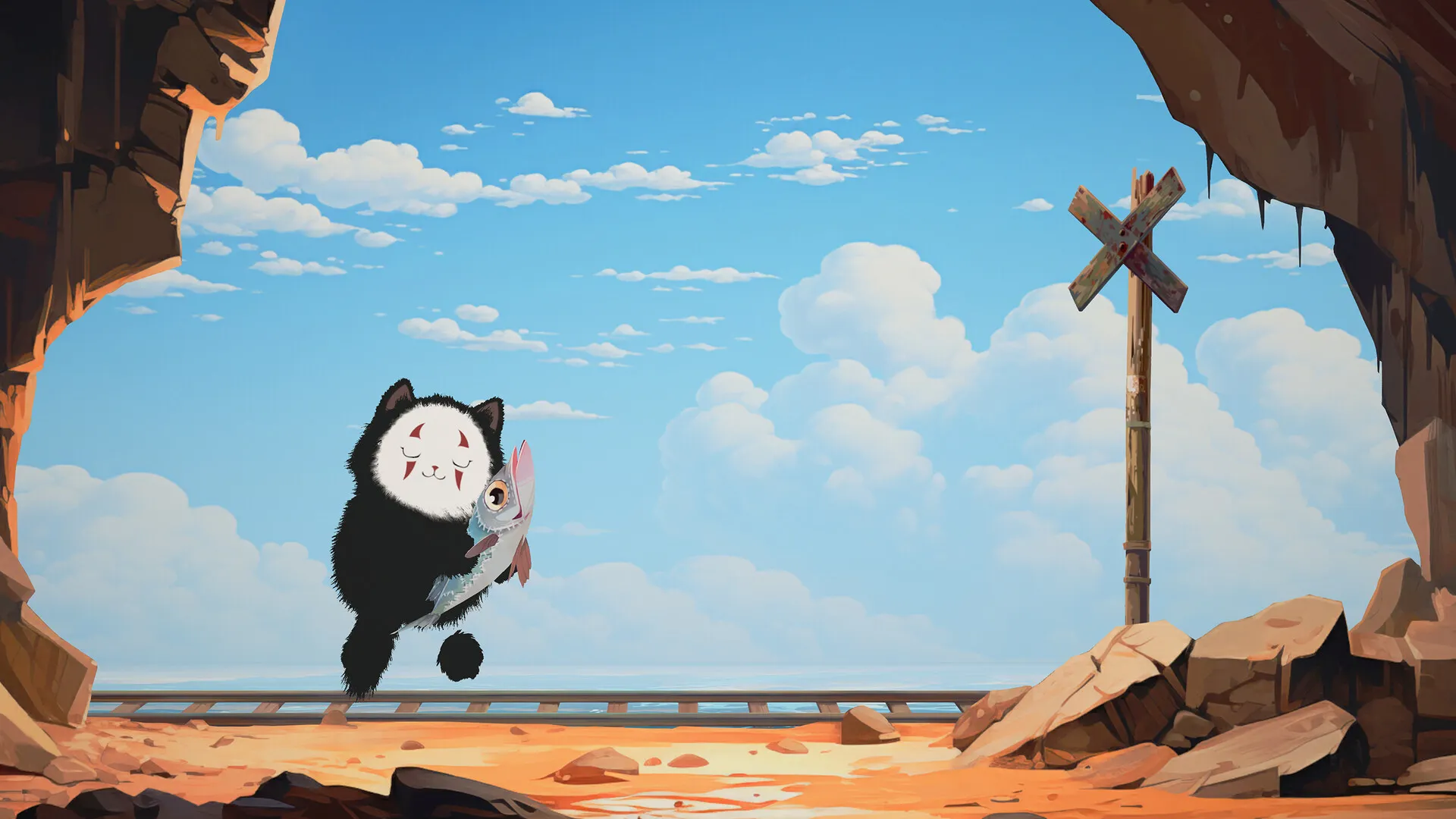

Cloud Cats’ Land opens with a premise found in fables from around the globe: a loyal animal companion separated from its human. We take on the role of a calico cat, adrift after a colossal sea creature attacks the small vessel helmed by its owner, a ship’s captain.
The immediate goal is simple, an objective that transcends cultural storytelling boundaries, which is to find a path to reunion. Thrown onto a mysterious island populated entirely by other felines, the player must guide this cat through a series of challenges.
The game presents itself as a point-and-click adventure, a genre with deep roots in Western game design. Its structure is built on exploration and puzzle-solving. The atmosphere is immediately whimsical, yet an undercurrent of strangeness suggests the journey ahead will operate on its own distinct and peculiar rules. This is not a straightforward tale of survival, but an entry into a world with its own internal logic.
A World of Whimsy and Shadow
The aesthetic of Cloud Cats’ Land feels like an artifact from a culture that has perfected the art of gentle presentation. Its beautifully illustrated, hand-drawn visuals create a tranquil atmosphere that immediately disarms the player. Every screen is a soft, inviting tableau, populated by charmingly designed floating felines whose serene expressions suggest a world free from harm.
This approach aligns the game with the contemporary “cozy games” movement, a design sensibility that has gained global traction as a response to the high-stress, action-oriented mainstream. This genre often prioritizes atmosphere, creativity, and emotional comfort over conflict. The game’s world, with its cozy and dreamlike feeling, certainly invites this kind of relaxed exploration.
This aesthetic has strong echoes of the Japanese concept of kawaii, which is not merely about “cuteness” but also encompasses a tenderness and affection for the small and unassuming. The art seems to tap into this sensibility, creating a powerful sense of place that feels both specific in its execution and universal in its appeal.
The game then skillfully subverts the expectations it builds. The tranquility is broken by the discovery of cryptic notes left behind by the cat’s owner. These handwritten messages, crumpled and water-stained, introduce a narrative of fear and desperation.
They speak of a mystical threat, an unseen horror that haunts the island, transforming the journey from a simple rescue mission into something more akin to a gothic mystery. This juxtaposition of the cozy and the menacing is a sophisticated storytelling technique. It creates a productive tension that elevates the experience beyond simple escapism.
This method is reminiscent of the narrative structure in many of Hayao Miyazaki’s films, where idyllic, natural worlds often harbor ancient dangers or profound sadness. Much like the friendly spirits of My Neighbor Totoro exist alongside the anxieties of parental illness, the cuddly cats of this island coexist with a creeping dread. The visual storytelling reinforces this duality.
The vibrant colors of the flora and the gentle animations of the cats stand in sharp contrast to the decaying remnants of a human presence, such as the splintered wood of the shipwreck or the desperate scrawl of the notes. It suggests a world where human logic and control have been usurped by a more ancient, whimsical, and perhaps more dangerous force.
Puzzles of Absurdity and Insight
The point-and-click adventure genre has a long history, particularly in Western game development, that is defined by a certain kind of logic. Titles from studios like LucasArts or Sierra, for all their humor, were typically grounded in a tangible, if eccentric, cause-and-effect reasoning. A key fits a lock; a tool is used for its intended purpose.
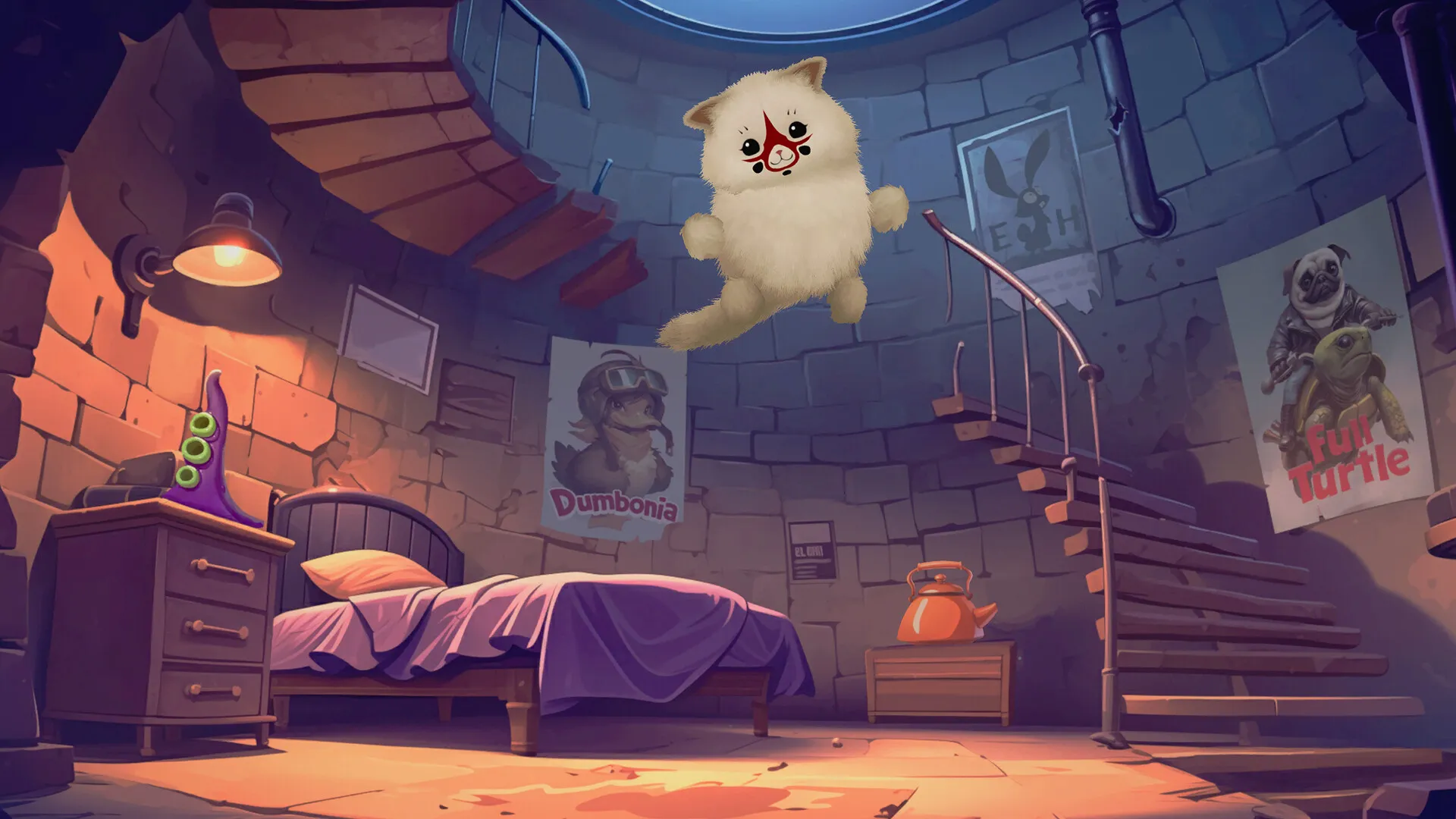
Cloud Cats’ Land departs from this tradition in a fundamental way. Its gameplay is built not on rational problem-solving but on a form of associative “dream logic.” The player still uses a standard inventory system, collecting objects and attempting to apply them to the environment. The solutions, however, rarely follow a linear or predictable path.
They require imaginative leaps that feel closer to interpreting a surrealist painting than to solving an engineering problem. This design philosophy asks the player to unlearn ingrained habits of logical deduction and instead engage with the world on its own terms. It is a demand to think poetically.
This approach is best understood by examining its effect on the player’s cognitive process. A puzzle might present a clear problem, yet the most obvious solution is almost always a red herring. The game intentionally blocks the path of conventional thought, forcing the player to consider the absurd.
For instance, the challenge of lighting a rocket’s fuse is not solved with a nearby torch, a solution rooted in elementary physics. The actual answer is a far more convoluted sequence of actions that has no basis in reality but makes perfect sense within the game’s whimsical framework. Success in Cloud Cats’ Land comes not from asking “what would work?”
but from asking “what story does this puzzle want to tell?” This can be an exhilarating experience. When a truly outlandish combination of items yields progress, it feels less like solving a puzzle and more like being let in on a wonderful secret. It is a moment of shared understanding with the game’s creators.
The puzzles, in their best moments, synergize perfectly with the dreamlike art style, reinforcing the idea that this is a world governed by emotion and symbolism, not by the laws of our reality. It shares a creative lineage with the surrealist prose of writers like Haruki Murakami, where a character might slip into an alternate reality simply by listening to a certain piece of music.
The difficulty with this design is that it creates a precarious balance between insight and frustration. For every player who can make the required intuitive leap, another will be left completely baffled. The game’s logic is so personal and idiosyncratic that it can feel arbitrary.
When a solution appears to have no internal consistency even within the game’s strange rules, the experience shifts from a creative dialogue to a guessing game. The pleasure of discovery is replaced by the tediousness of trial and error.
The contained nature of each chapter, which limits puzzles to a handful of screens, is a welcome concession. It prevents the player from having to test every bizarre inventory item on hundreds of potential targets across a massive map.
This design choice provides a necessary constraint, but it does not fix the underlying issue. The game’s mechanical core is a bold artistic statement about the value of non-linear thinking, but it is a statement that often comes at the expense of clear communication with its audience.
Charm, Humor, and a Missing Helping Paw
The personality of Cloud Cats’ Land is one of its strongest assets. The writing is consistently witty, with a self-aware tone that suggests it knows how strange its own world is. The dialogue and descriptions are peppered with clever wordplay and subtle in-jokes that are clearly intended for an adult audience.
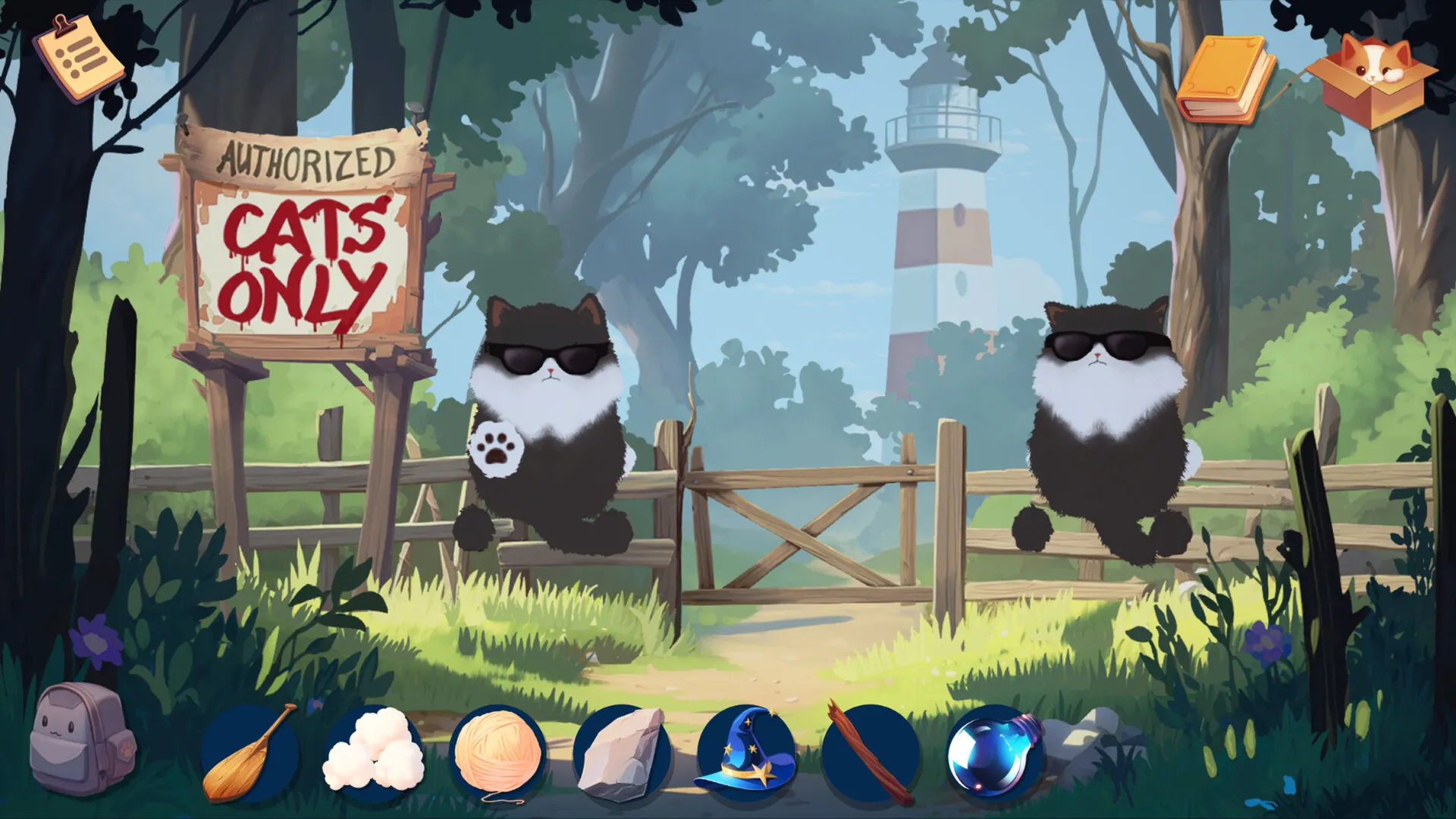
This layer of humor adds a welcome texture to the experience, providing moments of levity that make the world feel more lived-in and its creators more present. The use of language, particularly puns that depend on specific idioms, is an interesting choice. Such humor is often a casualty of localization, a point of friction in the cross-cultural exchange of media.
Its prominent place here suggests a deep confidence in its original linguistic context, a confidence that highlights an interesting contradiction within the game’s design. The game seems to trust that its players will understand its sophisticated verbal humor, yet it does not extend the same trust to their ability to parse its opaque mechanical language.
This brings us to the game’s most significant and damaging flaw: the complete absence of a hint system for its core puzzles. This is not a minor oversight; it is a fundamental miscalculation of the player experience. By building a game on a foundation of illogical puzzles, the designers created a system where getting stuck is not just possible, but inevitable for most players.
Without any kind of recourse or gentle nudge in the right direction, a state of temporary confusion can easily become a permanent roadblock. The player’s only option is to resort to brute-forcing a solution, mechanically clicking every inventory item on every possible hotspot.
This methodical but mindless process is the antithesis of the creative, intuitive thinking the puzzles are meant to inspire. It shatters the carefully cultivated atmosphere of whimsical discovery, replacing it with the cold, repetitive labor of a checklist. The beautiful, dreamlike world fades into the background, becoming a mere collection of interactive nodes.
One could argue this is a deliberate design choice, an attempt to create a high barrier to entry that rewards only the most dedicated or attuned players. Some games successfully use extreme difficulty to foster a sense of mastery and community.
The critical difference here is the distinction between difficulty and arbitrariness. A difficult puzzle is one with a complex but fair and consistent logic. An arbitrary puzzle is one whose solution has no discernible logic at all. Cloud Cats’ Land too often veers into the latter. The existence of a “skip” button for its various mini-games makes the omission of a hint system for the main puzzles even more baffling.
It shows the developers understood the need for player support in some areas but failed to apply that insight to the game’s most challenging and central feature. This failure of mechanical empathy ultimately undermines the game’s artistic vision. It erects a wall between its charming, inventive world and the very people who want to explore it.
The Review
Cloud Cats' Land
Cloud Cats’ Land is an artistic treasure locked behind a frustrating mechanical gate. Its gorgeous, dreamlike world and witty writing create a powerful sense of place that is a genuine joy to behold. This charm is consistently undone by a core puzzle design that favors arbitrary, illogical solutions without providing the necessary guidance for the player. The lack of a hint system turns a whimsical adventure into a tedious exercise in brute-force guessing, making its beautiful world feel inaccessible.
PROS
- Stunning, hand-drawn visual style.
- A tranquil and wonderfully immersive atmosphere.
- Clever, self-aware writing with subtle humor.
CONS
- Puzzle solutions are frequently illogical and counter-intuitive.
- The complete lack of a hint system creates major frustration.
- Gameplay breaks down into trial-and-error, spoiling the mood.