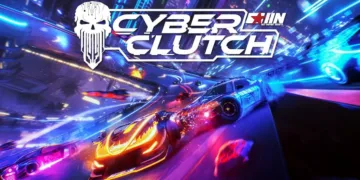





























Arcade combat racers feel like a relic from a bygone era. Titles like Blur and Split/Second once defined a generation of console gaming, but the genre has since become a quiet niche. Cyber Clutch: Hot Import Nights arrives with the apparent goal of reviving that spirit, wrapped in a sleek cyberpunk package. At first glance, it has all the necessary components.
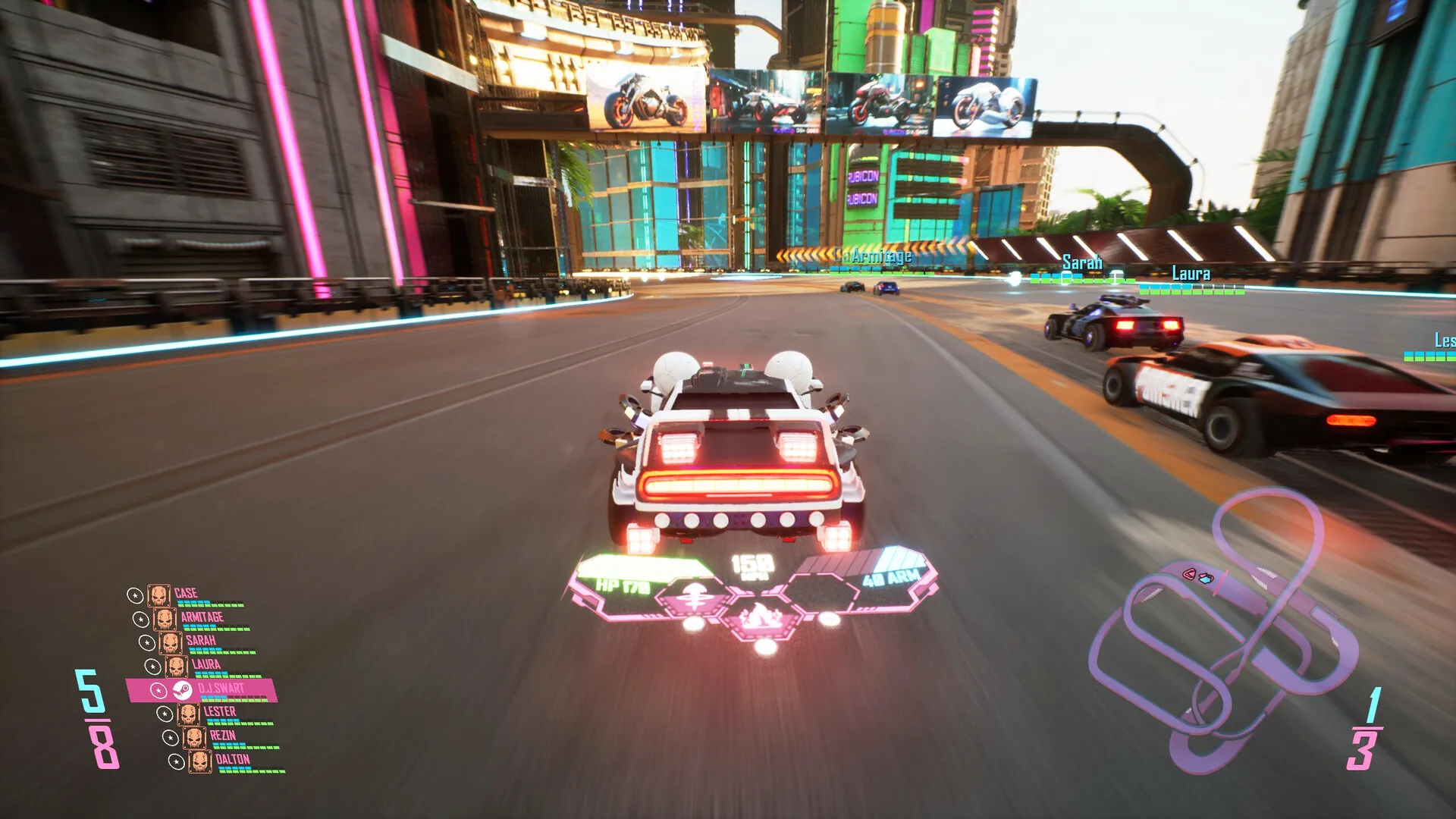
The game’s world is a wash of neon lights and futuristic architecture, with track designs that could be pulled straight from Tron. Its garage is filled with stylish, unlicensed cars that are aggressive reinterpretations of modern sports cars. The game presents a vision of high-speed racing and explosive combat that seems poised to fill a long-vacant spot in the market. This aesthetic raises the immediate question of whether the underlying mechanics can support the weight of its visual ambition.
On the Track: An Unresponsive Ride
The gameplay in Cyber Clutch quickly reveals fundamental problems, starting with the vehicle handling. The game attempts to implement a simple, accessible drift mechanic reminiscent of the Mario Kart series, where a single button press initiates a slide to build up a speed boost. In practice, this system is wildly unpredictable and frustrating.
A player might approach a wide, gentle curve, intending to execute a controlled drift, only for the car to abruptly snap into a severe angle, sending them directly into a wall. Conversely, attempting a tight hairpin turn can sometimes result in a drift so wide it feels completely disconnected from the player’s input. There is no consistent logic to it, making mastery feel impossible. This core mechanic, which should be the most reliable tool in a driver’s arsenal, instead becomes a frequent source of unforced errors.
This issue is amplified by the different vehicle classes. The “Light” cars, while quick to accelerate, feel exceptionally twitchy. Even on straight sections of track, they seem to fight against the player, requiring constant small corrections to avoid veering off course. The “Heavy” cars present the opposite problem. They feel sluggish and unresponsive, almost as if there is significant input lag.
Pushing the stick to turn results in a noticeable delay before the vehicle begins to change direction, making precise maneuvering a difficult task. The “Medium” class, intended as a balance between the two, inherits the flaws of both without excelling in any area. The result is that no matter which car you choose, you are fighting the controls as much as you are fighting your opponents.
This is compounded by a profound lack of physical feedback. A game like Burnout 3: Takedown made every collision a spectacular, visceral event, complete with satisfying crunches and showers of sparks. In Cyber Clutch, ramming an opponent at top speed feels like two plastic models bumping into each other. There is no sense of mass, no feeling of impact.
The absence of meaningful controller vibration is also a significant omission. The controller remains mostly inert, failing to communicate the texture of the road, the strain of a high-speed turn, or the impact of a weapon strike. This lack of feedback creates a deep disconnect, preventing any real sense of immersion in the action.
The combat portion of the game is similarly underdeveloped and poorly balanced. Each car has a couple of unique abilities, supplemented by standard weapon pickups scattered across the tracks. These systems fail to create engaging encounters. The weapon balance is heavily skewed towards one particularly punishing item: an “orbital cannon.” Imagine leading a race for several laps, driving perfectly, only to be vaporized by a beam from the sky moments before crossing the finish line.
This functions like Mario Kart’s infamous Blue Shell but feels even more unfair, as it can be a one-hit kill if your vehicle has sustained even moderate damage. The AI opponents use this weapon relentlessly against a human player in first place, making victories feel random rather than earned.
Other weapons are largely ineffective, rendering them almost pointless to pick up. The forward-firing rockets and machine guns lack proper tracking and are difficult to aim at fast-moving targets on the wide tracks. The deployable mines are easily avoided. This imbalance means that most offensive pickups are ignored in favor of defensive items like shields or simple boost pads.
The unique abilities tied to each car are also unremarkable, typically consisting of a generic shield or a short-lived speed boost. They fail to give any vehicle a distinct identity in combat, a stark contrast to the memorable character-specific powers found in a classic series like Twisted Metal. Ultimately, the combat feels less like a strategic duel and more like a lottery.
The Garage and the Circuits: A Repetitive Lap
The game’s content is structured around a shallow and repetitive progression loop that fails to maintain interest for long. The main single-player experience is the “Grand Circuit,” a linear sequence of five racing cups. Each cup is composed of three races, and you must achieve a first-place overall finish to unlock the next cup. This rigid structure becomes a chore.
If you have a bad result in the third and final race of a cup, you are forced to replay the entire three-race series from the beginning. There are no alternative event types, no rival challenges, and no branching paths to break up the monotony. It is a simple checklist of races, a far cry from the varied and engaging career modes seen in past titles like Project Gotham Racing, which featured diverse objectives like cone challenges, speed tests, and overtake missions.
After completing the Grand Circuit, the only new content offered is an “Expert” version, which is simply the same five cups with more aggressive AI opponents. While it offers a new set of cosmetic rewards, it does little to address the core problem of repetition. A “Quick Race” mode exists, but without any progression or unlocks tied to it, there is little incentive to use it outside of practicing on a specific track.
The multiplayer component, which could have provided long-term value, is effectively nonexistent. The game uses a matchmaking system with no option for a server browser. With a very low player count, this means finding a match is nearly impossible. The decision to exclude the PlayStation platform from the game’s cross-play feature further segments an already tiny community, ensuring the online lobbies remain a ghost town.
The game’s garage contains 20 different vehicles, which is a respectable number. The car designs are arguably the strongest part of the entire package, with creative, unlicensed models that evoke real-world cars like the Ford GT (“Torcher”), the BMW Z-series (“Shark”), and the Dodge Challenger (“Raven”).
These cars are divided into the Light, Medium, and Heavy classes, which directly affects their handling, top speed, and armor statistics. While the variety is welcome, the underlying handling issues mean that choosing between them is often about picking the least frustrating option rather than the most fun.
You can use currency earned from races to purchase cosmetic modifications for your cars, including new hoods, spoilers, wheels, and paint colors. While this adds a minor layer of personalization, the system lacks any real depth. The parts are purely visual and have no impact on vehicle performance. This feels like a significant missed opportunity.
A deeper tuning system, like those found in the Need forSpeed series, could have allowed players to adjust things like gear ratios or suspension stiffness to potentially mitigate some of the game’s awkward handling characteristics. As it stands, the customization is a shallow distraction that does little to enhance the core experience.
Presentation: A Buggy, Unstable Machine
The one area where Cyber Clutch makes a positive first impression is its visual design. The artists have successfully created a compelling cyberpunk world. The tracks are set against backdrops of towering skyscrapers, glowing holographic advertisements, and streams of flying traffic.

The lighting engine creates appealing reflections on rain-slicked roads, and the overall aesthetic is cohesive and well-executed. This visual polish, however, makes the lifelessness of the gameplay feel even more jarring. It is a beautiful diorama that is unfulfilling to interact with. The audio package fails to reach the same standard.
The electronic soundtrack provides a fitting but entirely forgettable backdrop of generic beats that quickly become repetitive. The sound design itself is lackluster, with weak engine noises that lack any distinct character and muted sound effects for collisions and weapon impacts that rob the action of any excitement.
This presentation is catastrophically undermined by a pervasive lack of technical stability. The game is riddled with bugs that directly interfere with gameplay. It is not uncommon for a car to be brought to a dead stop by an invisible object on the track. Jumps, which should be exciting moments, are often a gamble; landing can cause your car to clip through the floor or be launched into an invisible wall, unfairly ending a good run.
The issues extend beyond the races themselves. On the Steam version of the game, the entire achievement system is reportedly non-functional. None of the 32 achievements can be unlocked by anyone, a clear indication that the game was released without proper quality assurance testing.
The most critical technical failure is the game’s inconsistent performance. For any racing game, a stable frame rate is not a feature but a fundamental necessity. Cyber Clutch fails this basic test on some of its target platforms. Reports from players on the PlayStation 5 describe severe and frequent frame rate drops that make the game nearly unplayable.
When the on-screen action stutters, input response becomes delayed and erratic, making precision driving impossible. This problem turns an already frustrating handling model into an uncontrollable one. While performance may be better on high-end PCs, the variability across platforms points to poor optimization. A game built around speed and reaction cannot function properly without a smooth and reliable frame rate, and its absence here is the final, definitive flaw that cripples the entire experience.
The Review
Cyber Clutch: Hot Import Nights
Cyber Clutch: Hot Import Nights is a visually impressive shell hiding a fundamentally broken game. Its appealing cyberpunk aesthetic and cool car designs are completely undermined by frustrating handling, shallow combat, and a host of game-breaking bugs and performance issues. It has the look of a classic arcade racer but lacks the functional core required to make it playable.
PROS
- Strong cyberpunk art style and track visuals.
- Creative and appealing vehicle designs.
CONS
- Awkward and unpredictable vehicle handling.
- Basic, unbalanced combat mechanics.
- Repetitive single-player content.
- Severe technical bugs and performance drops.
- Non-functional multiplayer mode.