





















The Alaskan wilderness, a canvas of stark white and deep shadow, is the first character we meet. In this remote setting of an Iñupiaq village, a shocking act of violence tears through the quiet. Teddy Kyle Smith, a local actor of some note, commits a series of crimes, including the murder of his mother and the shooting of two men. The brutality is plain.
The motive is anything but. Smith confesses, yet his explanation ruptures the very fabric of legal reasoning. He claims his hands were moved by the Iñukuns, dwarf-like entities from ancient Inuit folklore. Blood & Myth begins here, at the confounding intersection of a police blotter and a mythological text. It poses a question that transcends guilt or innocence, asking instead what constitutes reality when an ancient worldview collides with modern law.
Our Man in Kotzebue
The audience’s guide through this philosophical blizzard is James Dommek Jr. He is our surrogate, a man of the community who knew of Smith and is personally connected to the Iñukun legends through his great-grandfather, a storyteller. His personal stake gives the investigation its emotional weight; this is not a detached journalistic exercise but a painful reckoning with his own culture and its shadowed corners.
The film’s structure follows his procedural efforts: filing FOIA requests for police tapes, interviewing locals, and working toward the narrative’s gravitational center, a prison meeting with Smith himself. Dommek’s methodical approach grounds the film in a familiar investigative rhythm, even as the subject matter spirals away from the rational.
This quest for an interview provides the film its primary tension. The entire story is filtered through Dommek’s subjective lens, raising immediate questions about his reliability and the very possibility of objectivity. He is a practical man attempting to chart a path through the supernatural. His internal struggle between modern skepticism and the pull of his heritage becomes the film’s true subject, a quiet examination of belief in a world that demands empirical proof.
Landscape as Psychic State
Director Kahlil Hudson paints with a frigid, minimalist palette. The cinematography renders the Alaskan landscape as a vast, expressionistic void, an externalization of the characters’ psychological states. Wide, static shots of the snow-covered tundra create a profound sense of isolation, a place where the barrier between the physical and metaphysical feels porous.
Also Read







The visual language is a form of arctic noir, employing a natural chiaroscuro of blinding snow against the blackness of forest and night. Low-angle shots emphasize the oppressive, empty sky, dwarfing the human figures below. The film’s style is mostly observational, using conventional talking-head interviews and archival materials that lend it a veneer of journalistic authority.
Yet it punctuates this verité approach with animated sequences that depict Smith’s alleged supernatural encounter. These are brief, feverish excursions into a purely mythological space, visually severing the film from its documentary roots. The sound design amplifies the unease, built around the disembodied, staticky voice of Smith from police recordings. His testimony is a ghostly confession that haunts the stark visuals, functioning like the ghostly voiceover of a classic noir protagonist already resigned to his fate.
The Folklore Defense
The established facts are brutal and simple. Teddy Kyle Smith, once a promising actor in On the Ice, saw his life decay into alcoholism before the final, violent rupture. The film presents these details with stark clarity. It then pivots to his defense, treating the Iñukun myth with anthropological seriousness.

The folklore is not presented as a convenient alibi but as a coherent, if alternate, system of being. Interviews with cultural experts and community elders ground the legend in a living tradition, creating a difficult ethical and epistemological gray zone. The documentary expertly juxtaposes the perspectives of law enforcement, which demands a rational motive, with the cultural view that acknowledges the power of these ancient stories.
The film places these worldviews in direct conflict without declaring a victor. It asks a deeply unsettling question: what happens when a modern legal system, built on provable facts, must judge an act explained by a reality it cannot recognize? It avoids a simple diagnosis of madness or a clear verdict of guilt. Instead, it presents both the legal and mythological frameworks as internally consistent, forcing the viewer into a state of profound uncertainty. This refusal to pick a side is its most unnerving quality.
A Study in Frustration
The documentary’s greatest success is its role as a cultural artifact. It offers a patient, respectful immersion into the Iñupiaq nation, showing a world where myth remains a potent force. For this insight alone, the film is essential viewing. Its primary narrative weakness, however, is a direct result of this focus and a deliberate subversion of genre expectations.
The entire structure builds toward Dommek’s climactic interview with Smith, the moment where truth is meant to surface. The confrontation, when it finally arrives, is a masterpiece of anticlimax. Smith’s responses are maddeningly circular, offering riddles instead of resolutions. Catharsis is denied. This structural frustration feels intentional, a reflection of a mystery without a solution, much like a noir detective who solves the crime but fails to restore any moral order.
Viewers hoping for a standard true-crime procedural will be disappointed. The film sacrifices forensic clarity for thematic depth, leaving Smith an inscrutable figure at the center of a story he refuses to explain. He is a ghost in his own machine, a psychological blank that heightens the film’s mystery while simultaneously frustrating any attempt at understanding.
The Persistence of Myth
Blood & Myth is a work of profound ambiguity. It is not a film that provides answers; it is a film that complicates the questions. Its purpose is not to solve a crime but to investigate the very nature of belief and reality.
The documentary powerfully demonstrates how narratives, ancient or modern, construct the worlds we inhabit. It questions if the “truth” of an event can be found in facts alone, or if it also lives in the stories we tell to make sense of the inexplicable.
The film forces a confrontation with the limits of rationalism, suggesting that some truths are not meant to be analyzed but experienced. It is haunting and intellectually restless. It refuses to reconcile the contradictions it presents, leaving the viewer in the same disquieting space as its narrator, staring into the white expanse and wondering what is real.
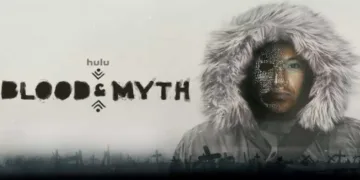
Blood and Myth is a documentary that premiered on Hulu on September 4, 2025. It explores a true crime story in a native Alaskan town, where a respected Iñupiaq actor becomes a fugitive. Upon his capture, he claims his actions were influenced by mythical beings from his culture, known as the Iñukuns. The film is available to watch on Hulu.
Full Credits
Director: Kahlil Hudson
Writers: James Dommek Jr.
Producers and Executive Producers: Jonas Bell Pasht, Jonah Bekhor, Kahlil Hudson, James Dommek Jr.
Cast: Chase Breithoff, James Dommek Jr., Kahlil Hudson
The Review
Blood and Myth
Blood & Myth is a masterclass in atmospheric filmmaking that deliberately trades the satisfactions of the true-crime genre for a deeper philosophical inquiry. It offers an invaluable and respectful immersion into Iñupiaq mythology, using its chilling Alaskan setting to pose difficult questions about belief and reality. While its refusal to provide narrative closure will frustrate viewers seeking easy answers, the film’s haunting ambiguity is precisely its point. It is an intelligent, unsettling piece of arctic noir that resonates long after the credits roll, rewarding patience with profound, lingering questions.
PROS
- The stark, expressionistic visuals of the Alaskan wilderness create a powerful and unsettling mood.
- Provides a deep and insightful exploration of Iñupiaq folklore and its place in the modern world.
- Challenges the viewer to confront complex questions about justice, reality, and the nature of belief.
- Successfully functions as a psychological thriller and philosophical text disguised as a documentary.
CONS
- The central mystery is never resolved, and the climactic interview is intentionally anticlimactic.
- Those expecting a traditional true-crime investigation with clear evidence and conclusions will be frustrated.
- The film offers little psychological insight into Teddy Kyle Smith, who remains an enigma.
- Its meditative and observational style may feel stagnant to some viewers.