
























![Kingdom Hearts Collection [I-III] Review](https://gazettely.com/wp-content/uploads/2026/10/Kingdom-Hearts-Collection-I-III-1-360x180.webp "Kingdom Hearts Collection [I-III] Review: KHII Holds Steady as Newer Entries Fluctuate 37")



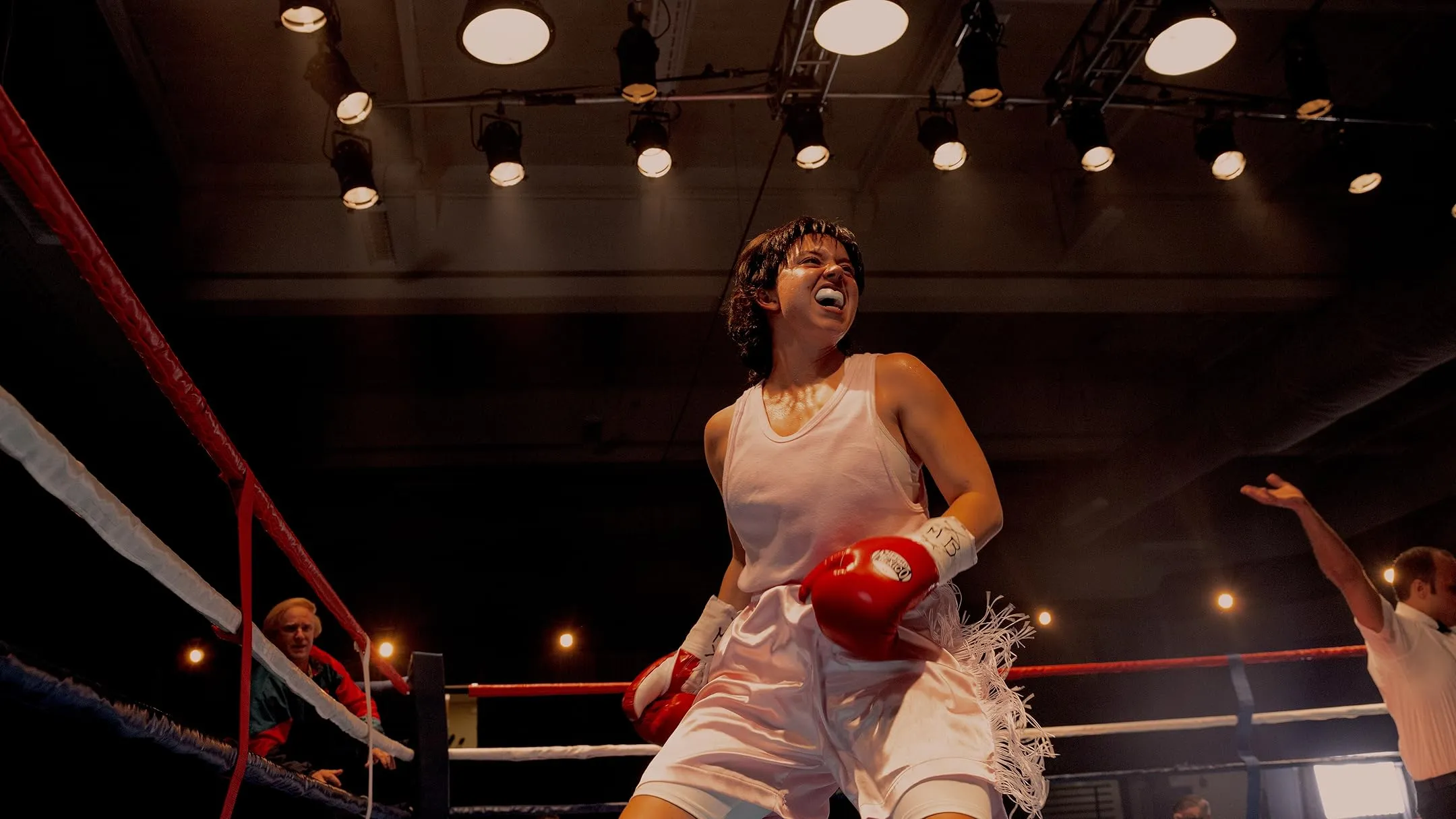

The sports biopic, as a form, often promises a clean narrative arc: adversity, training, triumph. Christy offers something far murkier. It presents the life of boxer Christy Martin, a pioneer in the nascent world of 1990s women’s boxing, as a study in profound dissonance.
Here is a fighter celebrated for her ferocity in the ring, a public figure carefully packaged in a baby pink boxing kit designed to soften her power for mass consumption. Yet the film’s true subject is the far more terrifying, less glamorous fight occurring outside the ropes.
David Michôd’s grim chronicle is not a story of victory against a sporting opponent. It is an unflinching examination of survival against a domestic one, exploring what it means to be a champion when your greatest battle is fought in the supposed sanctuary of your own home.
Embodying the Contradiction
The film rests entirely on the transformed shoulders of Sydney Sweeney. Her commitment goes far beyond the requisite physical alteration—the added muscle, the darkened hair, the boxer’s coiled stance. These are the expected entry points for such a role, the table stakes for a “serious” performance.
Her actual achievement is the embodiment of Christy’s deep internal schism, a kind of performative soul-splitting required for survival. The physicality itself becomes symbolic; the muscle is armor for the highly regulated violence of the ring, yet it offers no protection from the chaotic, intimate violence at home.
Her vocal work, a carefully pitched West Virginian accent, is not mere mimicry. It is the bedrock of a persona that can be weaponized into cocky bravado at a press conference or fractured into fearful whispers behind closed doors.
She captures the exhausting performance of being Christy Martin. The public-facing warrior, who trash-talks opponents with a practiced swagger, feels like a deliberate construction, a character Christy plays for the cameras and for her manipulative husband. In private, Sweeney dissolves that persona, revealing the coiled anxiety of a woman navigating a minefield.
Her posture changes subtly when Jim Martin enters a room; a straight back slackens, a confident gaze drops. It is in these quiet moments that Sweeney’s work is most potent. The film’s narrative may lean on familiar biopic beats, but her raw, emotional core makes the experience feel authentic and deeply unsettling. This is a study of a woman forced to build a fortress around herself, only to find the enemy was already inside.
Orbits of Abuse
Christy Martin’s world is populated less by characters and more by gravitational forces, each one pulling her deeper into a suffocating reality. Ben Foster’s turn as her trainer-husband, Jim Martin, is a chilling portrait of predatory fragility. He is terrifying, a man whose condescension towards “lady boxers” curdles into a monstrous need for absolute control as Christy’s star rises and his own fades into her shadow.
Foster portrays him not as a simple villain, but as an archetype of pathetic monstrosity, a man whose violence is the last, desperate act of the impotent. He embodies a particularly American brand of insecure patriarchy, where control is mistaken for strength.
In a different, quieter register is Merritt Wever’s horrific performance as Christy’s mother, Joyce. She represents a more insidious kind of violence: the tyranny of appearances and the complicity of silence. Her dismissal of Christy’s fear with a placid, pitying “Oh Christy, you sound crazy” is perhaps more chilling than any physical blow. It is the voice of a society that prioritizes the illusion of a “normal, happy life” over a person’s actual safety.
Amid this bleakness, Chad L. Coleman’s Don King offers a blast of garish energy, a court jester in this grim kingdom. He is another user, packaging Christy as the “Coal Miner’s Daughter,” but his transparent self-interest feels almost honest compared to the poison peddled by her family.
Against these figures, Katy O’Brian’s Lisa Holewyne provides a rare flicker of genuine warmth, a brief vision of an alternative, healthier existence that the film only allows in glimpses, making its absence all the more profound.
The Brutalism of the Biopic
Director David Michôd approaches the sports biopic with the grim sensibilities he brings to his crime dramas, creating a film that is most alive in its ugliest moments. The atmosphere is thick with a specific, domestic dread. One senses Michôd is far more interested in the psychological horror of Christy’s marriage than in the mechanics of her boxing career.
The fight sequences themselves often feel perfunctory, serving as narrative punctuation rather than visceral spectacle. They chart a professional ascent while a personal descent accelerates, presenting the sanctioned violence of the ring as an almost orderly affair compared to the lawless terror at home. This distinction is the film’s central argument.
The film follows the standard rise-and-fall structure, a choice that creates an interesting tension. At times, the adherence to formula in the first half feels repetitive, threatening to blunt the story’s radical edges with a generic sports-movie sheen.
Yet this conventional framework acts as a Trojan horse. It lulls the audience into a false sense of security, making the third act’s sudden, brutal turn toward unflinching domestic horror all the more shocking and effective.
The pacing, which can feel sluggish, reveals itself as the slow, deliberate tightening of a knot. The result is a flawed yet potent character study. It struggles with the conventions of its genre but ultimately succeeds as a harrowing tale of survival, leaving one to ponder the brutal realities that often hide behind our public stories of triumph.
The movie had its world premiere at the Toronto International Film Festival on September 5, 2025. It is scheduled for a theatrical release in the United States on November 7, 2025. Information on streaming availability has not yet been announced.
Full Credits
Director: David Michôd
Writers: Katherine Fugate, Mirrah Foulkes, David Michôd
Producers and Executive Producers: Kerry Kohansky-Roberts, Teddy Schwarzman, Brent Stiefel, Justin Lothrop, David Michôd, Sydney Sweeney, Michael Heimler, John Friedberg, Mirrah Foulkes, Brad Zimmerman, David Levine, Ryan Schwartz, Nick Shumaker
Cast: Sydney Sweeney, Ben Foster, Merritt Wever, Katy O’Brian, Ethan Embry, Jess Gabor, Chad L. Coleman, Tony Cavalero, Bill Kelly, Bryan Hibbard
Director of Photography (Cinematographer): Germain McMicking
Editors: Matt Villa
Composer: Antony Partos
The Review
Christy
Christy uses the sports biopic as a Trojan horse for a harrowing tale of domestic horror. The film sometimes struggles with conventional pacing, but it is anchored by Sydney Sweeney’s phenomenal, transformative performance. Supported by a chilling cast, she makes Christy Martin’s story a brutal, necessary watch. The film’s greatest strength is its unflinching look at the violence that happens far away from the cheering crowds, making it a powerful, if difficult, character study.
PROS
- Sydney Sweeney’s deeply committed and transformative lead performance.
- Chilling and effective supporting performances from Ben Foster and Merritt Wever.
- An unflinching and potent depiction of domestic abuse.
- A purposeful subversion of the triumphant sports biopic formula.
CONS
- Uneven pacing that can feel repetitive in the film's first half.
- Occasional reliance on standard genre tropes that feel clunky.
- Boxing sequences can feel perfunctory next to the more compelling domestic drama.
- The relentlessly grim tone makes for a difficult viewing experience.







