








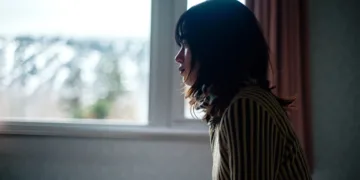


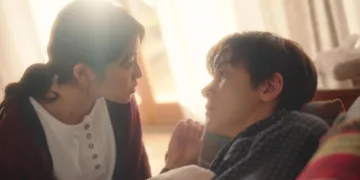
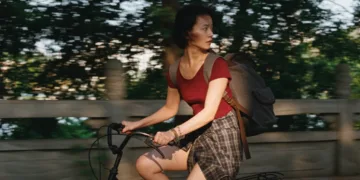











Alice Winocour’s Couture approaches the world of high fashion with a surprising sobriety. Instead of the expected satire, the film offers an observational drama, weaving together the lives of several women during the build-up to a major Paris runway show. We meet Maxine (Angelina Jolie), an American filmmaker navigating the professional pressures of directing a short for the event.
We also follow Ada (Anyier Anei), a young model from South Sudan experiencing her first show, and Angèle (Ella Rumpf), a makeup artist who watches events unfold with a writer’s eye. Winocour constructs a contemplative, almost somber atmosphere. The film is less interested in the industry’s extravagance and more focused on the quiet human moments that occur within its demanding machinery.
The Gravity of a Singular Plot
While Couture presents itself as an ensemble piece, its narrative engine is singular and intensely personal. Maxine’s story is not about fashion; it is a sudden, quiet confrontation with mortality. Shortly after arriving in Paris, a phone call from her American doctor sets in motion a sequence of urgent appointments, culminating in a breast cancer diagnosis that halts her world.

The film’s dramatic weight is placed squarely on Angelina Jolie, who channels her movie star presence into a performance of potent interiority. Her work here is remarkably restrained, conveying the character’s mounting dread through a guarded stillness and the subtle shifts in her gaze.
She portrays a woman attempting to maintain professional composure while her personal foundation cracks, a conflict most evident in her initial reluctance to leave the set for an appointment—a telling detail about the pressure women often feel to prioritize professional duty over self-care.
The story structure gives Maxine a few key interactions that reveal her state of mind. Her scenes with the French doctor, played by Vincent Lindon, are stark and effective in their directness, grounding the film’s one true high-stakes plotline in clinical reality.
Later, her impulsive proposition to her cinematographer (Louis Garrel) is less about romance and more a desperate grasp for physical vitality, an act of agency before her body is given over to the world of medicine. Most affecting are the phone calls with her teenage daughter. In one sequence, she calmly guides her lost daughter home, the subtext of a mother’s fear of no longer being there to help ringing louder than any of the dialogue. It is in these moments that Jolie’s arc provides the film with its necessary emotional anchor.
An Assembly of Strangers
The film’s primary structural weakness becomes apparent when it shifts away from Maxine. The other narrative threads function more as atmospheric sketches than as fully developed stories. The film gestures toward a multi-protagonist structure, but it lacks the thematic or narrative adhesive to hold the pieces together. The lives run parallel; they almost never intersect.

Ada, the Sudanese model and pharmacology student, offers a glimpse into the physical demands of the industry. We see her discomfort as an Italian photographer yells “Seduce the camera!” and find a small moment of humanity when she forms a bond with a Ukrainian model, another young woman displaced by war.
Angèle, the makeup artist, acts as a detached observer, an aspiring novelist who watches Marguerite Duras interviews and dutifully conceals the foot wounds of the models. Her role is to see and perhaps to document, but her own story remains indistinct.
These vignettes offer small, authentic moments, like Ada soothing her swollen feet in a champagne bucket. A seamstress (Garance Marillier) also appears periodically, a silent testament to the craft behind the clothes. Their connection to Maxine’s urgent crisis, however, is tenuous at best. They exist in the same location but not in the same emotional reality.
This choice creates a disjointed experience, with Maxine’s heavy personal drama feeling tonally disconnected from the fleeting observations that surround it. The lack of meaningful interaction removes any potential for dramatic friction between the plotlines. The result is an unbalanced film, one that asks a single character to bear almost all its narrative load.
A Triumph of Mood, A Tangle of Story
Alice Winocour’s direction prioritizes atmosphere over narrative architecture, a tendency seen in her previous work, which often explores the female body in extreme situations. The film is meticulously styled, and its melancholic sensibility is consistent, supported by an evocative score from Filip Leyman and Anna Von Hausswolff that enhances the stirring, somber feeling.

Winocour excels at finding quiet visual poetry and creating thematic links through images. A powerful motif emerges when the red adhesive strips marking Maxine’s breasts for a biopsy echo the patterning tape on a workshop mannequin. This parallel links the medical examination of her body to the industry’s objectification of the female form, a theme also touched upon in scenes of measuring tape wrapped around Ada’s wrists and neck.
The film’s aesthetic ambitions are most apparent in its finale. The climactic runway show, staged in an outdoor woodland setting, is engulfed by a sudden, violent rainstorm. The sequence is a striking visual spectacle, a gothic flurry of wind and drenched fabric that feels reminiscent of vintage McQueen. This elemental chaos is clearly intended to serve as a moment of catharsis for the characters. The problem is that the narrative groundwork has not been laid to support such a release.
Outside of Maxine, the characters’ internal lives have remained too opaque for their transformation to land with any real force. Couture succeeds as an exercise in tone, capturing fleeting moments of beauty and authentic human fragility. Its reluctance to weave its separate stories into a coherent whole, however, leaves it feeling slight. It is a film of powerful, isolated images that never quite assemble into a complete design.
The film premiered at the 2025 Toronto International Film Festival on September 7, 2025. It is set to be released in France on October 1, 2025 by Pathé.
Full Credits
Director: Alice Winocour
Writers: Alice Winocour
Producers and Executive Producers: Angelina Jolie, Charles Gillibert, Zhang Xin, William Horberg, Bob Xu, Benjamin Hess, Luc Bricault
Cast: Angelina Jolie, Anyier Anei, Louis Garrel, Ella Rumpf, Garance Marillier, Finnegan Oldfield, Adèle Montebourg, Vincent Lindon, Aurore Clément
Director of Photography (Cinematographer): André Chemetoff
Editors: Julien Lacheray, Lilian Corbeille
The Review
Couture
Couture is a film of striking moments rather than a complete narrative. Anchored by a quiet, potent performance from Angelina Jolie, the movie succeeds as an atmospheric study of a woman facing a private crisis. Director Alice Winocour creates a visually beautiful, melancholic world. The film's structural choice to keep its multiple storylines separate, however, prevents it from achieving a deeper resonance. It is an earnest and often beautiful picture, though one whose parts are more memorable than its whole.
PROS
- Angelina Jolie's restrained and powerful central performance.
- A strong, consistent visual aesthetic and melancholic mood.
- Several beautifully composed individual scenes and visual motifs.
CONS
- A fragmented narrative structure that feels unbalanced.
- Underdeveloped supporting characters and plotlines.
- A lack of strong thematic connection between the different stories.