



















![Kingdom Hearts Collection [I-III] Review](https://gazettely.com/wp-content/uploads/2026/10/Kingdom-Hearts-Collection-I-III-1-360x180.webp "Kingdom Hearts Collection [I-III] Review: KHII Holds Steady as Newer Entries Fluctuate 33")







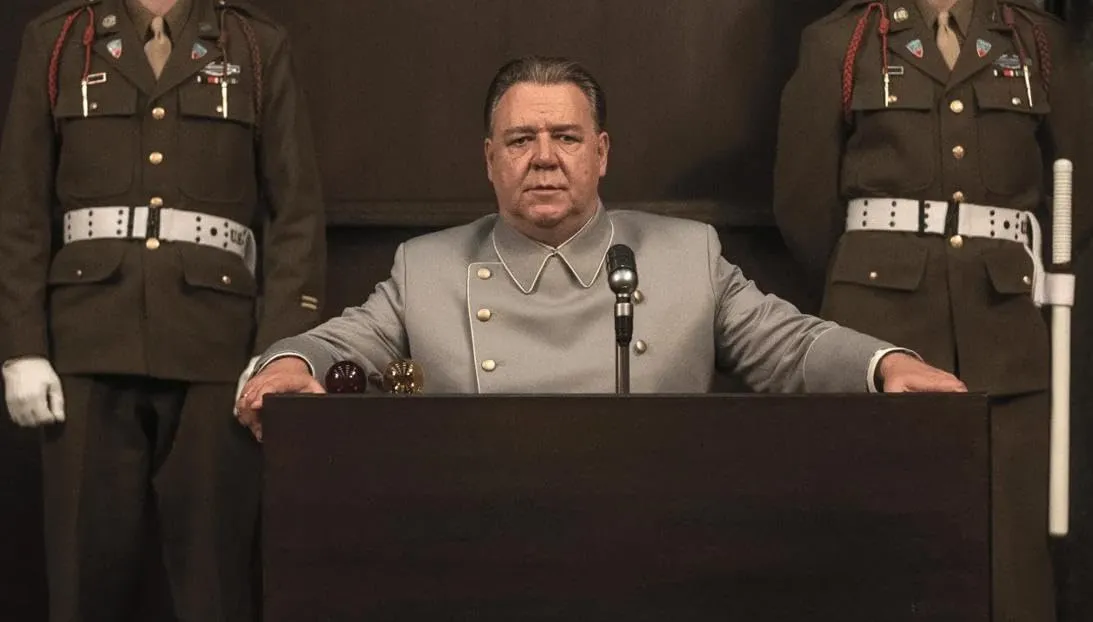

The Second World War is over. Europe lies in ruin, a landscape of ghosts and ash. From this wreckage, the Allies have collected the architects of the catastrophe, the surviving high command of the Third Reich.
The immediate question is one of primitive justice: a rope or a bullet? Some demand swift vengeance. A more ambitious, almost abstract idea is proposed by U.S. Supreme Court Justice Robert H. Jackson (Michael Shannon): an international tribunal.
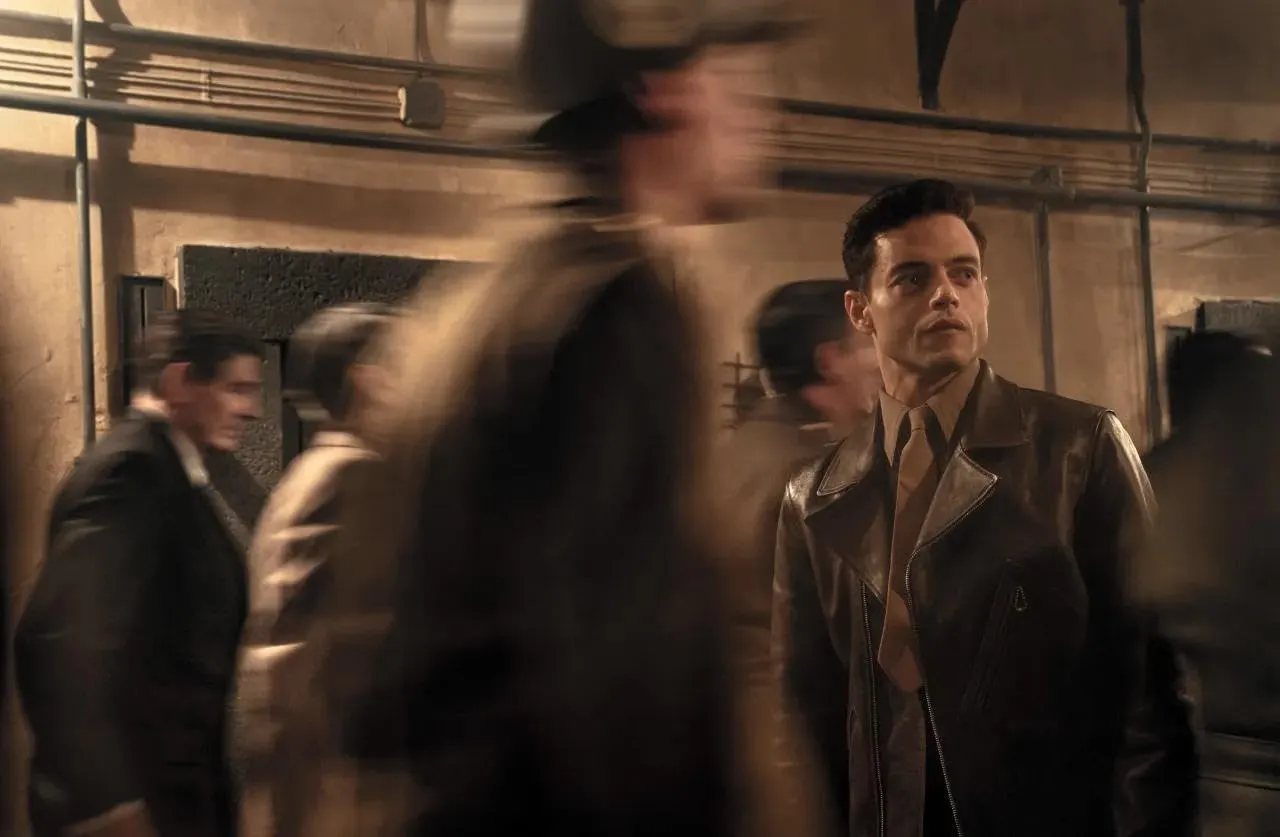
He envisions a trial that will not simply punish the guilty but will construct an unassailable historical record against future denial. This grand legal project provides the stage for a far more intimate conflict. We are introduced to the primary players: Hermann Göring (Russell Crowe), Hitler’s deputy, whose colossal ego remains intact within his prison cell, and Dr. Douglas Kelley (Rami Malek), an Army psychiatrist given the task of peering into these men’s souls.
The film’s focus becomes the tense psychological battle between the doctor and his patient, a duel of wits that questions the very nature of evil while the machinery of justice grinds into motion around them.
The Doctor and the Devil’s Advocate
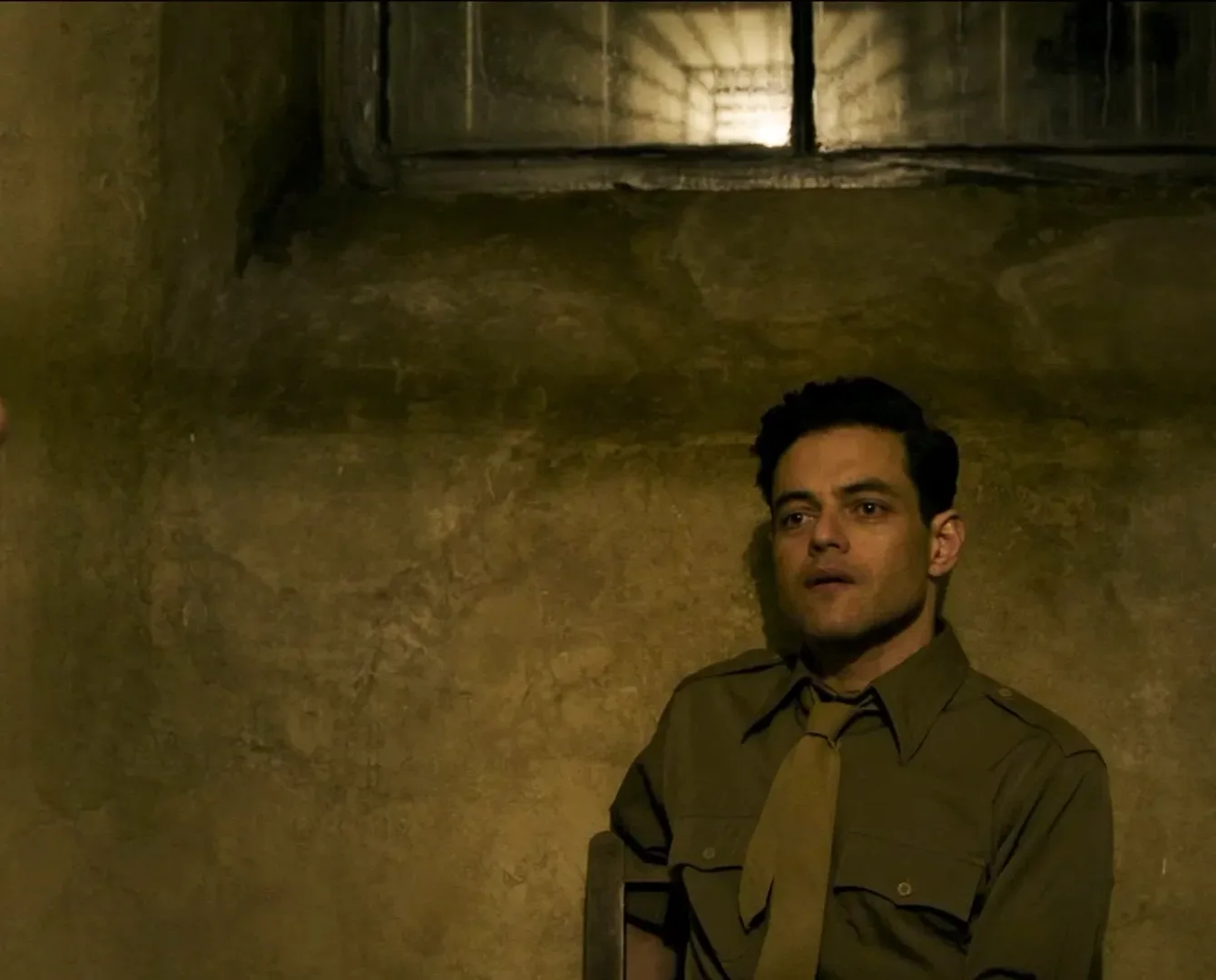
Dr. Kelley’s official assignment is to certify the prisoners’ fitness for trial, a task of clinical froideur. His personal mission is considerably more grandiose, almost Faustian. He aims to dissect the psychology of evil itself, to map its contours with Göring as his prized specimen. This ambition fuels the film’s central cat-and-mouse game, a series of encounters staged in the stark, expressionistic confines of a prison cell.
Cinematographer Dariusz Wolski employs a classic noir palette, bathing the scenes in chiaroscuro lighting that throws half of each man’s face into deep, ambiguous shadow, visually severing them from the world of law and reason outside. Göring, portrayed by Crowe as a creature of immense physical and intellectual gravity, is a master manipulator.
He feigns ignorance of English, deploys a disarming, almost avuncular charm, and operates with the unshakeable narcissism of a man who believes he is the protagonist of history. Kelley, in turn, attempts to penetrate this fortress of denial. Malek plays him with a nervy, restless intelligence.
His methods grow increasingly intimate, blurring the line between clinical observation and personal connection. Kelley’s own ambition, his desire to author the definitive text on the Nazi mind, makes him a compromised narrator. He becomes a man leaning too far over the abyss, fascinated by the darkness staring back at him.
The Architecture of Truth
James Vanderbilt contrasts the claustrophobic intimacy of the prison cells with the cavernous, almost theatrical space of the courtroom. Here, the film examines the mechanics of justice itself, presenting it as an imperfect human construct.
Michael Shannon’s Robert H. Jackson is a man of rigid principle, determined to build a case on a foundation of documented fact, as if evil could be cataloged and filed away. He believes the legal process can contain and explain the horror. His motivation is noble: to create a record so absolute that it will neuter any future attempt to deny the Shoah.
The film shows the limits of this approach during Jackson’s fumbled cross-examination of Göring, where legal reason proves a flimsy weapon against profound, performative nihilism. The trial’s pivotal moment arrives when the British prosecutor, Sir David Maxwell-Fyfe, takes a more direct approach. The film’s most arresting sequence, however, involves no dialogue.
Vanderbilt halts the drama to project the actual archival footage of the concentration camps onto the screen. It is a devastating choice that shatters the film’s own artifice. The audience, along with the characters, is jolted from cinematic narrative into raw, historical trauma. This footage becomes the ultimate prosecutor, an undeniable truth that renders all preceding games obscene.
Faces in the Frame
The film is a showcase for its performers, who are framed in relentless, probing close-ups that deny them any place to hide. Russell Crowe’s physical transformation into Hermann Göring is total; he commands the screen through sheer mass and an unnerving stillness.
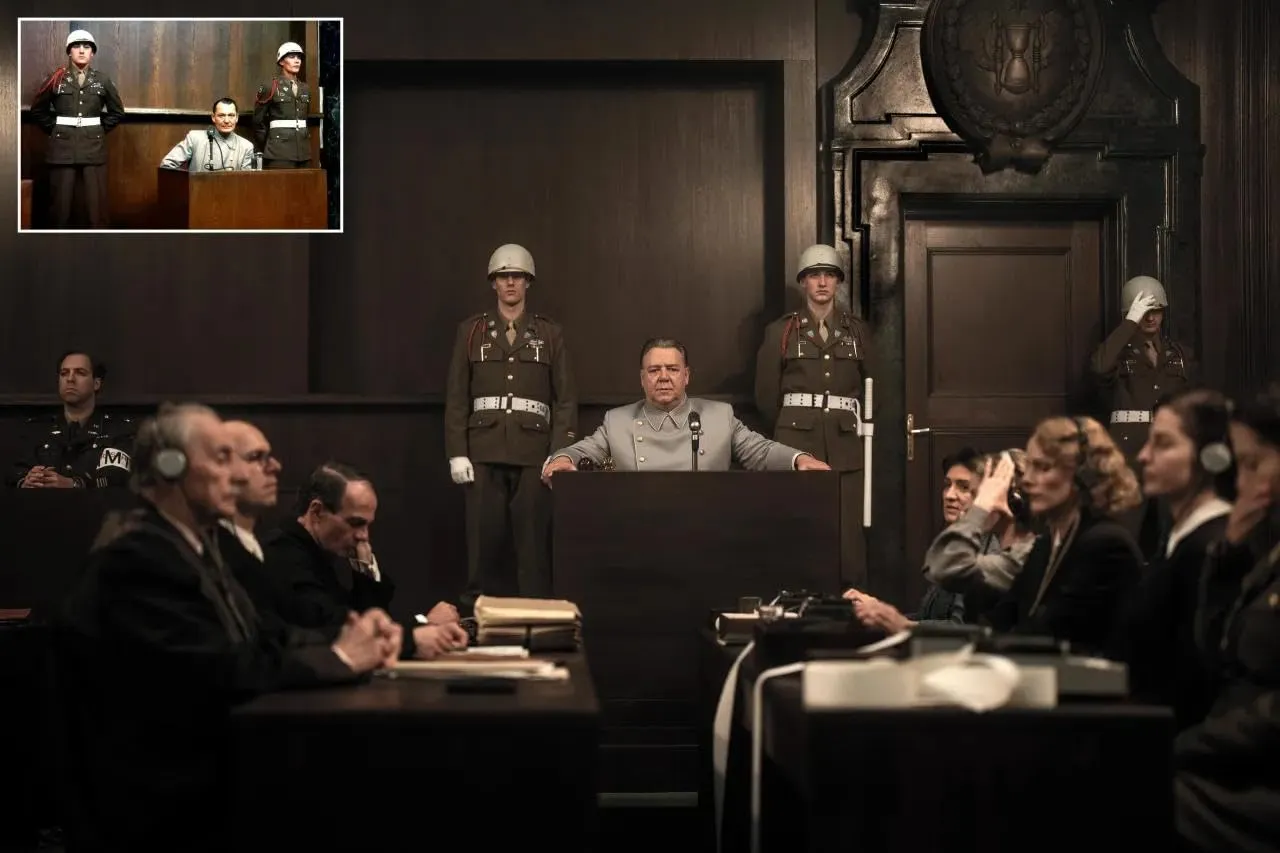
His vocal work is precise, capturing the low, self-satisfied rumble of the Reichsmarschall’s German accent and using it as an instrument of condescending charm. Rami Malek portrays Dr. Kelley as a man of sharp intellect whose curiosity threatens to consume him. Through fidgety movements and darting eyes, he conveys the moral vertigo of a man studying a monster at close range.
As Robert H. Jackson, Michael Shannon brings a stoic, granite-like presence. He uses his economy of expression to suggest a man bearing an impossible historical weight. The film’s emotional core, however, is found in a supporting role. Leo Woodall, as Kelley’s German-Jewish interpreter Sgt. Howie Triest, delivers a stunning monologue that recounts his family’s fate.
His raw, unvarnished grief provides a necessary counterpoint to the calculated intellectualism elsewhere. Brief, sharp performances from Richard E. Grant as the unflappable British prosecutor and John Slattery as the sternly pragmatic prison commandant further populate this grim world with convincing authority.
A Polished Parable
Director James Vanderbilt adopts a stately, classical style, crafting a film that feels like a throwback to the prestigious historical dramas of a past era. It is handsome, sober, and impeccably made, with a deliberate pacing that favors dialogue over action. The aesthetic is one of controlled prestige, seemingly designed with awards season in mind.
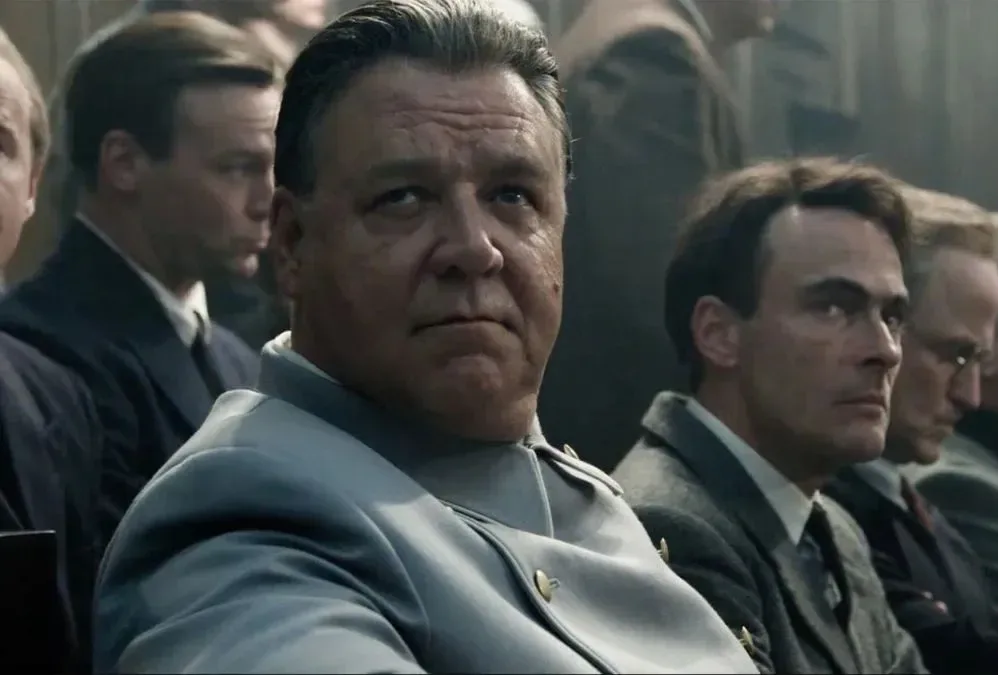
Cinematographer Dariusz Wolski’s work is a highlight, creating two distinct visual worlds. The interrogation scenes are steeped in the ambers and deep shadows of a psychological thriller, while the courtroom sequences are rendered in cool, detached blues that underscore the institutional nature of the trial. The film’s primary narrative choice is to filter the enormous, complex history of the Nuremberg trials through the personal relationship between two men.
This approach presents a philosophical trade-off. By simplifying the sprawling historical record into a focused duel, the film gains dramatic intensity. It becomes a tidy, effective parable about good and evil. One must question what is lost in this distillation. The film sacrifices the messy, bureaucratic, and often contradictory reality of the trials for a cleaner, more cinematic story, one where history’s jagged edges are sanded smooth for easier consumption.
The Mirror in the Dock
The film’s central argument, channeled through Dr. Kelley’s work, is a chilling articulation of what Hannah Arendt would later call the banality of evil. The Nazi leaders, as presented here, are not mythical demons emerging from some sulfurous pit.
They are men. They are intelligent, ambitious, and in Göring’s case, dangerously charismatic figures who rationalized monstrous acts in the service of an ideology. The film argues that their recognizable humanity is the most terrifying thing about them. It posits that the capacity for such evil is not an alien pathology but a latent possibility within the human condition, one that can be activated by political poison and moral cowardice. Vanderbilt makes this a clear warning for our own time.
He uses the past as a distorted reflection of the present, suggesting that the forces that animated these men have not been vanquished. Nuremberg holds up a mirror to a dark chapter of history and forces the viewer into an uncomfortable proximity with its perpetrators. The men in the dock are not an alien species, and the true horror lies in that recognition.
The film had its world premiere at the Toronto International Film Festival on September 7, 2025. It is scheduled to be released in the United States on November 7, 2025, and will be distributed by Sony Pictures Classics.
Full Credits
Director James Vanderbilt
Writers James Vanderbilt, Jack El-Hai
Producers and Executive Producers Richard Saperstein, Istvan Major, Bradley J. Fischer, William Sherak, James Vanderbilt, Paul Neinstein
Cast Russell Crowe, Rami Malek, Leo Woodall, Michael Shannon, John Slattery, Richard E. Grant, Colin Hanks, Wrenn Schmidt, Lydia Peckham
Director of Photography (Cinematographer) Dariusz Wolski
Editors Tom Eagles
Composer Brian Tyler
The Review
Nuremberg
While its stately, traditional filmmaking can feel overly familiar, Nuremberg succeeds as a gripping psychological thriller. Anchored by a monumental performance from Russell Crowe and sharp, noir-inflected cinematography, the film transforms a sprawling historical event into an intimate duel of wits. It effectively poses chilling questions about the nature of evil, even if its answers feel neatly packaged for cinematic consumption. A powerful, impeccably crafted, yet ultimately safe examination of humanity’s darkest chapter.
PROS
- A commanding and complex lead performance from Russell Crowe.
- The tense, well-acted psychological dynamic between Crowe and Rami Malek.
- Stunning cinematography that utilizes light and shadow to enhance the noir atmosphere.
- Powerful supporting performances, particularly from Leo Woodall and Michael Shannon.
- The impactful and devastating use of real archival footage.
CONS
- A conventional, "prestige picture" style that can feel dated and safe.
- The narrative significantly simplifies a complex historical event.
- The deliberate pacing may be too slow for some viewers.
- It retreads thematic ground familiar from other films on the subject.