

























What if the vow “‘til death do us part” is merely a contractual loophole? David Freyne’s film Eternity examines the logistical and romantic aftermath of love when forever is a literal proposition. The story follows Larry, played by Miles Teller, a man who finds himself in a bureaucratic purgatory called “the Junction” after 67 years of marriage to Joan (Elizabeth Olsen).
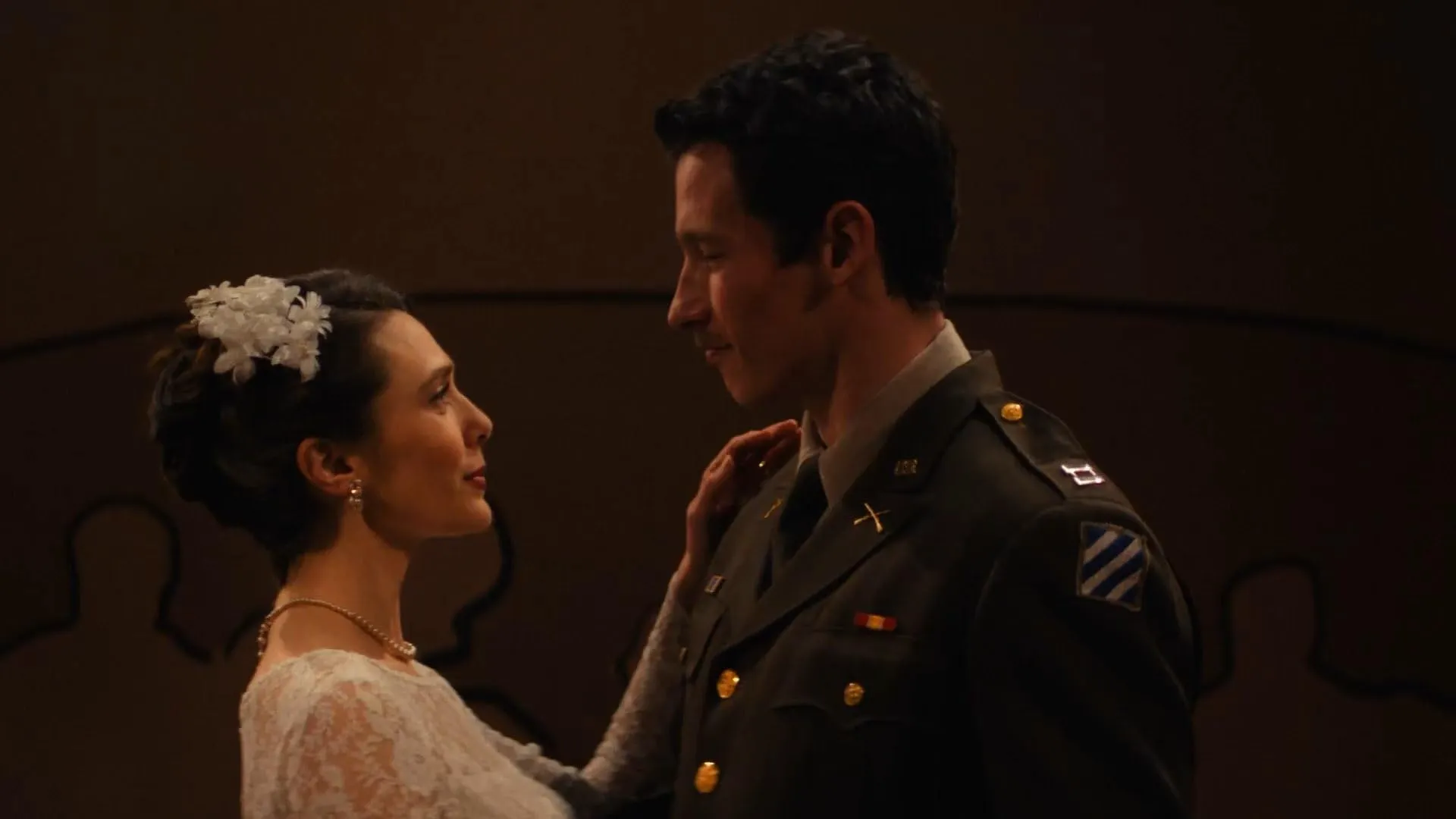
He appears in his younger body, ready to wait for his wife to join him. Larry’s plan for a shared afterlife is complicated when Joan arrives along with her first husband, the dashing Luke (Callum Turner). Luke, who died in the Korean War, has been waiting for her for decades. Joan is now faced with an impossible choice: which man will be her partner for all time?
Purgatory as a Corporate Timeshare
The film’s vision of the great beyond is a pointedly secular and commercial one, a significant departure from the spiritual or mythological heavens often depicted in Indian cinema. Where epics like the Mahabharata describe Swarga as a celestial paradise for the righteous, Eternity offers the Junction, a soulless space with the sterile ambiance of a mid-century American hotel.
This aesthetic choice is a sharp piece of satire; it frames the afterlife through the lens of post-war consumerism, turning salvation into a sales pitch. At an “eternity expo,” souls browse booths advertising different versions of paradise like timeshares at a trade show.
Options like Queer World, Capitalist World, and a hilariously overbooked Man-Free World reduce eternal bliss to a lifestyle brand. Zazu Myers’ production design crafts a world that is clever and specific, using details like memories displayed as static museum dioramas to underscore the idea that the past has been cataloged and commodified.
The rules of this universe are simple and corporate. New souls have seven days to select a permanent destination from a brochure of options. Failure to choose results in an indefinite service job, a fate Luke accepted to wait for Joan. This transactional system, managed by Afterlife Coordinators, presents a stark contrast to the concept of karma, where one’s afterlife is a consequence of earthly deeds, not a consumer choice.
While Ruairi O’Brien’s cinematography captures this imaginative world, the direction sometimes feels constrained. The camera often remains static, relying on functional medium shots that flatten the impressive sets, making this vast waystation feel smaller and more theatrical than intended. The visual execution does not always match the cleverness of the concept.
A Love Triangle for the Ages
The film’s central conflict is a classic love triangle, an emotional architecture that has powered countless Bollywood dramas for decades. At the dilemma’s heart stands Joan, torn between the life she lived and the one that was taken from her. Her situation is a direct parallel to the choice faced by heroines in films like Yash Chopra’s Silsila, where a woman must weigh the profound connection of a past love against the societal and personal duties of her marriage.
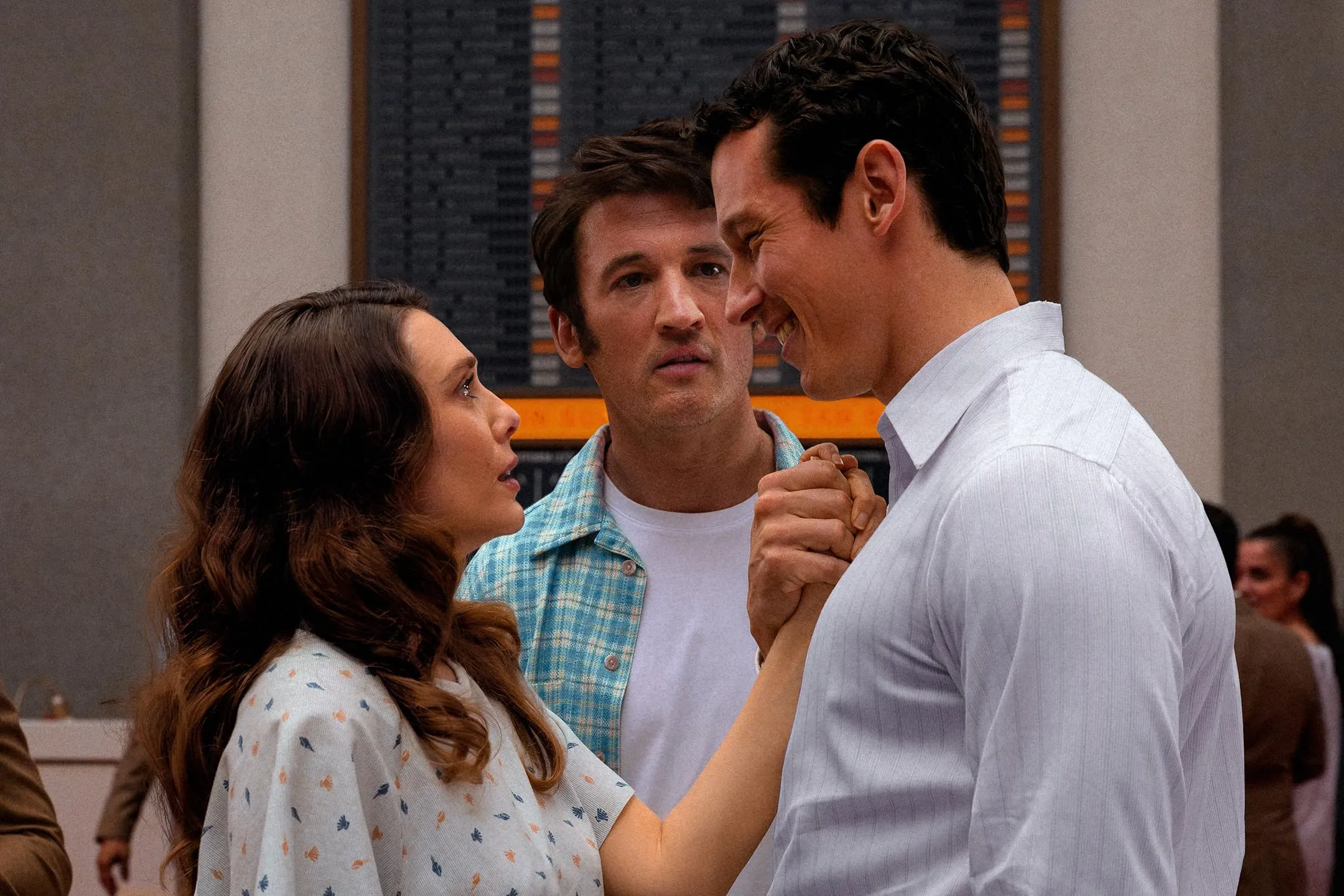
Elizabeth Olsen portrays Joan’s indecision with a convincing physical performance. Her entire demeanor shifts with her company; she carries herself with a comfortable familiarity around Larry, yet reverts to the giddy posture of a young woman in love when with Luke. The character, however, sometimes feels less like an active agent in her own destiny and more like a prize to be won.
The script frames her choice almost entirely through the lens of her personal happiness, a typically Western, individualistic perspective. An equivalent Bollywood story might place greater weight on the concept of dharma, or duty to the life and family she built. A briefly mentioned possibility of Joan forging her own path with a friend (Olga Merediz) is disappointingly left unexplored.
Miles Teller’s Larry is the reliable husband, representing decades of shared history, contentment, and the beauty of the mundane. Teller gives the character a grounded, everyman appeal, making a quiet case for unassuming, long-term partnership. He uses subtle gestures of annoyance to hint at Larry’s deep insecurity. In stark contrast, Callum Turner’s Luke is the romanticized dream, a war hero frozen in time as the perfect first love. He is the personification of “what could have been.”
Turner fulfills this matinee idol role while trying to give Luke a soulful melancholy born from nearly seventy years of waiting. The bickering between the two men provides some sharp comedic moments, but the dynamic risks becoming monotonous, threatening to stall the film’s momentum as Joan’s deliberation extends through the film’s middle act.
The Divine (and Divinely Funny) Middle Management
Injecting much-needed vitality into the proceedings are the Afterlife Coordinators, who ground the film’s high-concept premise with cynical humor. Larry’s AC is Anna, played by Da’Vine Joy Randolph, and Joan’s is Ryan, played by John Early.

They function as the story’s comic relief, two jaded celestial bureaucrats who become deeply and unprofessionally invested in the romantic drama unfolding before them. Their roles are reminiscent of the vidushak, the witty court jester in classical Indian drama, who serves as the hero’s confidant and speaks truth through comedy. Anna and Ryan are the audience’s surrogates, preventing the film from becoming overly sentimental by puncturing its romanticism with pragmatism.
Randolph and Early are the film’s undeniable highlights. Randolph’s delivery is a masterclass in dry wit; she projects a world-weary authority that makes every line land with precision. Early provides a perfect foil with a sassier, more conniving energy. Their banter feels fresh and alive, a sharp contrast to the sometimes-stilted central drama. One is left with the feeling that these gifted performers are somewhat constrained by the script, wishing they had more freedom to fully display their talents.
Forever is a Flawed Promise
Eternity uses its inventive setup to ask fundamental questions about love and commitment. By making “happily ever after” a literal and inescapable reality, the film exposes the concept as a potential nightmare. The pressure to choose one perfect state for all time is paralyzing, a celestial reflection of the choice anxiety that defines modern life.
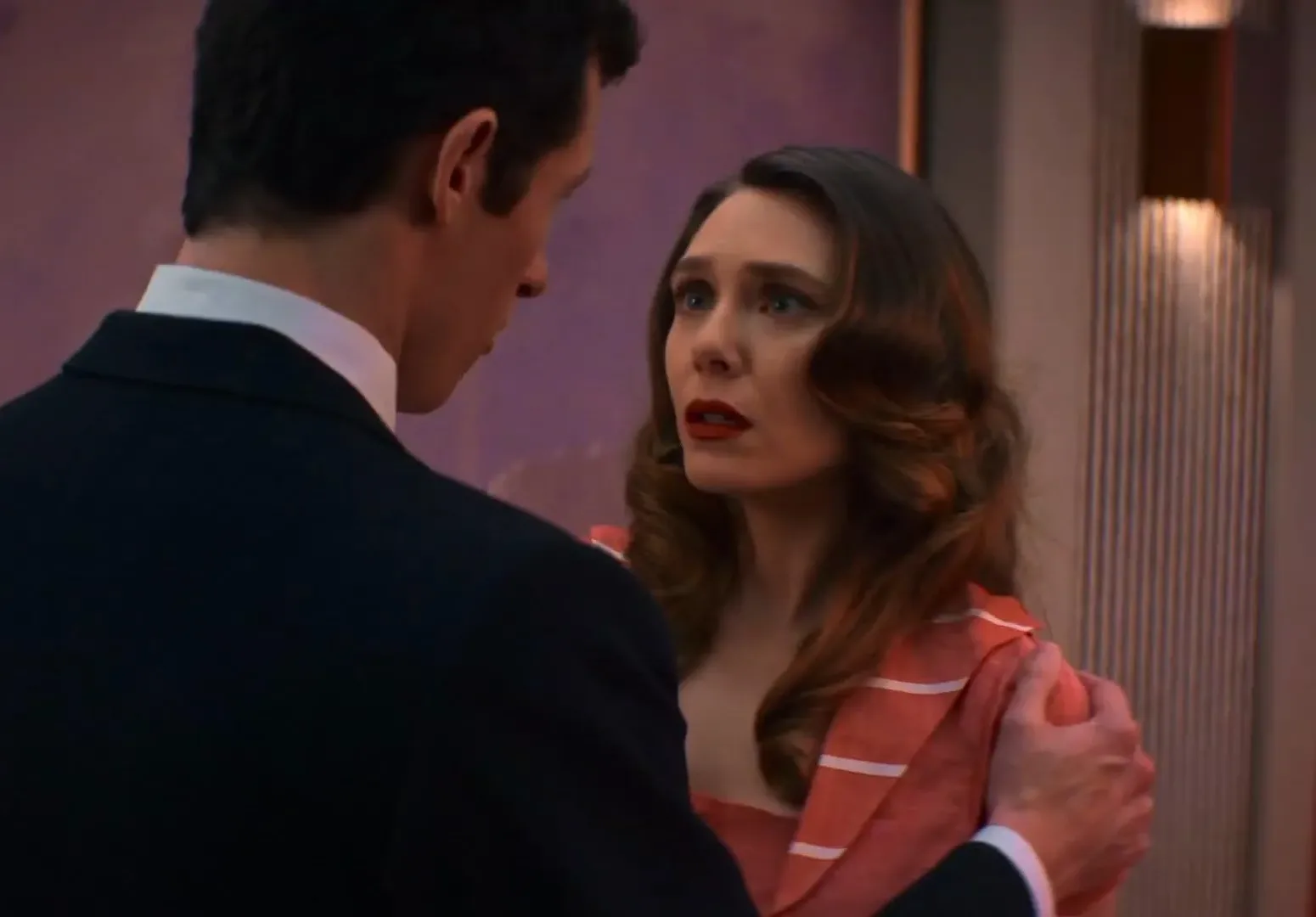
Is a relationship defined by its passionate, idealized beginning, or by its long, quiet, and imperfect continuation? The screenplay by Pat Cunnane is built on this strong idea but struggles to maintain its narrative drive. The film’s middle section, where Joan takes a trial run with each husband, feels protracted. It relies too heavily on conversations where characters restate their positions rather than advancing the plot through new revelations, thinning out the initial promise of the setup.
The film’s resolution moves toward a sentimental and traditional outcome. It avoids the darker, more existentially challenging implications of its premise, like the possibility of choosing oblivion over an imperfect eternity. This choice provides a comforting answer, one that reinforces a conventional message about creating our own paradise through the love we build in life.
It feels satisfying in a conventional sense, but it sidesteps the more difficult questions the story initially poses. This stands in contrast to many films from India’s parallel cinema movement, which often favor ambiguity or bittersweet realism over neat resolutions. By opting for a clean emotional finish, Eternity offers a sweet but ultimately safe exploration of its very complicated premise.
The film “Eternity” had its premiere on September 7, 2025, at the Toronto International Film Festival. It is scheduled to be released in a limited capacity in the United States on November 14, 2025, with a wider release to follow on November 26, 2025. The film is distributed by the company A24.
Full Credits
Director: David Freyne
Writers: Pat Cunnane
Producers and Executive Producers: Trevor White, Tim White
Cast: Miles Teller, Elizabeth Olsen, Callum Turner, Da’Vine Joy Randolph, John Early, Olga Merediz, Betty Buckley, Barry Primus, Jeff Sanca, Brady Droulis, Panta Mosleh, Noah Bromley, Jeanie Cloutier, Olga Petsa, Sebastian Billingsley-Rodriguez, Erik Gow, David Z. Cohen, Lucy Turnbull, Danny Mac, Meg Roe, Kyle Warren, Kristina Capati, Devielle Johnson, Bianca Foscht, Eva Ferguson, Peter D’Souza, Elodie Venece, Karl Reay, Riun Garner
Director of Photography (Cinematographer): Ruairí O’Brien
Editors: Joe Sawyer
Composer: David Fleming
The Review
Eternity
Eternity is a pleasant romantic comedy built on an inventive premise. While the central love story sometimes falters in a repetitive second act, the film is consistently saved by its brilliant supporting cast. Da’Vine Joy Randolph and John Early deliver scene-stealing performances that provide the sharpest laughs. The movie raises fascinating questions about love and forever, even if it settles for a conventional answer. It is a sweet, clever film that is more charming than profound.
PROS
- Inventive high-concept premise.
- Clever world-building and satirical production design.
- Hilarious, scene-stealing performances from Da’Vine Joy Randolph and John Early.
- Sharp comedic writing for the supporting characters.
CONS
- The narrative drags and feels repetitive in the middle section.
- The central love triangle loses its emotional weight over time.
- Avoids the deeper, more complex themes its premise suggests.
- Visual execution sometimes feels flat and constrained.