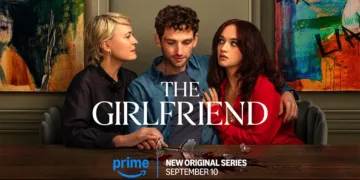































The monster-in-law trope is a television staple, usually played for sitcom laughs. The Girlfriend, a new six-part thriller, takes that familiar setup and gives it a vicious, psychological twist. At the center of this storm is Laura (Robin Wright), a wealthy London gallerist whose affection for her son Daniel (Laurie Davidson) is intense enough to set off alarm bells.
Daniel is a sweet, handsome medical student, and he has just fallen for Cherry (Olivia Cooke), a sharp young woman with a working-class background and a past she’d rather keep hidden. The first meeting is a masterclass in passive aggression.
Laura sizes up Cherry’s name, her dress, and her ambition, immediately pegging her as a manipulative social climber. The show wastes no time framing its central conflict: Is Laura’s fierce protectiveness a mother’s instinct, or a paranoid obsession? And is Cherry a cunning predator, or simply an ambitious woman being judged by an elite she dares to enter? What follows is a delicious, nasty war for Daniel’s affection.
A Tale of Two Liars
The Girlfriend’s cleverest trick is its narrative structure, a device that elevates the series beyond a standard potboiler. Each episode is split neatly down the middle, presenting a sequence of events first from Laura’s commanding point of view, then flipping to show the same moments through Cherry’s anxious eyes.
This framework is the engine of the show’s tension, weaponizing perspective to keep the audience perpetually off-balance. Through Laura’s lens, Cherry is a collection of red flags. She fibs about where she went to school, feigns knowledge of modern art by reading from a coffee table book, and seems to flaunt her sexuality with a shocking lack of decorum. Laura witnesses a stolen bracelet and a mysteriously freed cat, building a case for Cherry being a sociopathic threat. The audience is led, quite deliberately, to adopt Laura’s suspicions.
Then the script flips. From Cherry’s perspective, these events are re-contextualized not as malice, but as desperation. The dress Laura found so vulgar is a borrowed item Cherry cannot afford to ruin, causing her immense anxiety when coffee is spilled on it. Her attempts to fit in are clumsy acts of self-preservation in a world whose social codes are foreign to her.
A micro-aggression Laura barely remembers delivering lands like a declaration of war on Cherry. The show masterfully manipulates viewer allegiance, forcing a constant reassessment of who is the victim and who is the villain. The drama comes not from shocking plot twists, but from the interpersonal friction created by unreliable memory and perception.
It turns the audience into an active participant, a jury forced to weigh two biased testimonies without a definitive truth. This structure suggests that the real antagonist is not a person, but the way ego and prejudice can bend reality into a weapon.
The Lioness, The Vixen, and The Lamb
The show’s psychological warfare is fueled by two phenomenal, perfectly matched performances. Robin Wright plays Laura with a chilling poise, her cool elegance barely masking a frantic, possessive neediness. She deploys a wide-eyed faux-naïveté that makes her manipulations all the more insidious, pleading for people to just listen while refusing any interpretation of events but her own.

Wright imbues Laura with the quiet certainty of a woman who believes her wealth and status grant her moral authority. Her obsession is rooted in the past grief over a lost child, a tragedy she uses to justify any action, no matter how cruel. She is a lioness protecting her cub, and she gives herself permission to be a monster in the name of that protection.
Across the chessboard is Olivia Cooke’s Cherry, a captivating mix of scrappy determination and calculated charm. Cooke excels at playing her cards close to her chest. Her Cherry is a chameleon, code-switching effortlessly to survive in a hostile environment. One moment she is a sympathetic victim of classism; the next she is unapologetically punching an ex-boyfriend on a public street.
Cooke makes Cherry’s ambition feel like a legitimate defense mechanism. We learn of a dark past, including a shocking incident at an ex’s wedding involving a blood-filled balloon, that complicates any easy sympathy. The performance dares you to judge her while simultaneously showing you why she became the schemer she is.
Caught between them is Daniel, a character so sweet and bland he is less a person and more a human trophy. A supposedly brilliant medical student, his complete obliviousness to the war raging around him stretches belief to its breaking point. Yet his passivity is the vacuum that allows the two women’s rivalry to grow to monstrous proportions.
In a clever subversion, he occupies the traditional role of the passive female prize in older thrillers. He exists to be won. Providing a much-needed dose of sanity is Waleed Zuaiter as Howard, Laura’s husband. His performance is wonderfully layered; he is the story’s weary conscience, a man whose own grief has left him too tired for the games his wife insists on playing.
Prestige Trash and Proud of It
The Girlfriend looks expensive, and it belongs to a thriving television subgenre of Crazy Rich White Woman melodrama. Every frame is filled with the signifiers of wealth: minimalist London mansions with indoor pools, sun-drenched Spanish villas, and a wardrobe that wages its own silent battle. Robin Wright, who also directs the first three episodes, establishes a fluid, visually rich style.

The camera swirls and glides through these immaculate spaces, hinting at the rotten secrets they contain. The aesthetic is a key part of the storytelling. Laura’s home is a fortress of curated taste, and the costume design uses color to underline the conflict, with Laura’s sterile whites and cool tones clashing against Cherry’s bold, confrontational reds.
The show knows exactly what it is. It leans into its soapy, campy elements with glee, serving up outlandish plot developments without a hint of apology. This is not a series trying to be a weighty social drama; it is “glossy trash” in the best possible sense, designed for pure, unadulterated escapism. The soundtrack reinforces this tone. It opens with a moody Lorde cover and deploys sharp needle drops, like Wet Leg’s ‘Chaise Longue’ during a sex scene, to create a deliberate and effective tonal mix.
Love, Money, and Other Weapons
Beneath the glossy surface, this is a story about class. The central conflict is a form of warfare fought with social standing and economic power. Laura’s greatest weapon is her wealth and the unspoken rules of her elite world, which she uses to belittle and exclude Cherry.

Her home is a gallery of good taste, and Cherry’s very presence is a violation of its unspoken code. For Cherry, ambition is a survival tool. Her lies and manipulations are her attempt to claim the security and status that were never offered to her. The show also presents a cutting examination of possessive love.
Laura’s bond with Daniel borders on a Jocasta complex, an idea cemented in an early scene where they wrestle in a pool with an unsettling intimacy. Her affection is a form of control, a suffocating force disguised as maternal care. The feud between the two women is not just a rivalry; it is a primal battle for ownership, showing how ferocious affection can sour into something far more dangerous.
The Girlfriend is an upcoming television series scheduled to premiere on September 10, 2025. You will be able to watch it on Amazon Prime Video.
Full Credits
The Review
The Girlfriend
The Girlfriend is a deliciously nasty piece of work, a glossy thriller that knows its strengths and plays them to the hilt. Anchored by two stunning performances from Robin Wright and Olivia Cooke, its clever narrative structure and self-aware, campy tone make it an addictive watch. While some plot points strain credulity and the central male character is a blank slate, the psychological warfare is so expertly staged and beautifully shot that you will not care. It is a perfect slice of high-end, guilty-pleasure television.
PROS
- Engaging dual-perspective narrative structure that manipulates audience allegiance.
- Stellar lead performances from Robin Wright and Olivia Cooke.
- Stylish direction and high-end production design.
- Sharp exploration of class, ambition, and possessiveness.
- Entertaining, self-aware "guilty pleasure" tone.
CONS
- The character of Daniel is underdeveloped and functions as a plot device.
- Some plot developments are outlandish and stretch credulity.
- The central conflict can feel repetitive before it escalates in later episodes.