
























The ground beneath a modern city is a repository of history, though usually of a far less volatile sort than what’s unearthed in Fuze. The film begins with a premise of elegant simplicity: construction workers in London strike an unexploded German bomb from the Second World War. This single discovery halts the hum of urban life, sending a ripple of organized panic through the streets.
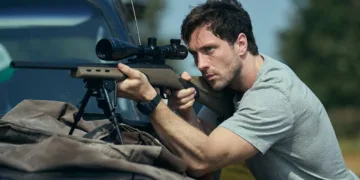
Director David Mackenzie establishes the stakes with methodical precision. An evacuation zone is declared, police cordons go up, and a military bomb disposal team arrives to manage the dormant threat. At the head of this team is Major Will Tranter, played by Aaron Taylor-Johnson with the exact brand of sharp confidence you would want from a man whose job involves preventing large explosions.
He is a figure of pure competence, taking command of the scene and preparing his team for the delicate task ahead. The film’s opening act functions as a tightly wound procedural, presenting a clear and immediate danger that places the entire narrative on a timer.
Two Clocks Ticking
The initial construction of Fuze is its most impressive feature, functioning as a near-perfect narrative machine. The script presents two distinct storylines running on parallel tracks, each meticulously crafted to generate its own specific brand of suspense.
On the surface, we follow Tranter and his team through the methodical rituals of bomb disposal. Mackenzie dedicates time to the technical details, lingering on shots of diagnostic equipment and specialized tools like the “clock-stopper.”
This focus on process makes the danger feel authentic and immediate. The squad’s cynical humor (“Don’t be sh*t”) is deployed sparingly, serving as a brief release valve in an otherwise suffocating atmosphere. The direction expertly builds anxiety around a largely static object, turning the muddy construction pit into an electric space where a wrong move means catastrophe.
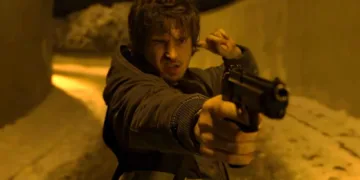
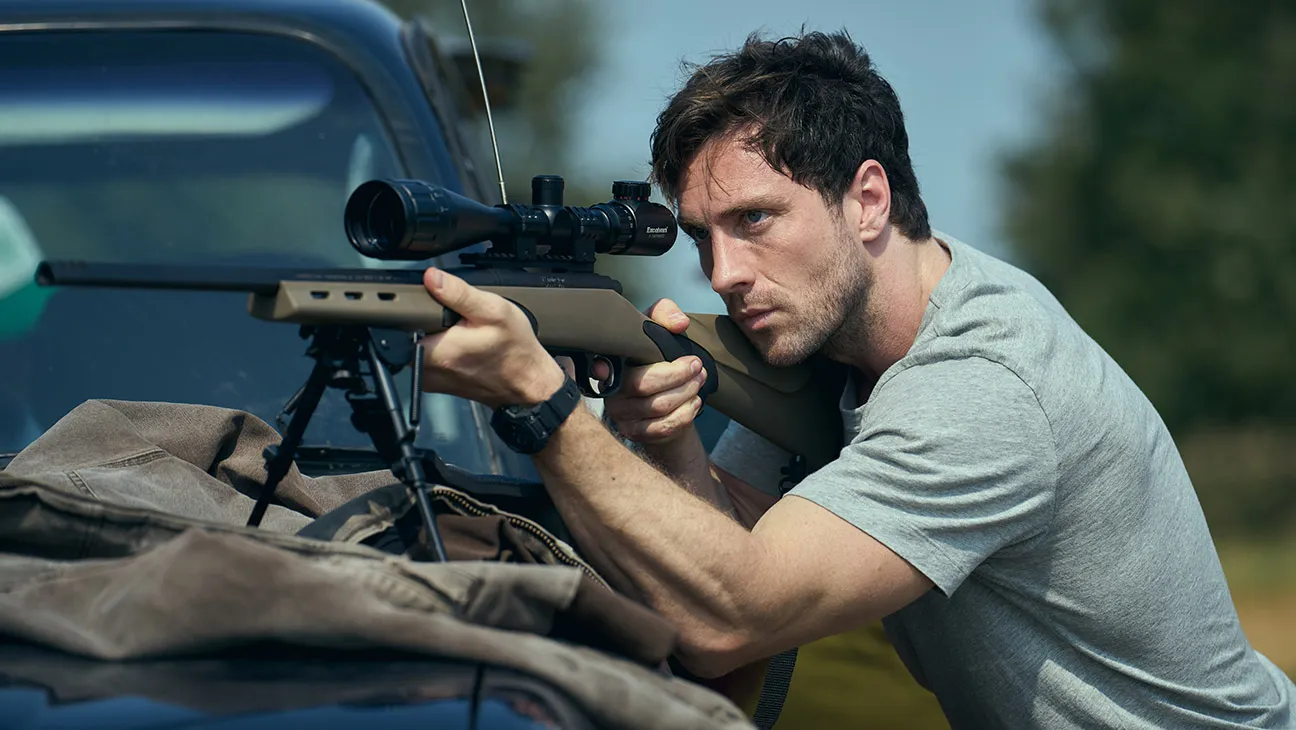
Simultaneously, another operation unfolds in the shadows. In the basement of an adjacent building, a team of thieves led by Theo James’s coolly detached Karalis uses the citywide distraction for their own purposes. Their world is one of quiet, methodical work. The sound design shifts from the open-air tension of the bomb site to the claustrophobic scrape and drill of the heist.
Their preparations, particularly the foresight to bring their own generator after the power is cut, signal a level of planning that borders on prescient. The film’s editing creates a compelling rhythm, cutting between these two ticking clocks. This structure does more than just double the stakes; it cleverly positions the audience in a state of divided loyalty. We are conditioned to root for the hero saving the city, yet the film makes the thieves’ competence so engaging that we also become invested in their success.
Archetypes Under Pressure
A film built on such a precise mechanical premise relies on its characters to function as equally well-defined cogs, and Fuze populates its world with effective genre archetypes. Aaron Taylor-Johnson’s Will Tranter is introduced as the story’s heroic anchor, a man of action and decisive authority whose confidence is his primary tool.
Yet the performance is layered with subtle tells; a flicker of unease and an over-eagerness to assert command suggest his confident exterior may be a carefully constructed shield. He quickly dismisses a subordinate’s observation that the bomb’s metal seems too new, a small act of hubris that signals a deeper complexity waiting to be revealed. His character arc is the film’s most significant, beginning as a straightforward hero and morphing into something far more ambiguous.
As the leader of the thieves, Theo James portrays Karalis with an opposite energy. He is unassuming and watchful, a strategist whose calm demeanor is more unsettling than any overt threat. James’s understated performance makes the character a true enigma, and the script wisely keeps his motivations close to the vest for much of the runtime.
Gugu Mbatha-Raw provides the film’s procedural grounding as Superintendent Zuzana, observing the situation from a control room filled with monitors. She is the omniscient viewer, the “person in the chair” who spots anomalies like an errant heat signature.
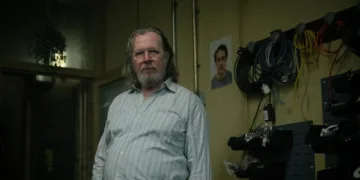
Her role is a necessary narrative function, allowing the film to feed information to the audience organically. The wider cast, including Sam Worthington as the heist crew’s pragmatic muscle and Elham Ehsas as an evacuated civilian caught in the chaos, provides different vantages on the crisis, filling out the world without distracting from the central players.
When the Premise Detonates
At its midpoint, the narrative architecture of Fuze undergoes a planned demolition of its own. The revelation that the WWII bomb is a modern fake, planted specifically as a diversion for the bank robbery, acts as a fundamental structural pivot. The story instantly transforms, shedding its bomb-disposal skin to become a full-fledged crime thriller.
This is the script’s cleverest maneuver, a genuine surprise that re-contextualizes the entire first act and Tranter’s earlier signs of stress. The film’s pacing, which is breakneck and riveting up to this point, faces a significant challenge. Once the primary source of tension is removed, the subsequent manhunt and series of double-crosses struggle to maintain the same level of pure, focused intensity. The narrative energy shifts from a clear external threat to a more muddled internal conflict among the conspirators.
The story begins to purposefully obscure character motivations, shifting allegiances in a way that erodes the clear rooting interests established earlier. This is a standard feature of the heist-gone-wrong genre, but here it feels less like a natural evolution and more like an attempt to compensate for a spent premise. The plot becomes a web of uncertain logistics and betrayals.
This complexity is further complicated by the third act’s use of flashbacks. These sequences seem designed to add depth and explain the backstory of the conspiracy, but they disrupt the story’s forward drive at a critical moment. Instead of clarifying, they create a sense of disorientation, leading to an abrupt ending that feels more like a cessation than a resolution. The lack of a traditional catharsis seems to be a deliberate choice, but it leaves the viewer questioning the story’s ultimate point.
A Study in Competence
David Mackenzie directs Fuze with a steady, proficient hand. He is a capable builder of tension, and the film’s first half is a masterclass in staging and suspense. The visual style is clean and functional, with Giles Nuttgens’s bright, crisp cinematography giving the action a glossy sheen that is common in contemporary thrillers.
The editing is economical, never wasting a shot and ensuring the story moves at a rapid clip. Yet for all its technical polish, the film sometimes lacks a distinct personality. It clearly aims to be a modern successor to the stylish, adult-oriented thrillers of the 1990s or the work of directors like Tony Scott, where process and professionalism were sources of aesthetic pleasure.
While the shaky opening titles and musical cues gesture in that direction, the execution feels restrained. There is a sense of professional competence throughout, but little of the kinetic energy or directorial bravado that makes the best examples of the genre so memorable. It feels less like a passion project and more like a high-end television drama, well-made and engaging but lacking a certain cinematic scale.
A Clever Device
The central idea of Fuze is undeniably smart, offering a fresh angle on two well-worn genres. Its initial act is a skillfully constructed piece of suspense, propelled by a propulsive pace and a strong cast led by a compelling Aaron Taylor-Johnson. The film works best when it operates as a high-tension procedural, where the stakes are clear and the dangers are physical.
Its primary weakness is that the very cleverness of its premise becomes a narrative burden that the second half struggles to carry. The plot becomes more convoluted as it proceeds, and the loss of the initial ticking-clock premise leaves the remaining story feeling less focused.
The film’s reliance on a chain of unlikely variables and confusing structural choices in its final act keeps it from reaching its full potential. Fuze is a solidly entertaining thriller with a first-rate setup, a good example of a genre film that is satisfying in the moment, even if its intricate design starts to show cracks upon later inspection.
Fuze premiered at the Toronto International Film Festival on September 5, 2025. A wider release date has not yet been announced, but it will be available in cinemas and on Sky Cinema.
Full Credits
The Review
Fuze
Fuze is a cleverly engineered thriller that excels in its first half, building exceptional tension from a brilliant dual-narrative premise. The film's structural pivot is smart, but the story struggles to maintain its gripping momentum afterward, becoming a more conventional and convoluted crime caper. Supported by a strong cast, it remains an entertaining and proficient genre piece, though its impressive initial construction gives way to a less stable foundation. It is a film of great moments rather than sustained greatness.
PROS
- An intelligent and original high-concept premise combining two genres.
- The first act is a masterclass in building suspense and pacing.
- Strong, layered performance from Aaron Taylor-Johnson.
- The narrative structure is initially tight and highly effective.
CONS
- Loses significant momentum and focus after the central plot twist.
- The third act becomes convoluted with poorly integrated flashbacks.
- The ending feels abrupt and lacks a satisfying resolution.
- The direction is competent but lacks a distinctive stylistic flair.