























In the quiet, moneyed enclave of Sag Harbor, a place saturated with history, Charles Blakey is a man coming apart. He is the last heir to a generational home that is slowly succumbing to gravity and neglect, a perfect mirror for its current occupant.
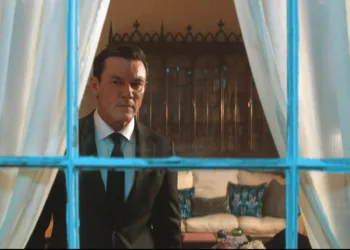
We are introduced to a character study in stasis. Financial ruin is the practical threat, but a deeper spiritual foreclosure looms. Charles drifts through his days with a self-loathing that curdles into aimless rage, a man so disconnected from his own lineage he seems a ghost in his own life. Then comes a knock at the door. Anniston Bennet appears, a figure of immaculate tailoring and unnerving calm.
His proposition is simple, lucrative, and laced with the sulfur of a classic Faustian pact. He wishes to rent the basement for a short time, for a sum that would erase all of Charles’s problems. It is a lifeline offered by a man who looks suspiciously like he holds the other end of the rope. The mystery is not what he wants, but why he wants it here, a question that hangs in the still, heavy air.
The Architecture of Memory
The Blakey residence is no mere set piece; it is the film’s decaying heart, a diegetic tomb of inherited memory. The production design excels in communicating a history of pride eroded by time, a mise-en-scène of profound neglect. Every floorboard creak, every patch of peeling paint, speaks to a lineage that Charles has allowed to go to seed.
Cinematographer Ula Pontikos frames the house with a sense of oppressive weight. Low-angle shots make the ceilings feel as if they are pressing down on our protagonist, while tracking shots that follow him through the cluttered halls suggest a man lost in a labyrinth of his own making. The home is less a shelter and more a psychological archive, a physical container for the history Charles has actively ignored.
His forced excavation of the basement, a space of literal and figurative repression, yields artifacts from another world: West African masks that stare out from the gloom with an unnerving vitality. These are not just antiques. They are ciphers of a past he never knew, triggering jarring, cryptic visions. The arrival of Narciss Gully, a local historian and curator, provides the necessary intellectual framework.
She is a grounding presence, a foil to the two men lost in their psychodrama. She sees a museum where Charles sees a pawn ticket, a living history where he sees dead weight. Her proposition to preserve the collection within the house itself creates a clear philosophical conflict. Is history a sacred text to be preserved or a raw material to be sold off to the highest bidder? Charles’s predicament makes the question anything but academic.
Chiaroscuro for Two Voices
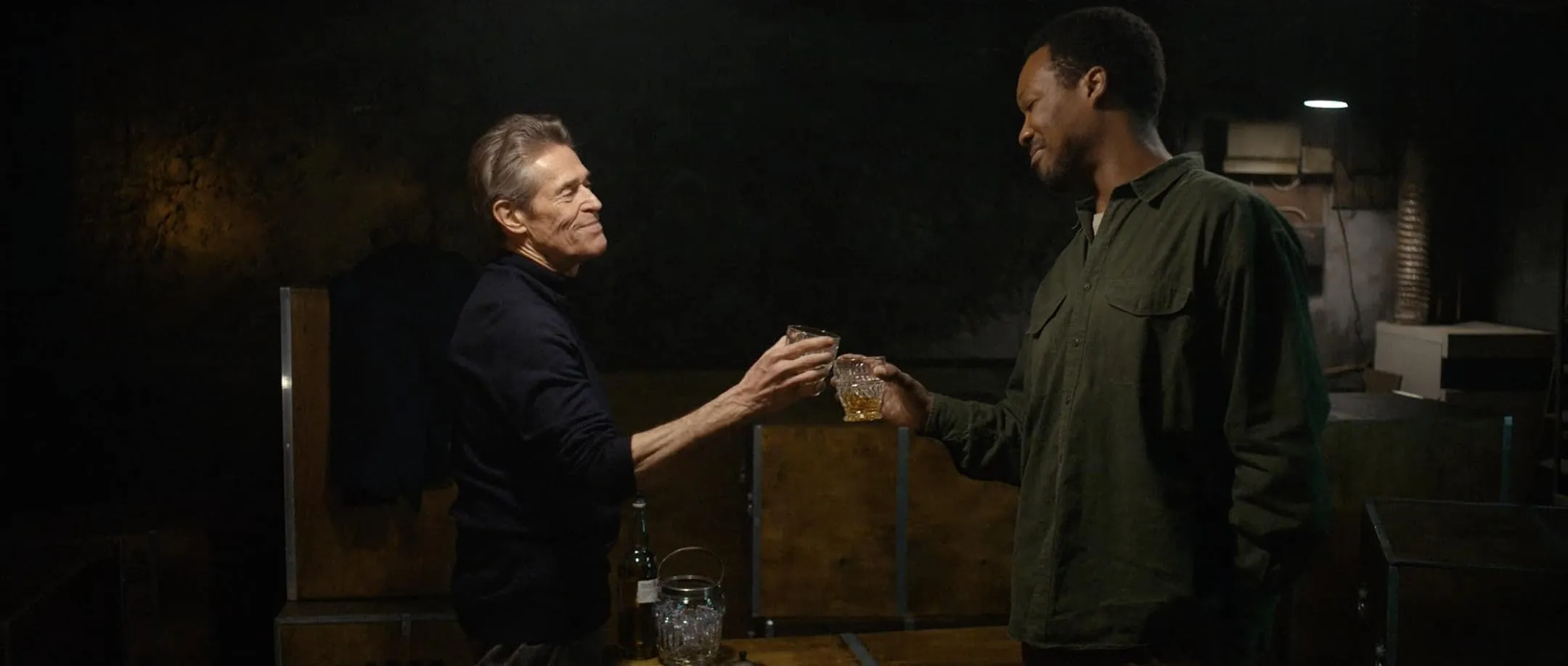
The film’s centerpiece is a truly bizarre and potent image: Anniston Bennet, a wealthy white man, constructs a steel cage in the basement of a Black man and locks himself inside. This act violently inverts the power dynamics of American history, literalizing them with an almost surrealist audacity. Charles becomes the reluctant jailer of his tenant, a master who serves his prisoner three meals a day.
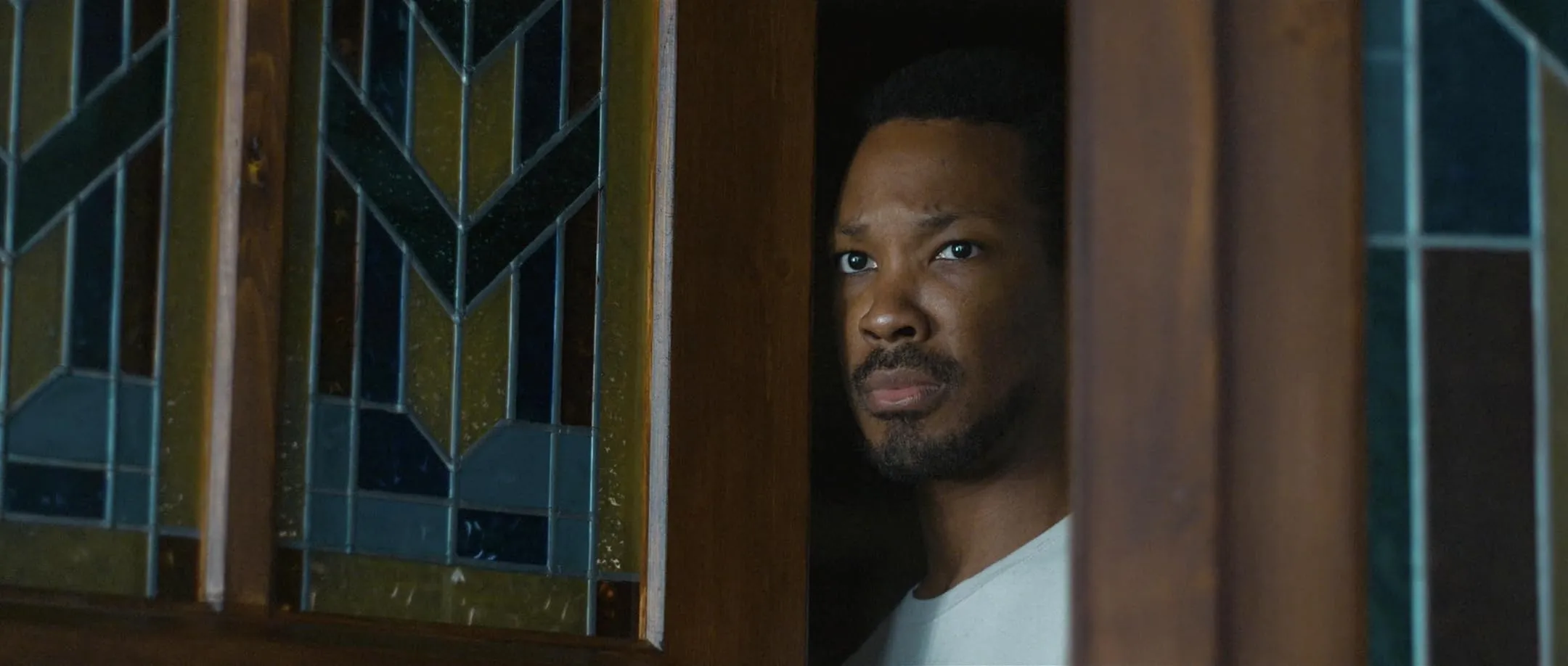
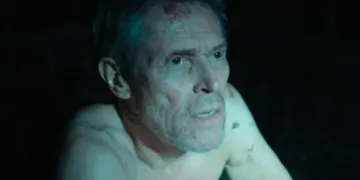
Director Nadia Latif understands the psychological horror of the optics for Charles himself, and the basement becomes a stage for a tense two-hander, shot with an expressionistic flair that owes a clear debt to classic noir. The use of chiaroscuro is pronounced; single, harsh light sources carve figures out of the oppressive darkness, rendering moral ambiguity in stark visual terms.
The camera’s behavior is deeply intelligent here. It often traps Charles in tight frames, pinning him against the architecture of his own home. At other times, it assumes Anniston’s perspective from within the cage, making the viewer complicit in his calm, unsettling gaze. This is where the performers take over. Corey Hawkins charts Charles’s descent with a palpable fragility. His physicality shifts from a resigned slump to a coiled, erratic energy, the portrait of a man handed power who has no idea how to wield it.
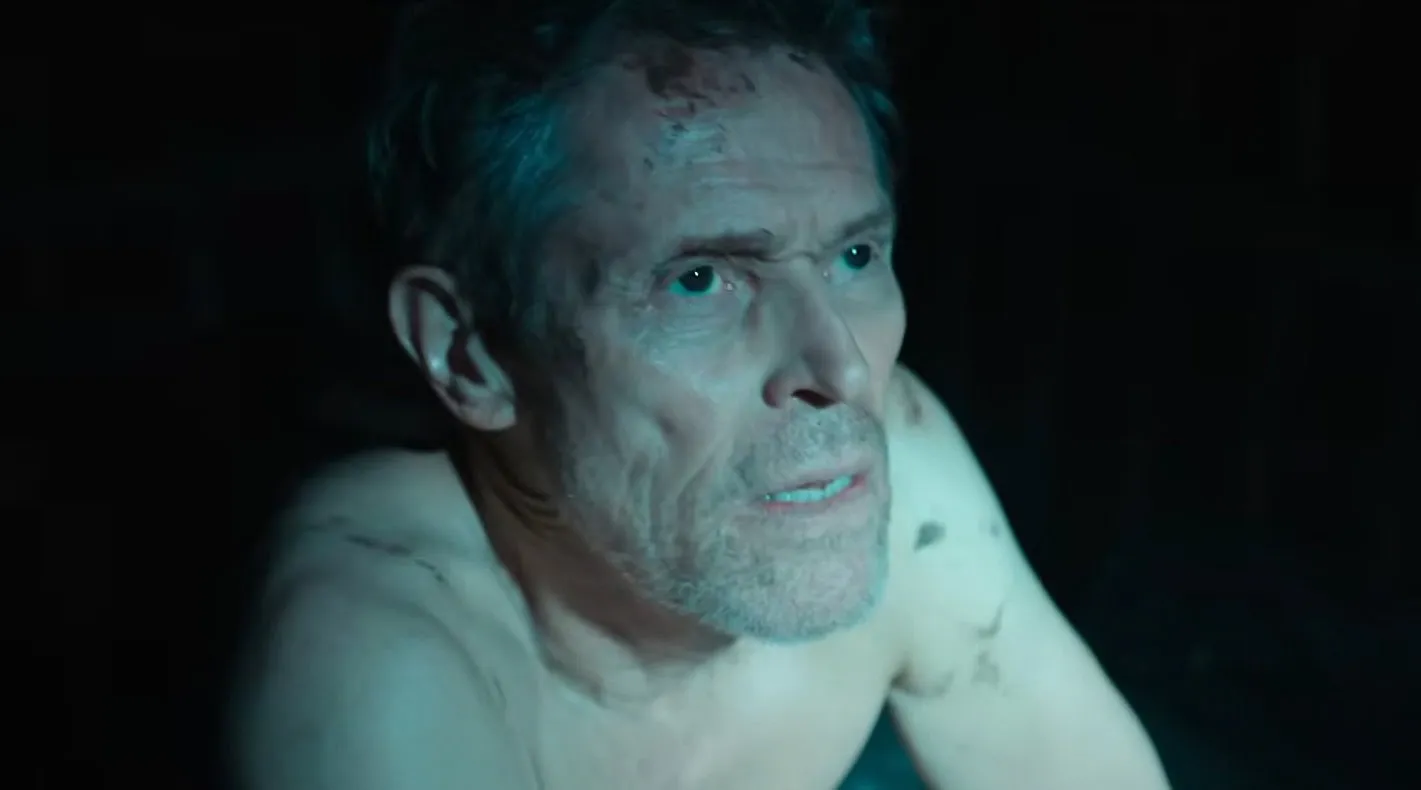
Willem Dafoe, in contrast, is a study in placid menace. His vocal delivery is key, a calm, almost therapeutic cadence used to deliver the most unsettling provocations. His Anniston is both confessor and provocateur, using philosophical monologues as surgical instruments to dissect Charles’s identity. From inside his cell, he remains the one in control, orchestrating a dark Socratic dialogue where every question is designed to lead Charles deeper into the maze of his own past. It is a slow, methodical chess match played in near total darkness.
A Thesis in Search of a Plot
For all its atmospheric potency, the film is burdened by the weight of its own ideas. It is an allegory first, a story a distant second, a common pitfall when a novelist adapts their own richly interior work for the screen. The screenplay labors to articulate its dense subtext concerning colonialism, inherited guilt, and the psychic wounds of history.
These are profound subjects, yet they are often delivered through Anniston’s lengthy, cryptic monologues instead of being embedded in the narrative action. The “why” of Anniston’s self-imprisonment remains frustratingly abstract, a symbolic gesture that lacks the grounding of believable human motivation. He speaks of atonement, of balancing some cosmic ledger, but his explanations feel like excerpts from a graduate thesis.
The story’s momentum suffers for it. The pacing is glacial, struggling to build suspense from a premise that is fundamentally static. After the initial shock of the setup, the plot idles in a pool of intellectual rumination. Subplots, such as the visions and the museum proposal, feel like separate thematic tracks running parallel to the main story instead of intersecting with it in a dramatically meaningful way. The film mistakes intellectual discussion for dramatic tension, resulting in a narrative that feels inert and overly didactic. It knows exactly what it wants to say. It just has not found a compelling way to show it.
An Unsteady Camera
Nadia Latif’s directorial debut begins with immense promise. The opening act is a masterclass in establishing mood, using unpredictable camera movements and a palpable sense of place to draw us into Charles’s hermetic world of decay. The initial tension is thick enough to be cut with a knife. A problem arises as the film progresses. This confident visual language gives way to a kind of stylistic hesitation.
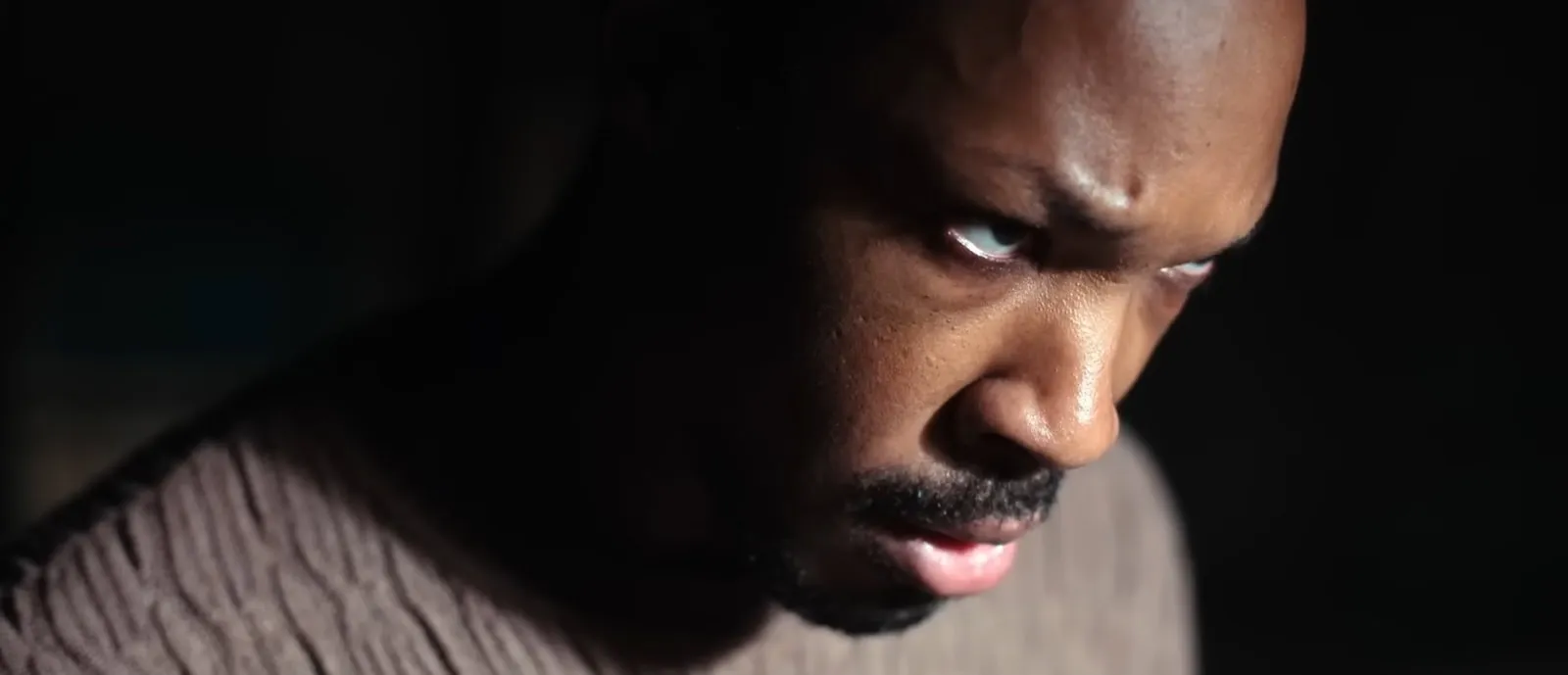
The dynamic, often handheld work of the opening scenes is replaced by static, stage-like blocking in the basement, a visual choice that unfortunately deadens the film’s energy. Faced with a radical, claustrophobic premise, the filmmaking often retreats to a conventional, even tame, aesthetic.
The introduction of cheap jump scares is a particular misstep, a concession to genre that feels like a fundamental misunderstanding of the film’s own strengths. The horror here is psychological and atmospheric, not something that pops out from the shadows. The film stands as a thought-provoking effort, anchored by two formidable lead performances. Its primary weakness is a failure of cinematic nerve, an inability to match its radical ideas with equally radical filmmaking. It constructs a brilliant cage for its themes but seems afraid to lock the door.
The Man in My Basement premiered at the Toronto International Film Festival on September 5, 2025. It is scheduled for a limited theatrical release in the United States on September 12, 2025, and will be available for streaming on Hulu.
Full Credits
Director: Nadia Latif
Writers: Walter Mosley, Nadia Latif
Producers and Executive Producers: Diane Houslin, John Giwa-Amu, Dave Bishop, Len Rowles, Nick Batzias
Cast: Corey Hawkins, Willem Dafoe, Anna Diop, Tamara Lawrance, Mark Arnold, Pamela Nomvete, Brian Bovell, Kayla Meikle, Ashley Brooke Walter, Miah Hasselbaink, Olivia Michi Shrenzel, Shellia Kennedy, Lizzie Lomas, Jonathan Ajayi, Gershwyn Eustache Jnr
Director of Photography (Cinematographer): Ula Pontikos
Editors: Mark Towns
Composer: Robert Aiki Aubrey Lowe
The Review
The Man in My Basement
The Man in My Basement is a film of potent ideas and committed performances trapped within a static narrative. While its central premise is a fascinating inversion of power, the screenplay struggles to translate its allegorical weight into a compelling story. The direction, initially strong, loses its nerve, leaving a philosophically rich but dramatically inert work. It is a thought-provoking piece that does not quite succeed as cinema.
PROS
- Powerful and committed lead performances from Corey Hawkins and Willem Dafoe.
- A bizarre and intellectually stimulating central premise.
- Strong atmospheric tension and production design, especially in the film's first act.
- Intelligent use of noir-inspired cinematography in key scenes.
CONS
- A plodding pace and a narrative that lacks forward momentum.
- An overly didactic script that explains its themes through monologues.
- Underdeveloped subplots that feel disconnected from the central conflict.
- An inconsistent visual style that becomes conventional and hesitant.