













There is a peculiar stasis that defines much of modern existence, a sense of being adrift that is no longer the exclusive property of the young. In Poetic License, this existential float is the water in which Liz Cassidy (Leslie Mann) finds herself swimming.
Transplanted to a quaint university town for the career of her economist husband, Liz faces the twin vacancies of an emptying nest and a life without professional purpose. Her daughter is busy forging a new identity; her husband is absorbed by professorial duties. So, Liz, a former therapist, does what the privileged and purposeless do: she audits a class.
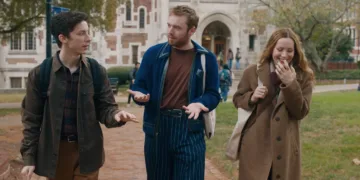
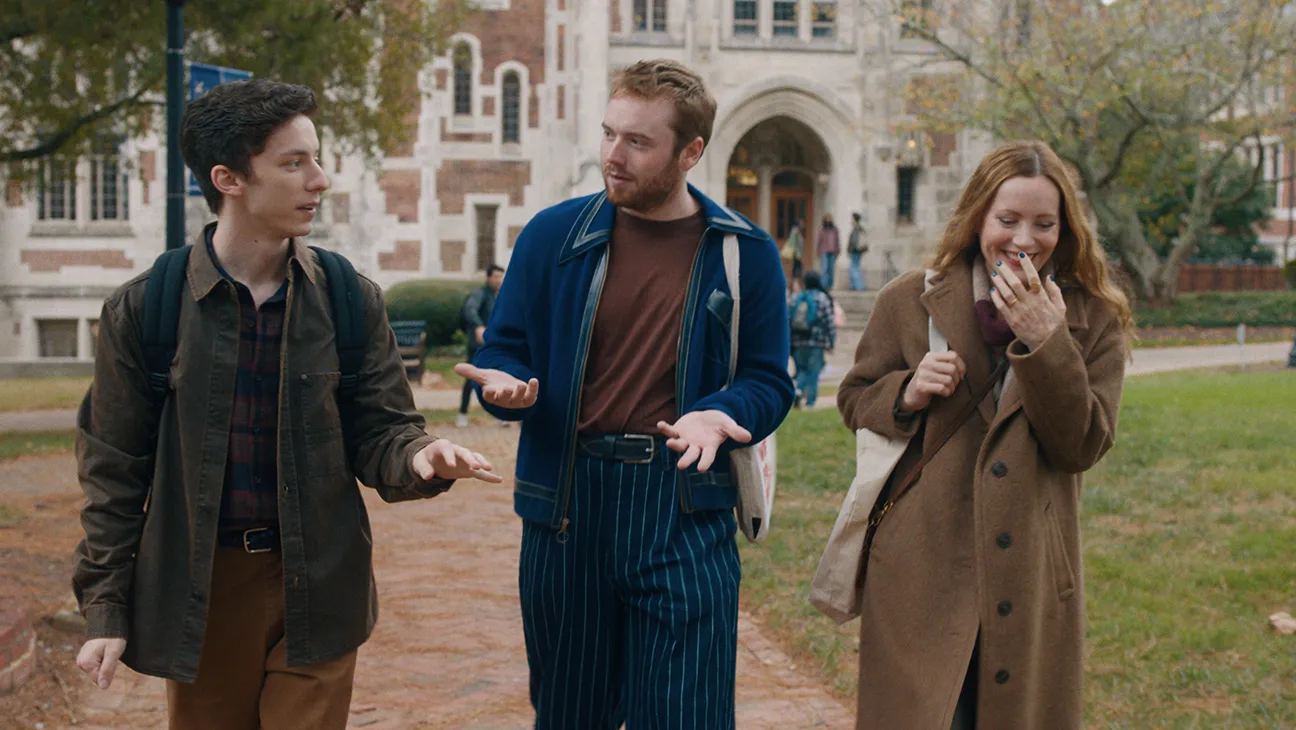
The class is poetry, a subject whose romantic imprecision suits her state. Here she becomes an object of intense curiosity for Ari (Cooper Hoffman) and Sam (Andrew Barth Feldman), two students wrestling with their own late-adolescent chaos. Their unlikely friendship becomes the film’s central specimen, a study in how loneliness seeks its own level across generational divides.
A Triumvirate of Yearning
The film rests almost entirely on the delicate, off-kilter chemistry of its three leads. Leslie Mann gives Liz a frazzled authenticity, a woman whose comedic neuroses barely conceal a desperate yearning for relevance. Her obliviousness to the romantic fixation she inspires is one of the script’s sharpest observations; it’s a form of psychological self-preservation.
Her need is for audience and affection, not for conquest. She seeks a non-judgmental space to perform a version of herself that existed before the titles of “wife” and “mother” subsumed her identity. The deep irony, of course, is her past as a couples therapist, a history that renders her unable to diagnose the profound unease in her own life.
As the boys, Cooper Hoffman and Andrew Barth Feldman are a perfectly mismatched pair. Hoffman’s Ari is a vortex of manic energy and inherited wealth, his verbal assaults on Sam a clear screen for a deep, almost painful codependency. His character is a sharp critique of a certain kind of modern malaise, where material comfort provides no defense against spiritual emptiness. Feldman’s Sam is the anxious, tightly-wound foil, a young man already planning a life of quiet desperation at Morgan Stanley.
His friendship with Ari is a lifeline to a more spontaneous part of himself he is actively trying to suppress. Their rapport feels authentic and lived-in, a friendship whose history is felt in every shared glance and cutting remark. Together, the three actors generate a peculiar gravity, pulling the film’s wandering attention back to its human center every time they share the screen. Their dynamic is what holds the picture together.
A Patrilineal Echo, A Feminine Cadence
For a directorial debut, Maude Apatow’s work is remarkably self-assured, particularly in its command of a specific, salty-sweet tone. The influence of her father’s filmmaking style is present (a loose structure, a fondness for rambling dialogue), yet the sensibility here feels distinct, less reliant on profane riffs and more attuned to emotional interiority.
The direction is personal and warm, especially in its treatment of Mann, whom Apatow shoots with the clear affection of a daughter documenting her mother’s enduring charisma. This approach transforms parts of the film into a quiet, familial document.
Raffi Donatich’s script prioritizes character moments over plot mechanics, finding humor and meaning in small, behavioral observations. It understands that the real story is not what happens to these people, but how they feel while nothing much is happening. This is a film about the universal search for validation, a coming-of-age story for people who should, by all accounts, already have come of age.
It speaks to a contemporary condition where traditional life stages have blurred. The film’s best moments are its quietest or its most absurdly funny, like the poetry class itself. The professor, played with masterful deadpan by Martha Kelly, uses the classroom as a stage for her own marital collapse, a hilarious and poignant detour that exemplifies the film’s strengths.
Her stream-of-consciousness grievances about a contested air fryer offer more insight into the human condition than any formal lecture on meter. These scenes demonstrate a knack for finding profundity in awkward human interaction.
The Fog of Arbitrary Detail
The film’s focus on its central trio is so intense that everything on the periphery becomes hazy and ill-defined. This tight focus is a source of strength but also the movie’s primary weakness. The supporting characters, chief among them Liz’s husband (Method Man, an odd casting choice), are less like people and more like narrative placeholders.
He exists simply to ensure the central entanglement remains safely platonic, a walking symbol of a life Liz is trying to escape. Her daughter, Dora (Nico Parker), fares slightly better, but her subplot about making new friends feels like an unnecessary diversion from the main event.
This lack of specificity extends to the world itself. The crucial subjects of “poetry” and “economics” are treated like interchangeable pieces of set dressing. We never understand what draws these characters to these fields or what ideas they represent. This intellectual vacuum is a missed opportunity; a deeper engagement with these disciplines could have provided a rich metaphorical layer to the characters’ internal struggles.
It gives the film a generic quality, a sense that its story could be happening anywhere, about anyone. The script’s aimlessness begins to feel less like a reflection of its protagonist’s inner state and more like a structural flaw. It creates a picture that is charming in the moment but evaporates from memory soon after, a pleasant fog that never quite resolves into a lasting image.
The film Poetic License premiered at the Toronto International Film Festival on September 6, 2025. It is a 2025 American comedy film that is currently seeking U.S. distribution.
Full Credits
Director: Maude Apatow
Writers: Raffi Donatich
Producers: Judd Apatow, Maude Apatow, Josh Church, Thalia Daniel, Will Greenfield, Benjamin Hung, Olivia Rosenbloom
Executive Producers: Jamal Daniel, Michelle Upton, Renee Witt, Harrison Kreiss, Jay Cassidy
Cast: Andrew Barth Feldman, Cooper Hoffman, Leslie Mann, Nico Parker, Maisy Stella, Cliff “Method Man” Smith, Martha Kelly, Will Price, Jake Bongiovi, Sam Snyder
Director of Photography: Jeffrey Waldron
Editors: Jay Cassidy
Composer: Jeff Morrow
The Review
Poetic License
Poetic License is a film of immense, concentrated charm. Its success is almost entirely attributable to the magnetic interplay of its three leads and Maude Apatow's warm, intelligent direction. Yet, the film is an island; the world beyond its central relationship is a forgettable fog of arbitrary detail and underdeveloped characters. It is a pleasant, often funny, and heartfelt experience that captures a specific modern aimlessness, but its lack of thematic and narrative specificity prevents it from leaving a deeper mark. It fades from memory almost as quickly as it appears.
PROS
- The film is anchored by the sparkling, lived-in chemistry between Leslie Mann, Cooper Hoffman, and Andrew Barth Feldman.
- Maude Apatow’s debut is tonally assured, mixing heartfelt emotion with dry, observational humor.
- The screenplay excels with its character-driven focus and intelligent, often funny, dialogue.
- It effectively explores the feeling of being unmoored in life, a condition that cuts across generations.
CONS
- Characters outside of the central trio, particularly the husband and daughter, feel like narrative placeholders.
- The film's world feels thin and generic, with key elements like poetry and economics serving as little more than set dressing.
- The narrative sometimes mirrors its characters' lack of direction, leading to pacing issues and a story that feels structurally weak.
- The film's charms are immediate but ephemeral, leaving little lasting impression.