
















To be unseen is a type of death. For Gavin Bain and Billy Boyd, two Scottish youths with hip-hop ambitions beating in their chests, the world of the early 2000s offered only this quiet erasure. They existed as hollow echoes in Dundee call centers, their artistic aspirations a private joke to a dismissive culture.
A trip to London for a talent audition confirmed their deepest fear: their voices, filtered through a Scottish cadence, were imperceptible to the gatekeepers of fame. The rejection was an existential verdict on their very being. So, they chose a radical form of rebirth. They would kill their provincial selves to fashion new ones from the myths of Americana.
As Silibil N’ Brains, a rap duo from California, they would construct an identity palatable to the world that had denied them. Their mission was a philosophical gambit, a plan to hold a mirror to the industry by becoming the illusion it craved.
The Ecstasy of the Counterfeit
A new self is assembled from fragments, a ghost built from the celluloid of other people’s stories. The duo’s method is a kind of ritual, endlessly repeating movie quotes until the foreign sounds become their own. This is not mere mimicry; it is a desperate act of transubstantiation, an attempt to will a new soul into existence through sheer repetition.
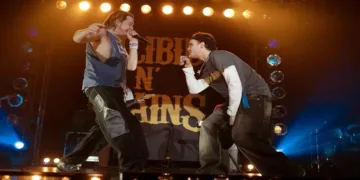
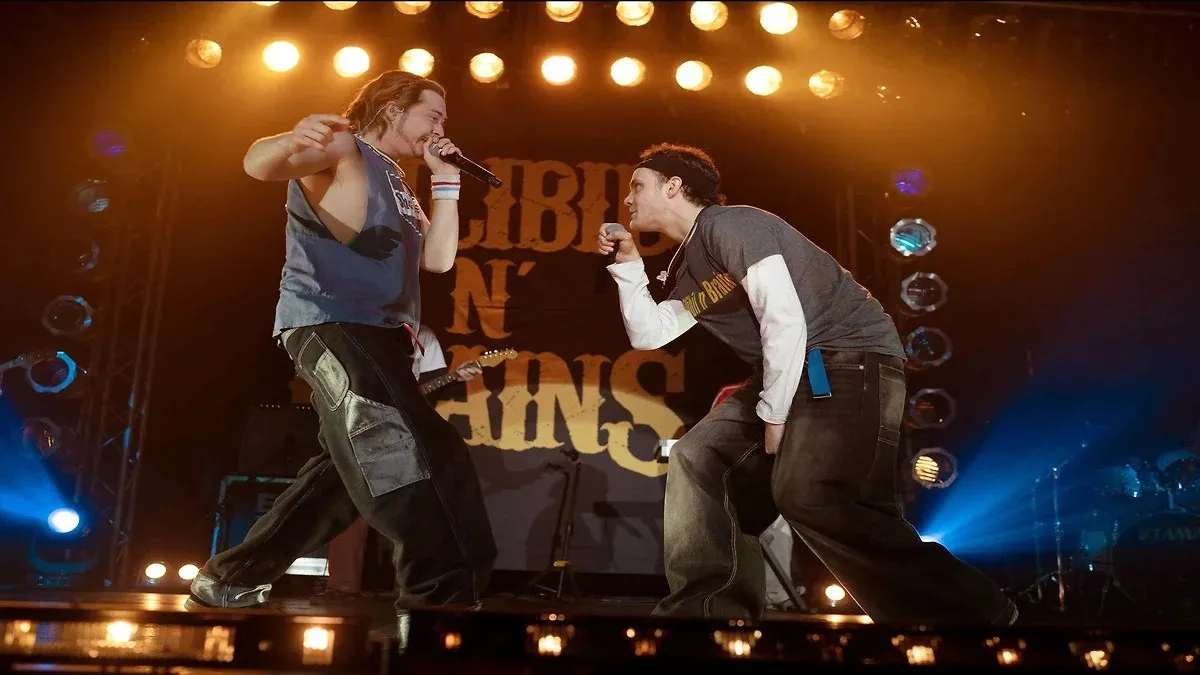
Their prayer is answered in the sticky, pulsing darkness of a London club. They talk their way onto the stage, two apparitions from a place that does not exist, and unleash a torrent of sound. The performance is raw, their lyrics sharp, their energy a strange fusion of practiced bravado and genuine panic. The industry, a beast that feeds on narrative, consumes their fiction whole.
A record agent sees them, and their lie is given life. The film captures this vertiginous ascent with a disorienting energy. It moves beyond a simple success story to question the very substance of authenticity. The world did not want two talented boys from Dundee. It wanted a strange, marketable story, and Silibil N’ Brains provided the perfect script. Their improbable success suggests that in the marketplace of art, a well-crafted fiction is infinitely more valuable than a complex truth.
The Slow Collapse of a Shared Self
A constructed reality is a fragile prison, its walls built of constant vigilance and fear. The initial thrill of the con inevitably curdles into a protracted state of anxiety. For every moment of public adoration, there is a private moment of terror, the knowledge that a single slip of the tongue could shatter their world. This psychic weight presses down unevenly on the two friends, splitting them apart.
Gavin, as played by Séamus McLean Ross, chooses to dissolve completely into the fiction. He embraces the drugs and the adulation as necessary fuel to sustain the performance, a performance that has become his only reality. His original self is a hollowed-out ruin, and he clings to the mask of “Brains” because there is nothing left underneath.
Billy, in Samuel Bottomley’s more vulnerable portrayal, cannot make this final sacrifice. He carries the weight of their abandoned lives, and the lie becomes a corrosive acid eating away at his conscience. His relationship with Mary, his girlfriend, is his last tether to a tangible world, a world Gavin views with contempt. The film finds its tragic center in this schism, illustrating how a shared dream becomes a private nightmare that destroys the brotherhood that birthed it.
An Unsteady Vision for an Unsteady Soul
James McAvoy’s directorial hand seems to tremble with the same anxiety that plagues his characters. His debut is a work of restless, often chaotic, energy, a fitting style for a story about fractured identity. The visual language of the film is deliberately unstable. Compositions are often cluttered, and the camera swings with a nervous energy, refusing to settle.
McAvoy shifts between clean digital footage, grainy handheld shots, and the degraded look of broadcast television. This is not an error in craft but an aesthetic choice that plunges the viewer into the characters’ disoriented state of mind. His direction of the actors is similarly focused on capturing this internal turmoil.
Séamus McLean Ross gives Gavin a frighteningly manic energy, his performance becoming more blurred and erratic as the character loses his grip. It is a portrait of a man erasing himself in real time. Samuel Bottomley provides the film’s sorrowful heart, his quiet, haunted presence conveying the immense burden of their secret.
He is the repository for all the authenticity they have sacrificed. Even the rousing concert scenes feel less like triumphs and more like dazzling, desperate illusions, a final burst of light before the inevitable darkness closes in.
The film premiered on September 6, 2025, at the Toronto International Film Festival. It has distribution in the UK and Ireland through StudioCanal. There is no information available on where to watch it on a streaming platform at this time.
Director: James McAvoy
Writers: Archie Thomson, Elaine Gracie, Gavin Bain
Producers and Executive Producers: Danny Page, Michael Mendelsohn, Paul Aniello, Simon Kay, Stephen Kelliher, Guy J. Louthan, Sophie Green
Cast: Samuel Bottomley, Séamus McLean Ross, James McAvoy, Lucy Halliday, Rebekah Murrell, Amber Anderson, Tayla Kovacevic-Ebong, David Witts
Director of Photography: James Rhodes
Editors: Joe Sawyer
Composer: Raffertie
The Review
California Schemin
McAvoy's debut is a raw, philosophically rich exploration of fabricated identity. While its visual language is as fractured as its protagonists' souls, the film is anchored by powerful performances that probe the painful space between who we are and who the world demands we be. It is a messy, thoughtful work about the high cost of a successful lie, sacrificing narrative polish for a chaotic energy that feels true to its subject.
PROS
- A thought-provoking examination of identity and authenticity.
- Energetic and committed lead performances.
- An incredible true story provides a solid foundation.
- The unsteady directorial style effectively mirrors the film's themes of internal chaos.
CONS
- The inconsistent visual approach can be jarring and feel unrefined.
- It adheres to a predictable rise-and-fall biographical structure.
- Gavin's characterization is at times blurry and difficult to parse.
- The rapid pace occasionally misses opportunities for greater texture and detail.