
























![Kingdom Hearts Collection [I-III] Review](https://gazettely.com/wp-content/uploads/2026/10/Kingdom-Hearts-Collection-I-III-1-360x180.webp "Kingdom Hearts Collection [I-III] Review: KHII Holds Steady as Newer Entries Fluctuate 37")





The new season of Slow Horses begins with a sequence of such brutal, unsparing violence that it snaps you to attention. It’s a cold open that feels ripped straight from the day’s headlines, a stark reminder that this show, for all its humor, operates in a world with genuine, life-ending stakes. We are quickly thrown back into the familiar squalor of Slough House, the administrative purgatory for MI5’s cast-off spies.
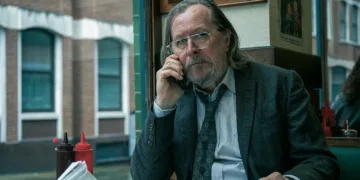
Here, the magnificent Jackson Lamb, a slovenly wreck of an agent played with greasy perfection by Gary Oldman, presides over his team of “slow horses.” The series has built a reputation on its acidic dialogue and tightly wound spycraft. This season immediately raises the stakes.
A wave of seemingly random, chaotic attacks begins to sweep across London during a contentious mayoral election. The trouble this time appears to have a direct link to one of Slough House’s own, pulling the entire team into a mess they are uniquely qualified to worsen before they fix.
A City in Chaos
The central mystery of season five unfolds with a kind of manic glee, a series of provocations that feel designed by a particularly unhinged trickster. The attacks are not coordinated strikes against infrastructure; they are acts of weaponized absurdity. One moment there’s a shocking public shooting, the next cars are bursting into flames across the city, and at one point, penguins at the London Zoo become the targets of an explosion.
This is a campaign of anarchic terror meant to sow maximum discord and social media chatter, making the threat impossible to profile. The fuse for this powder keg is none other than Roddy Ho, Slough House’s insufferable tech genius and self-proclaimed ladies’ man. His monumental ego finally makes him a security risk when he becomes entangled with a glamorous new girlfriend who is, predictably, a little too good to be true.
His predicament, born of his own vanity, becomes the thread the team must pull to unravel the entire scheme. This forces Lamb’s agents to connect the dots on their own, operating in the shadows with no resources while Regent’s Park, led by the perpetually exasperated Diana Taverner, wants them kept firmly in their box.
This chaos plays out against the backdrop of a bitter mayoral race between the slick, media-savvy Zafar Jaffrey and the populist firebrand Dennis Gimball. The political subplot feels very much of our time, a funhouse mirror reflecting a media landscape defined by deep, seemingly unbridgeable divisions. I found the show’s handling of politics to be more effective as broad caricature than as sharp satire.
It simplifies complex ideas to serve the high-octane plot, presenting archetypes we all recognize from cable news. Jaffrey is the smooth operator with a practiced smile, while Gimball is the plain-speaking man of the people with a nativist edge. This approach works for the story, using the election as a volatile stage for the spy games, even if it feels less interested in deep political commentary. The season’s structure is a marvel of efficiency.
Its six episodes move with a relentless forward momentum, telling a complete, satisfying story that feels like a single, well-paced film. Watching it, I was reminded how effective a compressed narrative can be. In an age of bloated, eight-to-ten episode seasons that often feel padded, Slow Horses respects your time, a quality that makes its annual return so welcome.
Shifting Focus
One of the great pleasures of a long-running series is seeing background characters get their moment, and this season is a generous gift to the supporting players. It belongs to them. Roddy Ho is masterfully elevated from a recurring punchline to a pivotal figure in the central plot. Christopher Chung rises to the occasion, revealing the deep well of insecurity that fuels Roddy’s bravado.

His panicked attempts to maintain his “Dragon Slayer” facade while in genuine physical danger are both hilarious and strangely pitiable. His scenes opposite the unimpressed leadership of MI5 are squirm-inducing delights. Aimee-Ffion Edwards gives Shirley Dander a raw, aggressive edge as she channels her grief over Marcus’s death from the previous season.
Her anger makes her both reckless and hyper-focused, and Edwards portrays this internal conflict with a coiled intensity, often through glares and clipped line deliveries that say more than a monologue ever could. Her proactive investigation into Roddy’s situation drives much of the early narrative.
The season’s true surprise is the emergence of J.K. Coe. The silent, menacing watcher from last season becomes a key field agent, and actor Tom Brooke is given a chance to speak. Pairing his deadpan, unexpectedly chatty agent with Jack Lowden’s earnest River Cartwright creates a fantastic odd-couple dynamic that produces some of the season’s most memorable comedic beats.
Their shared scenes are a masterclass in contrasting energies. Of course, the show still revolves around Gary Oldman’s Jackson Lamb, a magnetic force of nature who finds new ways to be both disgusting and brilliant. Oldman can deliver a withering insult like no one else, yet he also shows Lamb’s sharp tactical mind in moments of crisis.
A much-discussed scene involving Lamb’s weaponized flatulence is a perfect encapsulation of his methods: crude, effective, and utterly humiliating for his target. River Cartwright takes a slight step back after the intense family focus of season four, but Lowden ably shows how those events have shaped him into a more mature, less arrogant agent.
The guest cast is excellent, particularly Nick Mohammed, who sheds his nice-guy persona to play a politician who is anything but lovable. James Callis also returns as the fantastically incompetent MI5 head Claude Whelan, a perfect bureaucratic foil for Kristin Scott Thomas’s cool and calculating Diana Taverner.
A Tonal Tightrope
This season is, without a doubt, the funniest and most outlandish Slow Horses has been. The humor is broader, the situations more absurd, leaning heavily into the workplace comedy aspect of its premise. The bickering between River and Coe, Roddy’s ill-fated attempts at spycraft, and Lamb’s constant stream of creative put-downs provide a constant source of laughter.

At times, I did wonder if the increased silliness risked deflating the tension. The show walks a very fine line between spy thriller and outright farce, and a few moments of high absurdity threaten to tip the entire story into pure parody. It is a credit to the writers and the grounded performances of the cast that the stakes still feel genuine, even when the circumstances are ridiculous.
The show’s signature move is its willingness to place shocking violence right next to slapstick comedy. That jarring opening scene is a perfect example of this potent formula. This tonal whiplash could easily feel clumsy or cynical in lesser hands, but here it creates a unique and unpredictable viewing experience that feels true to the source material’s spirit.
The world of Slough House is one where a crude joke can be followed by a gunshot, and the speed of that transition is what keeps you on edge. This approach is less successful when it comes to the season’s thematic ambitions.
The story begins by pointing toward a serious exploration of political radicalization and domestic terror. As the plot becomes more fantastical and the conspiracy more elaborate, its connection to any real-world commentary feels weaker. It trades the opportunity for genuine insight for a safer, more purely entertaining resolution.
The View from the Director’s Chair
Director Saul Metzstein, who helmed the show’s first two seasons, returns to guide all six episodes, and his familiarity with the material is evident. His direction is confident and energetic, establishing a clear visual language that distinguishes the different worlds of the series. He contrasts the grimy, cluttered, and poorly lit interiors of Slough House with the sleek, sterile, and cold look of Regent’s Park. This visual dichotomy reinforces the class-like system within MI5.

The season is more action-heavy than its predecessor, and Metzstein handles these sequences with exceptional clarity and impact. The editing is crisp and coherent during car chases and shootouts, avoiding the shaky-cam confusion that plagues so many modern thrillers. The use of practical effects gives these moments a visceral, grounded feeling.
The sound design also plays a key atmospheric role, from the low hum of London traffic to the jarring silences that precede a moment of violence. London itself is captured beautifully, not as a tourist postcard but as a sprawling, lived-in city full of shadows and secrets.
A Worthy Chapter
Slow Horses season five succeeds by shifting its focus to the wider ensemble, delivering a fast-paced and wickedly funny plot that balances its dark humor with genuine thrills. It is a confident and hugely entertaining piece of television.

It may not possess the same emotional depth of season four, which put River Cartwright through a deeply personal and affecting ordeal, yet it successfully moves the characters and their overarching stories forward. This season also marks the departure of showrunner Will Smith, who has done a remarkable job adapting Mick Herron’s novels with such wit and precision.
He established the show’s distinctive tone and breakneck pacing, and he leaves the series in excellent health. He has cemented its status as one of the most consistent and enjoyable shows currently running. Based on the strength of this entry, which is a testament to the durability of its core concept and characters, there is no reason to believe the slow horses will be slowing down anytime soon.
Slow Horses is a spy thriller series. Season 5 is based on the novel “London Rules” by Mick Herron. The show is available to watch on Apple TV+. The season will premier on September 24, 2025.
Full Credits
Director: Saul Metzstein
Writers: Will Smith, Morwenna Banks, Mark Denton, Jonny Stockwood
Producers: Julian Stevens
Executive Producers: Jamie Laurenson, Hakan Kousetta, Iain Canning, Emile Sherman, Douglas Urbanski, Gail Mutrux, Will Smith, Graham Yost
Cast: Gary Oldman, Jack Lowden, Kristin Scott Thomas, Saskia Reeves, Rosalind Eleazar, Christopher Chung, Aimee-Ffion Edwards, Ruth Bradley, James Callis, Tom Brooke, Jonathan Pryce, Nick Mohammed
Cinematographer: Danny Cohen
Editors: Katie Weiland, Luke Dunkley
Composer: Mick Jagger, Daniel Pemberton, Toydrum
The Review
Slow Horses Season 5
Season five is a wildly entertaining, laugh-out-loud funny entry that proves the series has one of television's best ensembles. By shifting focus to its supporting cast, the show finds new sources of energy and humor. While it doesn't quite reach the dramatic heights of its predecessor and its political commentary feels a bit shallow, the season's breakneck pace, sharp writing, and thrilling set pieces make it another resounding success. This is expertly crafted television that remains as sharp and enjoyable as ever.
PROS
- Spotlight on supporting characters provides fresh energy.
- Excellent performances from the entire ensemble cast.
- Sharp dialogue and an effective mix of humor and tension.
- Brisk, efficient pacing across six episodes.
- Well-directed action and a strong sense of atmosphere.
CONS
- Less emotional depth compared to the previous season.
- Political themes are handled with broad caricature.
- The plot's absurdity occasionally lessens the story's impact.







