
























![Kingdom Hearts Collection [I-III] Review](https://gazettely.com/wp-content/uploads/2026/10/Kingdom-Hearts-Collection-I-III-1-360x180.webp "Kingdom Hearts Collection [I-III] Review: KHII Holds Steady as Newer Entries Fluctuate 37")



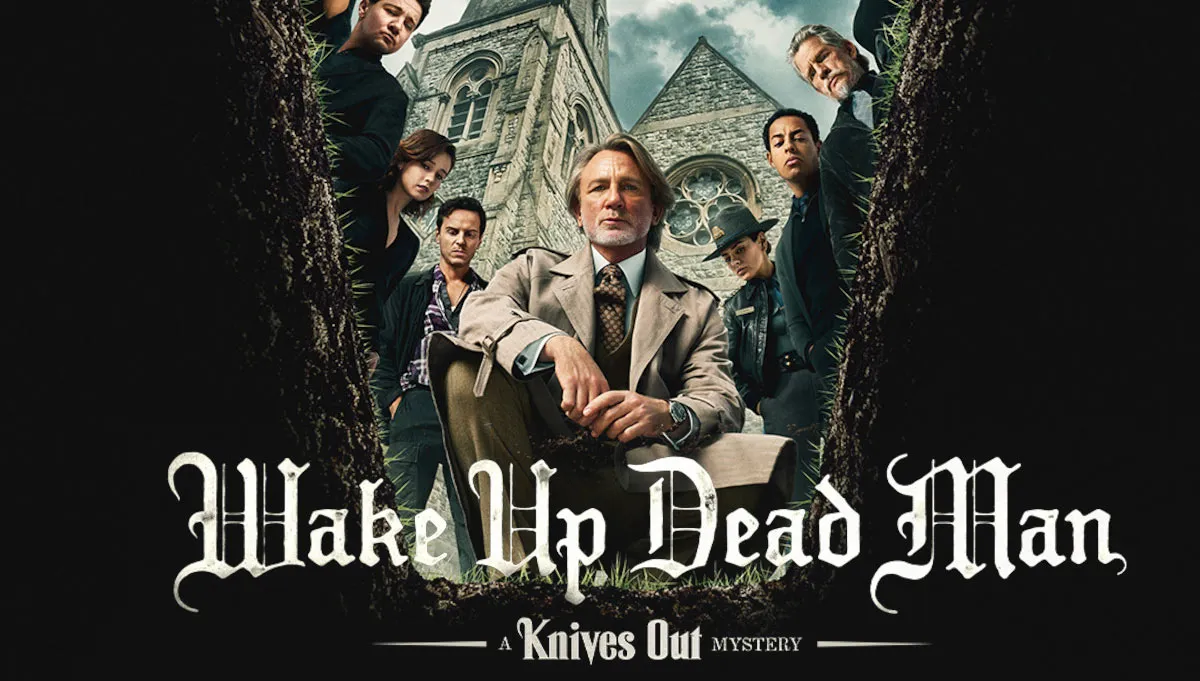

Incense drifts across the nave as Monsignor Jefferson Wicks strides from the pulpit into a side closet; half a minute later, a body on the floor, a blade with a devil’s head for a hilt, a parish frozen in shock. The setting is a wintry parish in upstate New York, all stone, wood, and drafts that whistle through the rectory.
Into this chill walks Rev. Jud Duplenticy, a former boxer assigned to assist the volatile Wicks, and Benoit Blanc, the unhurried observer whose entrance lands after the flock has already chosen sides. The film balances caustic humor with gothic unease, letting irreverent jokes brush against questions of belief, guilt, and the uses of power.
Beneath the puzzle sits a town’s social order, where loyalty, shame, and status grind against one another. This chapter narrows the series’ scope, trading spectacle for concentrated pressure, and it thrives on the intimacy of a single community watching itself in the candlelight.
Story Architecture and Puzzle Design
The narrative spine is Jud’s written account, a formal confession that folds past and present into crisp chapters. Early stretches withhold Blanc’s voice, an unusual quiet that lets Jud’s vantage dominate. Time is parceled with care, so each return to the sanctuary carries new informational weight.
The locked-room set piece centers on a Good Friday service with clear geography: the nave filled with regulars, the pulpit raised and imposing, a side closet within sight of dozens of eyes. The kill occurs inside that closet, the door shut, the timeline measured in seconds, the devil-head knife discovered under conditions that appear to deny access. Sight lines, hymn cues, and the echo of the organ are not atmosphere alone, they are measurement tools.
Clue plants recur with satisfying friction. Keys pass hands. Vestments and linens hide small mechanics. A handheld camera and clip-on mic promise “truth” while inviting performance. Ledgers and boxes of parish records matter less for what they say than for how and when they surface. Behavioral tics read as quirks on first pass and as signals later. Tossed-off lines carry exact phrasing that returns with altered meaning.
Misdirection thrives in ritual. Choreography that looks devotional doubles as stage business. The parish book club’s zeal for classic “impossible crime” tales seeds expectations that the script plays with. Lighting shifts, from stained-glass daylight to blackout, steer attention without cheating.
Pacing favors a long first act to lay character tracks; momentum tightens once Wicks falls and interrogations crosscut. The denouement lands with Blanc in the pulpit, a playful Phantom flourish, and a brief moral reckoning. The fair-play audit holds: key devices appear on screen, alibis are testable, one late reveal leans on precise wording rather than hidden information. Rewatch value is high. Early confessional scenes, the first parish meeting in the rectory, and the Good Friday buildup each hide plain-sight tells that reframe Jud’s narration.
Characters and Performances
Entrance timing matters. Silence in the opening act turns his later talk into an event. The cadence remains musical, comic without mugging, and every malaprop has a function. Method stays grounded in cause and effect, yet he reads souls with a relaxed empathy that disarms witnesses. The reveal sequence plays like a sermon on attention, both an explanation of mechanics and a reading of motives.

A boxer’s past and a priest’s calling sit in tense balance. Penitence guides conduct, anger keeps trying to break through. The role carries the film’s live wire. O’Connor locates grace in small hesitations, then flashes hard resolve when pressed. Agency is real. He initiates the rectory prayer circle, confronts Wicks in private, and chooses integrity even when suspicion tilts against him. Key beats: the first confession he hears from Wicks, the community meeting that exposes fault lines, the quiet late decision that turns principle into action.
Charisma used as a cudgel. Sermons single out congregants with courtroom precision. Confessionals turn lurid, then menacing. The figure stands as a study in authority without sliding into cartoon. Theological language becomes a scaffolding for control, and Brolin gives it a feral edge.
Martha Delacroix (Glenn Close) manages books, linens, and secrets, her micro-reactions a metronome for the room. Samson Holt (Thomas Haden Church) anchors scenes with physical stillness and guarded loyalties. Vera Draven (Kerry Washington) scans rooms like a litigator, composed but alert to family fractures. Dr. Nat Sharp (Jeremy Renner) treats bodies and hides his own hurts, triaging the crime scene with clipped efficiency.
Lee Ross (Andrew Scott) arrives prickly, the wit sharp enough to cut. Simone Vivane (Cailee Spaeny) feels spaces with an artist’s ear, her chair placement and gaze patterning matter in key shots. Cy Draven (Daryl McCormack) keeps a camera running, hungry for leverage. Chief Geraldine Scott (Mila Kunis) provides procedural ballast, patient with Blanc’s methods and quick to pivot when the facts move.
Blanc and Jud function as mentor, foil, and mirror. Wicks binds Martha and select parishioners through fear and favor. The congregation’s long grudges double as motive. Scene stealers are O’Connor, for flinty softness that snaps into clarity, and Close, for command in silence. A few players get thinner arcs, yet nearly every entrance leaves a trace. Line readings to flag for later: Wicks’ weaponized piety, Blanc’s pulpit aria, Jud’s brief, unguarded appeal for grace.
Ideas, Tone, and Satire
Blanc treats inference as liturgy. Jud treats mercy as praxis. Miracles receive precise scrutiny, yet the film lets longing for the impossible hover around the edges. The tension is productive, not decorative. A parish can heal or harden. Wicks runs a weekly theater of humiliation, selecting a target, shaping the room through fear. The flock absorbs this stance, then carries it into kitchens and sidewalks. Ritual becomes an engine for cohesion and for cruelty, depending on who leads and why.

Jud’s history fuels a need for repair. Parishioners act from old wounds that curdle into habit. The investigation peels back manners to reveal contracts of mutual protection and mutual harm. The cleric as strongman operates on grievance, purity tests, and staged outrage. The portrait lands because the rhetoric grows from character, not lectern bullet points. Faith serves as banner and as mask. The film tracks both uses with calm clarity.
Confessional vulgarity arrives as shock and as diagnostic. Jokes about media platforms and streaming culture wink without breaking tone. Laughter loosens the grip, then the knife turns again. Certainty carries a cost. Trust and submission sit a hair apart. The final reveal forces earlier moral claims to face daylight, and a small human decision lands harder than any flourish.
Craft: Image, Sound, Rhythm
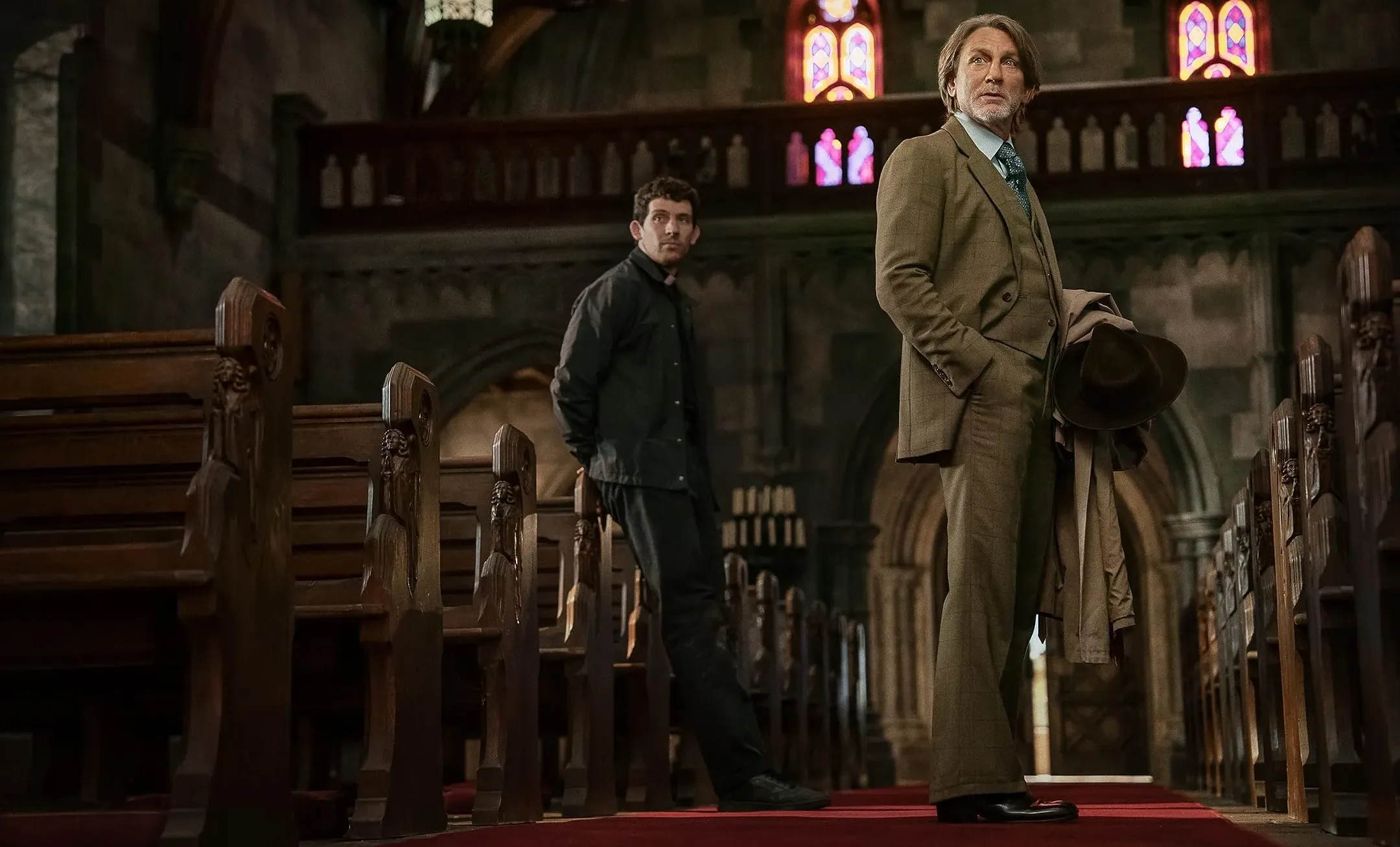
Lanterns and candles carve faces into bas-relief. Stained glass throws colored blades across stone. Blackouts drop the sanctuary into pure shape and sound. Depth-of-field games hide mechanisms in soft corners, then snap them into focus. The forest and graveyard ring the church like a moat, wet leaves and old marble turning each exterior into a cold exhale.

Benches worn smooth by decades. Sacristy closets with hinges that creak on cue. Filing cabinets and banker’s boxes stacked in a rectory that reads like a biography in paper form. Side rooms feel built for stagecraft, which suits the mystery’s needs without feeling schematic.
Vestments glitter during feast days, then look severe under winter light. Parishioners wear pride, fatigue, and class markers on sleeves and shoes. Small accessories signal allegiance: keys on a ribbon, a recording pin that keeps showing up.
The mass sequence cuts on gesture and music, so the locked-room trick reads cleanly. Interrogations interlace without noise. Blocking in tight interiors keeps hands, pockets, and sight lines visible, which matters once the solution comes. Organ pipes swell and then leave a hush that vibrates. Footsteps on stone arrive with metronomic precision, foley that doubles as evidence. A single scrape, a latch click, a gasp from the choir loft, each placed with intent.
Blanc’s pulpit address, lit from above in a heavenly cone, turns exposition into spectacle. The discovery of the knife carries a dry comic beat before dread settles. A brief exchange in the rectory catches Jud in profile, jaw set, eyes soft, a whole arc in one held breath.
Evaluation and Takeaways
The core trick is ingenious and legible. Clues appear in plain sight, and the script resists hiding vital tools off screen. One detail hinges on phrasing, a fair move that rewards attention. Jud’s arc holds center. The story honors his need for grace without smoothing his roughness. Blanc’s final speech clarifies the film’s stance on truth, showmanship, and the comfort of stories.
The joke rate is high, yet punchlines tilt character rather than deflate tension. A few gags nibble at the streamer ecosystem and at pop mythmaking without smirk. The long opening invests in rooted texture. Once the death lands, tempo builds cleanly toward the pulpit reveal. A late stack of reversals arrives briskly, still clear.
Some supporting arcs are lean. Close, Washington, and Renner make crisp use of limited minutes. Spaeny’s sensory focus generates quiet clues that ripple forward. This entry sharpens Blanc as an ethicist of attention and gifts him a partner who tests his worldview. The church setting gives the series a fresh container for motive, ritual, and theater.
Puzzle construction, thematic cohesion, lead turns from O’Connor and Craig, below-the-line craft, rewatch value. Images and lines to cite: colored glass across pews during the hymn, the closet door shutting on Good Friday, a single word in a confession that detonates hours later.
The film premiered at the Toronto International Film Festival on September 6, 2025. It is scheduled for a limited theatrical release starting on November 26, 2025, and will be available to stream on Netflix on December 12, 2025.
Full Credits
Director: Rian Johnson
Writers: Rian Johnson
Producers: Ram Bergman, Rian Johnson, Katie McNeill
Cast: Daniel Craig, Josh O’Connor, Glenn Close, Josh Brolin, Mila Kunis, Jeremy Renner, Kerry Washington, Andrew Scott, Cailee Spaeny, Daryl McCormack, Thomas Haden Church
Director of Photography (Cinematographer): Steve Yedlin
Editors: Bob Ducsay
Composer: Nathan Johnson
The Review
Wake Up Dead Man: A Knives Out Mystery
A taut, witty gothic whodunit with an elegant locked-room reveal, sharpened by Craig’s poise and O’Connor’s quiet fire. The writing values fair clues, the craft gleams, and the pulpit finale lands with showman snap. The extended first act tests patience and a few supporting roles feel thin, yet the film’s moral spine and playful rigor keep it gripping.
PROS
- Ingenious locked-room mechanics with clear fair-play clueing
- Josh O’Connor’s layered turn; Daniel Craig’s precision and cadence
- Moody, handsome visuals; purposeful lighting and framing
- Production design that doubles as misdirection
- Humor that sharpens character without deflating stakes
CONS
- Prolonged opening movement slows early momentum
- Select ensemble arcs feel underfed
- One key twist leans on exact wording
- A few winks risk cuteness







