














Most games treat time as a convenience. A day-night cycle might change NPC routines, or a story may jump forward years between chapters, but the world itself remains largely static, patiently waiting for the player. We are used to our actions being the sole catalyst for change. Towa and the Guardians of the Sacred Tree presents a different, more unsettling proposition: what if the world refused to wait?
This isometric action-roguelite places the relentless march of time at the very center of its design. Its core premise involves the priestess Towa and her eight Prayer Children, warriors pulled from history to battle the demonic Magatsu. The game’s defining features are a dual-character combat system and, most significantly, a home base that lives and breathes and ages without you.
For every major victory on the battlefield, decades fly by in Shinju Village. This ambitious concept promises a poignant look at legacy and loss, yet the game surrounding it is a discordant experience of brilliant ideas hampered by frustrating and poorly realized mechanics.
A Feast for the Senses
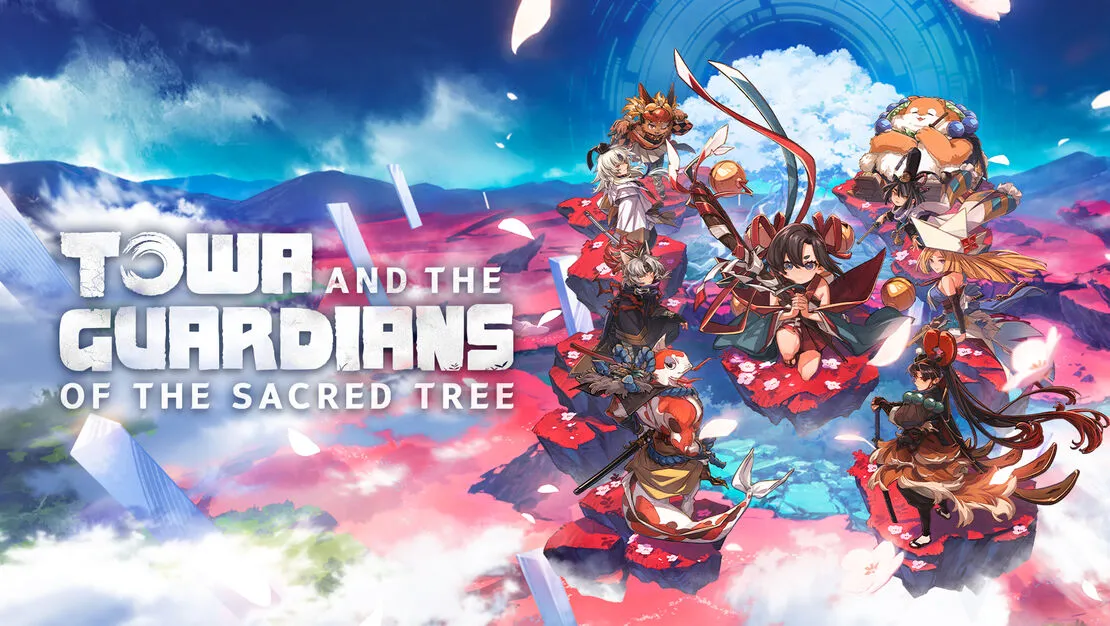
From its opening moments, Towa makes an incredible first impression through its sheer artistic craftsmanship. The game’s aesthetic is a lavish celebration of traditional Japanese art, rendered with a modern vibrancy that makes every screen a painting. Environments are sumptuous and colorful, from tranquil forests bathed in dappled light to corrupted lands shrouded in an ominous purple haze.
Each biome has a distinct personality, though this strength is slightly diluted as the game progresses and new areas begin to feel like simple palette swaps of locations you have already conquered. The character design is where the artistry truly shines, presenting a cast brimming with personality. These are not generic archetypes; they are memorable individuals.
Nishiki is not just a fish-man, but a noble warrior whose shimmering scales suggest both beauty and strength. Bampuku, the colossal cat chef, communicates warmth and reliability through his soft, fluffy design and practical attire. Every guardian is visually distinct, promising unique playstyles and stories.
Also Read




This powerful visual storytelling is most potent in the central hub of Shinju Village. Here, the game’s central theme of passing time is made tangible. You watch the world evolve across generations in a way few games attempt. The humble blacksmith’s stall, initially just a single forge, grows into a sprawling workshop over the decades.
You see the original smith’s hair turn gray, then watch as his apprentice, once a young boy, takes over, his own face now lined with age. A mischievous child who plays pranks grows up to become a respected teacher. The village is a living chronicle of the lives your immortal guardians touch but can never truly be a part of.
This visual splendor is matched by an equally impressive auditory experience. The soundtrack is the work of the legendary Hitoshi Sakimoto, and his signature style, familiar from titles like Final Fantasy XII, lends the game an epic, orchestral scale. The grand, sweeping compositions are beautiful, sometimes creating an interesting contrast with the often-mindless gameplay they accompany. The sound design in combat is crisp and impactful, with the clash of steel and the sizzle of magic providing satisfying feedback for every action.
To complete the presentation, the game features a full suite of excellent voice acting in both Japanese and English. The performers do a remarkable job bringing the charismatic cast to life, injecting personality and energy into their roles. They deliver their lines with a professionalism that often elevates the source material, doing their best to find emotional truth in a script that frequently gives them little to work with.
A Flawed Partnership
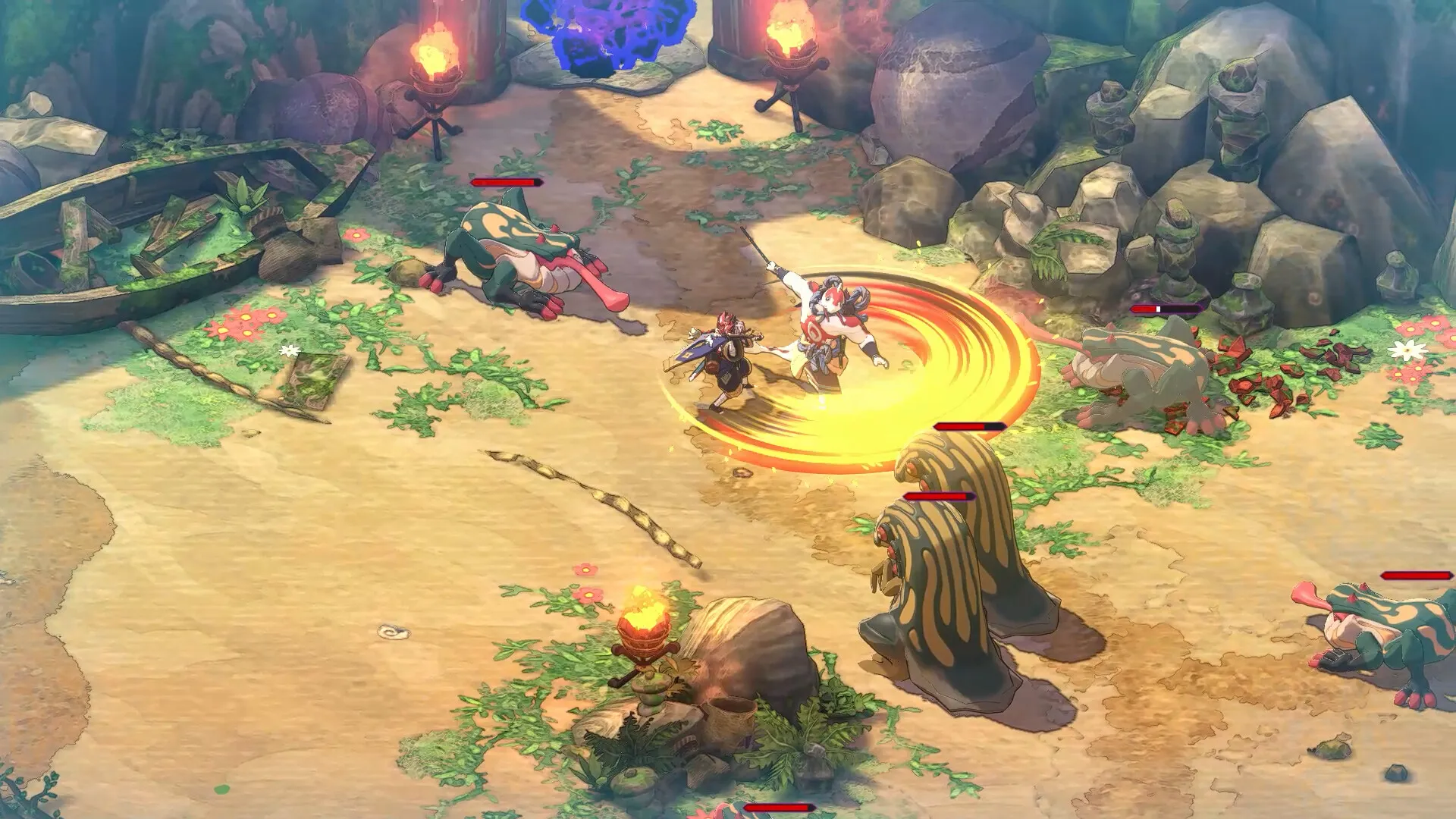
Towa’s combat is built upon its ambitious dual-character system. In every run, you control two guardians simultaneously. The primary character, the Tsurugi, is a melee fighter under your direct command. The secondary character, the Kagura, is a support unit who follows behind, automatically casting a pair of equipped spells as they come off cooldown.
With nine distinct playable characters, each with their own attacks and abilities, the potential for tactical depth seems immense. Pairing a fast, close-range fighter like the ninja-like Shigen with a long-range spellcaster should, in theory, open up countless strategic possibilities.
You could imagine pinning down enemies with the Tsurugi while the Kagura charges a devastating area-of-effect spell, or using one character’s defensive buffs to enable the other’s aggressive assault. The system suggests a deep, synergistic dance of blades and magic.
The reality of this partnership, however, is a clumsy, frustrating affair. The AI controlling your Kagura is simply not reliable. Imagine perfectly dodging a massive, telegraphed slam from a boss, only for your Kagura, tethered to you by an invisible leash, to lag a half-second behind and take the full force of the blow. This happens constantly. The game punishes you for a mistake you did not make and could not prevent.
This design flaw removes player agency and turns what should be your greatest asset into your biggest liability. The frustration is magnified by a “rubber-banding” effect that can snap your Tsurugi back toward the Kagura’s position, often pulling you directly into an attack you were trying to escape. This flawed dynamic extends to the local co-op mode, which disappointingly relegates the second player to the passive Kagura role, reduced to little more than casting a couple of spells on a timer. It feels like a shallow, tacked-on feature.
The core swordplay of the Tsurugi is, at first, engaging. Combat is fast, responsive, and relies heavily on a snappy dodge. A weapon durability mechanic requires you to swap between two equipped swords as their sharpness degrades from use. The intended rhythm seems to be an A-B-A-B cadence of alternating weapons and their associated attack styles.
Players will quickly discover, however, that the system is easily exploited. A quick double-tap of the swap button instantly restores the durability of your preferred sword. The intended rhythmic combat is thus reduced to a pointless twitch action.
The optimal strategy becomes finding a single character with a powerful, spammable attack, like Mutsumi’s secondary sword slash, and using it relentlessly. This reduces a potentially interesting mechanic to mechanical fluff and encourages a mindless, button-mashing approach to most encounters.
The Perils of Repetition
For a roguelite, a genre built on the thrill of variety and the promise that the next attempt will be different, Towa is shockingly repetitive. The basic loop is familiar: you fight through a series of chambers, choose a path with different potential rewards, and face bosses. Yet the procedural generation that gives the genre its longevity is almost entirely absent.
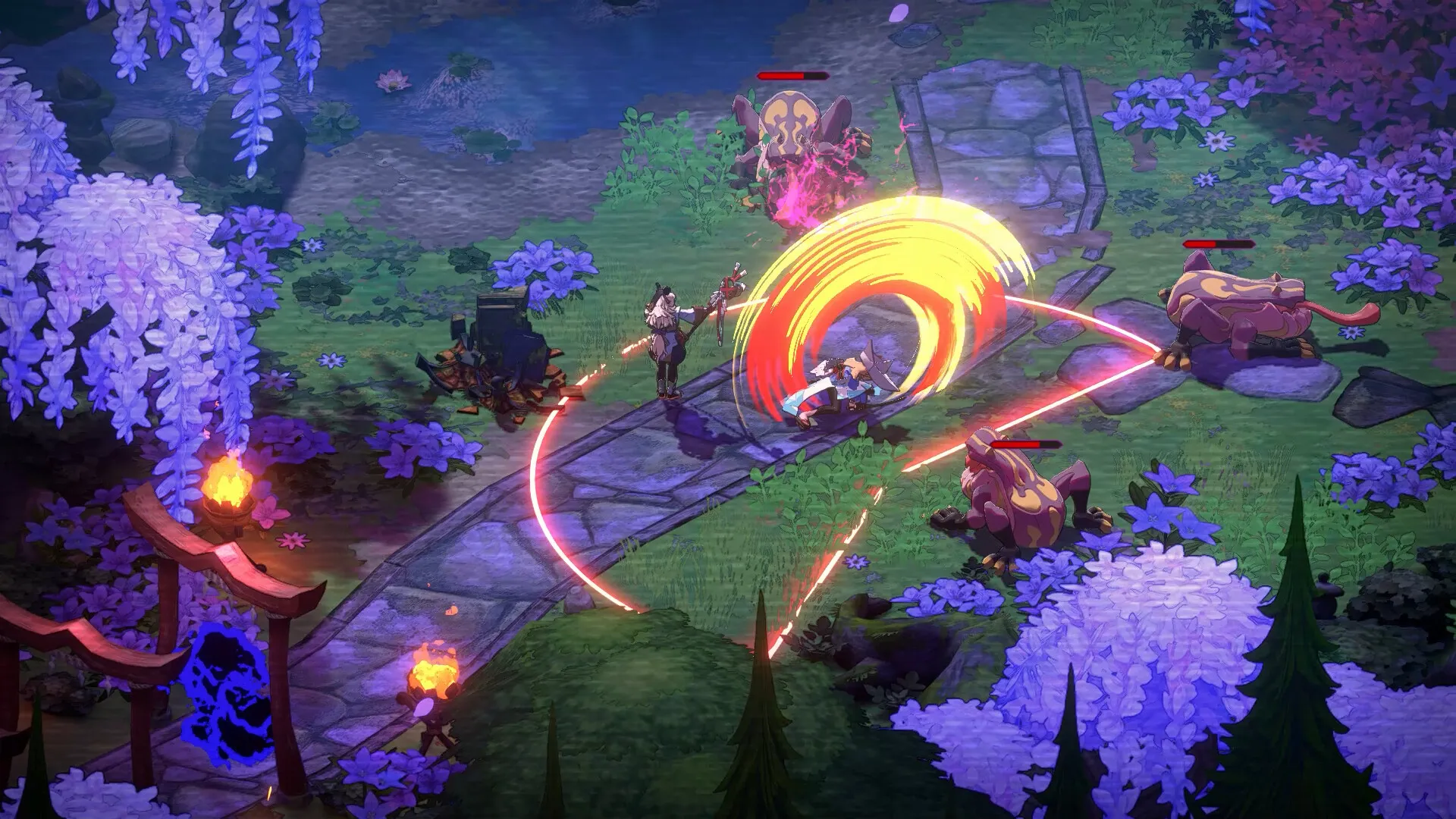
Hades, for example, ensures that even after a hundred runs, you might encounter a new combination of chambers or boons. Towa, by contrast, feels like it is working from a deck of ten cards and simply deals you eight of them each run. After just a few attempts within a single biome, you have seen every possible room layout and enemy configuration. Failure is not a learning experience that prepares you for new challenges; it is a sentence to replay the exact same content again. This design fundamentally disrespects the player’s time, undermining the “one more run” impulse that defines the best games in the genre.
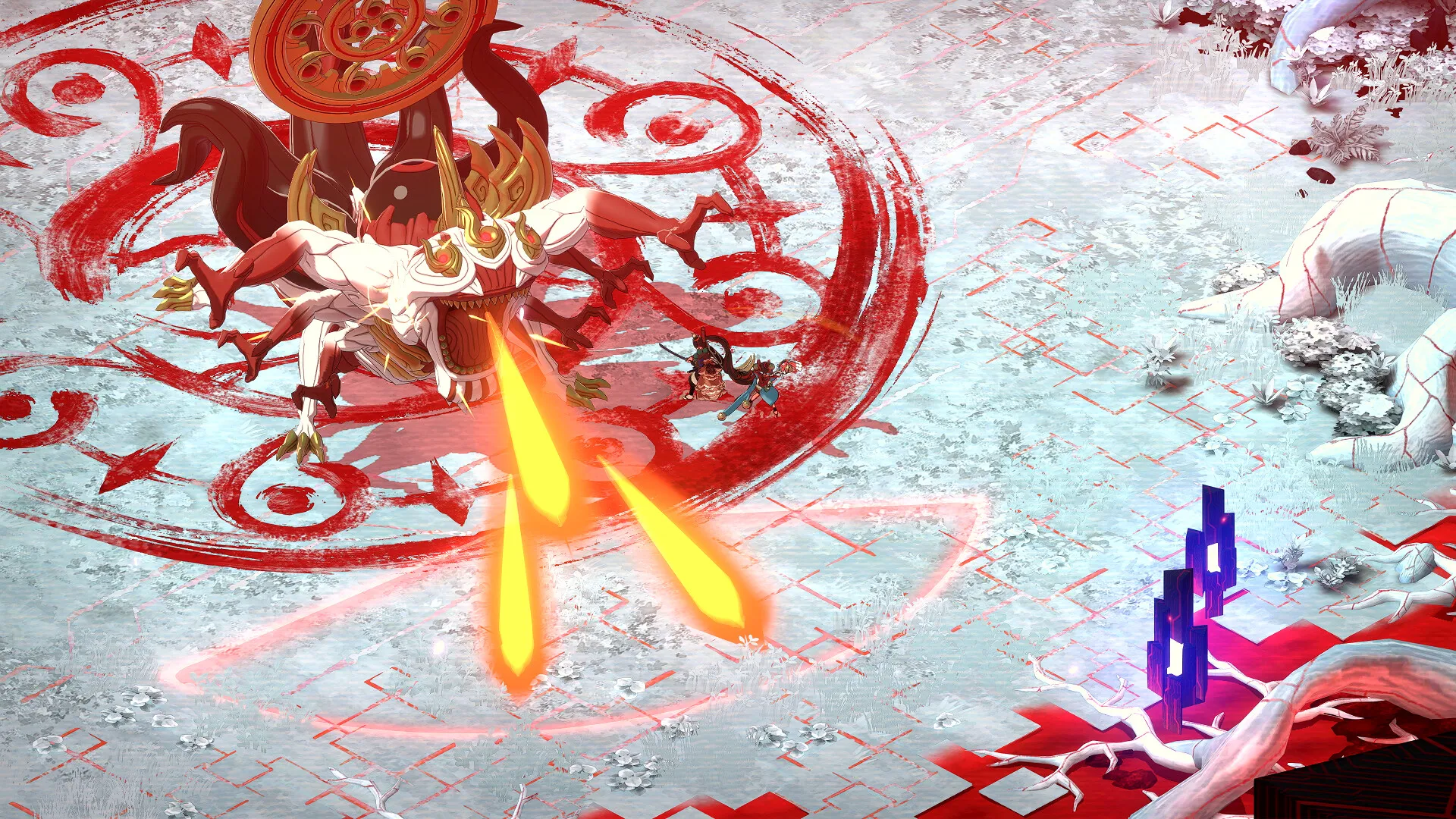
This exhausting repetition makes the game’s brutal boss fights even more infuriating. These encounters are not sophisticated tests of skill; they are frustrating difficulty spikes designed to end your 40-minute run in a flash of cheap tactics. Bosses are damage sponges with absurdly large health pools, yet they can often eliminate you with a single combo.
The challenge rarely feels fair or earned. Deaths often come from an instantaneous teleport followed by an attack that leaves no time for reaction, or from a boss unpredictably spinning 180 degrees in the middle of a telegraphed move.
The screen often erupts in a visual overload of red enemy AoEs, your own bright attack effects, your Kagura’s spells, and other particle effects. In this chaos, losing track of your own character is not a possibility; it is an inevitability, made worse by the baffling decision to place red attack indicators on top of blood-red arena floors.
The game’s sole saving grace in this loop is the permanent progression tied to Shinju Village. It is the carrot that pulls you through the frustrating stick of the core gameplay. Every run, successful or not, rewards you with currencies that can be invested back home. You can visit the Dojo to permanently raise a character’s base stats. You can fund the construction of new buildings that provide global buffs to all your guardians.
The most in-depth system is sword forging, a series of QTE-based minigames where your performance in timing hammer strikes and quenching the hot metal determines the quality of your new weapon. Forging a slightly sharper blade or a sword with a new passive effect is often the only tangible progress you make, and it is the promise of this incremental improvement that provides the motivation to endure another nearly identical run.
A Tale of Missed Opportunities
The narrative foundation of Towa is built on the exceptionally powerful themes of time and legacy. Its central mechanic, where time in Shinju Village jumps forward by decades after each major victory, is a brilliant concept. You are an immortal observer, a guardian spirit watching over a town as it grows and changes. This creates a profound, bittersweet atmosphere that is the game’s greatest narrative achievement. You see the personal stories of the villagers unfold across their entire lives.
A mischievous child you meet at the start of the game grows up to become a respected teacher, passing on her wisdom to a new generation. The young blacksmith’s apprentice eventually takes over the forge from his aging master, their shared craft a legacy passed through hands. A family of chefs spends generations perfecting a single recipe. The game is asking poignant questions about what it means to live forever, and what impact one leaves on a world that is constantly flowing past.
Yet, this thoughtful, melancholic storytelling is consistently undermined by the main plot and its execution. The guardians themselves, the player’s avatars, seem almost immune to the emotional weight of their situation. A character might return to the village to find their parents have passed away, and their reaction is little more than a resigned, “Ah, well.” The script consistently shies away from genuine emotion, treating these profound moments with a baffling flatness.
The overarching plot is a painfully generic “stop the ancient evil” tale, with the antagonist Magatsu being a faceless, personality-free force with no interesting motivation. The game’s pacing is also a serious issue. After a frantic, action-packed run, the momentum grinds to a halt as you are forced to sit through minutes of stilted, often pointless dialogue. These lengthy conversations feel like they belong in a different, much slower game. This disconnect is perfectly encapsulated by the character sacrifice mechanic.
The story requires you to permanently give up your teammates for the greater good, a concept that should be emotionally devastating. The act is rendered weightless by the weak writing, and is later made meaningless by a plot development that retroactively removes the permanence of the sacrifice, cheapening what should have been the game’s most impactful moments. The true heart of Towa is found in the quiet lives of its villagers, a beautiful story trapped within a far less interesting and deeply flawed game.
The Review
Towa and the Guardians of the Sacred Tree
Towa and the Guardians of the Sacred Tree is a stunningly beautiful game with an ambitious and poignant central theme of passing time. Its art and music are exceptional, and the evolving village is a narrative highlight. Unfortunately, this brilliant presentation is chained to a deeply flawed experience. The repetitive, non-randomized runs, frustrating combat mechanics, and cheap boss encounters turn what should have been a compelling roguelite into a tedious grind. It's a case of great ideas crippled by poor execution.
PROS
- Stunning art direction and visuals.
- Exceptional soundtrack by a legendary composer.
- The evolving village is a unique and compelling narrative element.
- Charismatic and memorable character designs.
CONS
- Extremely repetitive gameplay with minimal randomization.
- Flawed dual-character combat with frustrating partner AI.
- Shallow mechanics that encourage mindless button-mashing.
- Unfair and cheap boss fight design.
- A weak main story that fails to deliver on its emotional premise.