

























![Kingdom Hearts Collection [I-III] Review](https://gazettely.com/wp-content/uploads/2026/10/Kingdom-Hearts-Collection-I-III-1-360x180.webp "Kingdom Hearts Collection [I-III] Review: KHII Holds Steady as Newer Entries Fluctuate 37")




In the void between galaxies, there is a place where discarded ideas go to rest. This is the Force Hold, a cosmic junkyard of abandoned timelines and forgotten characters, a repository for every piece of a story that was deemed unfit. From this conceptual graveyard, a figure of pure destructive will emerges.
Darth Solitus, clad in shadow and wielding chained purple lightsabers, is not merely a villain from a lost tale; he is the embodiment of revision, a being determined to erase a universe he finds flawed and rebuild it from the scraps. His escape sets the stage for LEGO Star Wars: Rebuild the Galaxy – Pieces of the Past, a series that is less a story and more a gleeful detonation of a modern myth. The narrative returns to the fractured, remixed reality created by the young Force-builder Sig Greebling.
As Sig continues his unorthodox training with the affable Jedi Bob, his brother Dev’s misguided quest for power becomes the catalyst for Solitus’s return. The threat is not one of galactic domination but of absolute annihilation, forcing heroes and their dark-side reflections into a desperate, chaotic alliance to save a reality that is already beautifully broken.
The Canon as a Toy Box
Star Wars, as a cultural text, often suffers from the immense weight of its own canon. Decades of films, books, and series have created a narrative so dense that it risks collapsing under its own history. Pieces of the Past addresses this by treating the entire history as a toy box, a collection of parts to be reassembled with the joyous irreverence of a child on a rainy afternoon.
The series functions as a critique of narrative rigidity, arguing that a story’s true vitality lies not in its consistency but in its capacity for reinvention. This philosophy is most evident in its humor, which is both loving and surgical. A witty aside about the origins of Supreme Leader Snoke is more than a simple joke; it is a cathartic release for a fandom that has spent years debating plot holes and narrative decisions. The line serves as a knowing wink, an acknowledgment that the creators understand the absurdity and still find joy within it.
The most potent expression of this creative rebellion is the show’s character remixes. Presenting Jabba the Hutt as a benevolent Jedi Master is not just a visual gag; it is a conceptual inversion that questions the franchise’s archetypal representations of greed and power. In this version, Jabba’s bulk signifies gravitas, not gluttony. A heroic Jedi Vader, fighting for the light, offers a glimpse of a less tragic path, allowing the audience to ponder the thin line between hero and monster.
The return of the infamous Darth Jar Jar elevates a fan theory into a legitimate threat, validating a corner of fan culture that has long existed in the margins. The series also demonstrates a deep respect for the lore it so cheerfully dismantles. The television debuts of characters like the enigmatic Darth Revan and the swashbuckling Jaxxon are significant events.
These figures, beloved from games and comics, occupy a liminal space in the official canon. Their inclusion here is a powerful statement about the legitimacy of fan-anointed narratives. The show’s dedication to its source material is meticulous, with subtle homages to specific musical cues and camera movements that reward the most devoted viewers without alienating the uninitiated. It proves that one can profoundly understand a text and still choose to scribble in its margins.
Plastic Figures, Genuine Stakes
A narrative built from plastic bricks and cynical fan theories risks feeling weightless, yet the series finds a surprisingly robust emotional anchor in its characters. The central conflict between the brothers Sig and Dev transcends a simple good-versus-evil binary, framing their struggle within the timeless archetype of sibling rivalry. Their opposing ideologies—Sig’s belief in building and Dev’s desire to break—mirror the show’s own thematic tension between creation and deconstruction.

They are two halves of the same imaginative impulse, and their journey toward a fractured reconciliation provides the story with its heart. The voice cast is instrumental in selling these emotional stakes. Gaten Matarazzo gives Sig an earnest, unfailing optimism that prevents the character from becoming saccharine. His performance resonates with a sincerity that makes Sig’s faith in a broken universe feel earned. Tony Revolori, as Dev, expertly balances menace with a tangible sense of vulnerability, suggesting a boy lost in a role he does not fully comprehend.
The antagonist, Darth Solitus, is a genuinely formidable presence, thanks in large part to Dan Stevens’s exceptional voice work. He imbues Solitus with a gravelly, patient menace that is truly unsettling. His line delivery is deliberate and cold, suggesting an ancient intelligence that views the galaxy’s inhabitants as little more than misplaced components. He is not a ranting tyrant but a methodical artist of destruction. The supporting cast adds further depth and texture.
Bobby Moynihan’s Jedi Bob is a brilliant subversion of the traditional Jedi Master. He is humble, slightly goofy, and free from the dogmatic arrogance that led to the Order’s downfall in the prequel era. He represents a healthier, more adaptable vision of the Jedi way. In a similar vein, the droid Servo undergoes an unexpectedly poignant emotional development.
Voiced by Michael Cusack, Servo’s journey from a utilitarian machine to a being with genuine emotional attachments serves as a quiet critique of how droids are often treated as disposable plot devices. The guest appearances from franchise legends Mark Hamill and Ashley Eckstein function as a formal blessing, a passing of the torch from the keepers of the old canon to the architects of this new, unruly one.
The Art of Structured Chaos
The aesthetic of Pieces of the Past is a testament to the idea that limitations can inspire creativity. The inherent rigidity of LEGO minifigures forces the animators to communicate through staging, timing, and dynamic action rather than subtle facial expressions. This results in a visual language that is clear, inventive, and deeply cinematic.
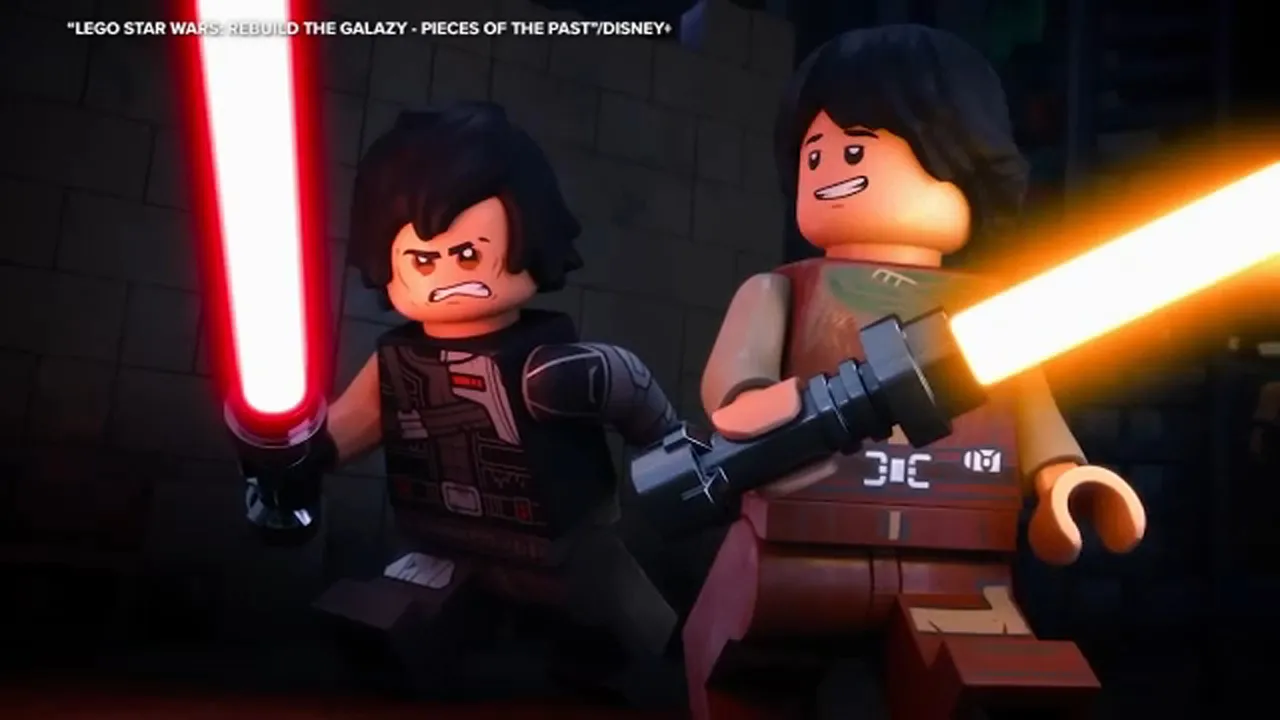
The show’s greatest visual strength is its depiction of Sig’s Force-building ability. These sequences are breathtaking displays of structured chaos, as hundreds of individual bricks fly through the air and coalesce into intricate starships and complex machinery.
This is more than a special effect; it is the show’s central theme made manifest. It is the visual representation of creating order from chaos, of finding a coherent design within a storm of random parts. The animation celebrates the act of creation itself, turning a superpower into a profound artistic statement.
This philosophy of dynamic construction reaches its zenith during an extended action sequence set aboard the Death Star. The scene is a masterwork of kinetic storytelling, transforming the iconic battle station into an arena of constant reinvention. It is not a battle in a location but a battle with the location itself. Walls are disassembled to become shields, floor panels are ripped up to create cover, and spare TIE fighter parts are reconfigured into makeshift projectiles.
The geometry of the space is fluid and unpredictable, with the heroes and villains literally rebuilding the battlefield around them as they fight. The sequence brilliantly captures the tactile experience of playing with LEGOs, where every structure is temporary and every piece holds the potential for something new. It is an innovative piece of action choreography that few live-action films would dare to attempt, a perfect fusion of the show’s visual style and its thematic core. It is structured chaos rendered as high art.
Lego Star Wars: Rebuild the Galaxy – Pieces of the Past is an animated special that premiered on September 19, 2025, on Disney+. The story follows brothers Sig and Dev Greebling as they team up to stop a new threat to the galaxy. The series continues the story from the previous season, exploring more of the Lego Star Wars lore.
Full Credits
Director: Chris Buckley
Writers: Dan Hernandez, Benji Samit
Producers and Executive Producers: Dan Hernandez, Benji Samit, James Waugh, Jacqui Lopez, Josh Rimes, Jill Wilfert, Jason Cosler, Keith Malone, Daniel Cavey, Dan Langlois
Cast: Gaten Matarazzo, Tony Revolori, Bobby Moynihan, Marsai Martin, Michael Cusack, Ahmed Best, Mark Hamill, Dan Stevens, Ashley Eckstein, Ben Schwartz, Anthony Daniels, Dee Bradley Baker, Trevor Devall, Nika Futterman, Brian George, Jake Green, Jennifer Hale, Phil LaMarr, Ross Marquand, Piotr Michael, Cameron Monaghan, Kevin Michael Richardson, Helen Sadler, Matt Sloan, André Sogliuzzo, Catherine Taber
Composer: Michael Kramer, Roberto Prado
The Review
Lego Star Wars: Rebuild the Galaxy - Pieces of the Past
Lego Star Wars: Rebuild the Galaxy - Pieces of the Past is a brilliant and chaotic celebration of creative rebellion. It uses its "what if" premise not just for laughs, but as an intelligent critique of narrative dogma, proving that a story's spirit is found in its capacity for reinvention. With stunningly inventive animation, a genuinely menacing villain, and a script brimming with wit and heart, the series is a must-watch piece of Star Wars media that understands the joy of breaking the rules.
PROS
- Intelligent, self-aware humor that playfully deconstructs the franchise.
- Wildly creative character remixes and alternate-timeline scenarios.
- Exceptional voice acting, especially from Dan Stevens as the villain.
- Visually inventive animation and action sequences.
- Surprising emotional depth in its core character relationships.
CONS
- The underlying plot follows familiar thematic beats of the Star Wars saga.
- Its humor is richest for viewers with an extensive knowledge of the franchise's lore.







