


















There exists a distinctly modern illusion of control, a belief that life can be curated, optimized, and experienced through a clean digital interface. We book our homes, our holidays, our relationships, with the sanitized detachment of a customer selecting a product. The horror of Bone Lake erupts from the violent puncture of this illusion. It posits that beneath the sleek surfaces of our arranged realities, a chaotic, predatory id waits for an invitation.
The film’s premise is deceptively simple: a couple, Sage and Diego, rents a sterile luxury mansion to perform maintenance on their failing partnership. Their space is then violated by Will and Cin, strangers who embody everything antithetical to the curated life. They are messy, carnal, and dangerously perceptive.
Director Mercedes Bryce Morgan uses the framework of the home-invasion thriller not to explore the fear of a physical break-in, but the far more insidious terror of a psychological one. The film becomes an allegory for the breakdown of social contracts, questioning what happens when the politeness we use to shield ourselves becomes the very tool of our undoing.
Pathologies of the Modern Couple
Sage and Diego are a portrait of a relationship under the immense pressure of contemporary expectations. Their problems are not cinematic inventions; they are the ambient anxieties of a generation. We see the financial strain of the gig economy, where one partner must sacrifice personal ambition for the other’s creative lottery ticket.
Diego’s character is a particularly sharp critique of a certain kind of artistic masculinity, one so inwardly focused on its own perceived genius that it becomes blind to the world around it. His insecurity is a gaping wound, and Sage, through a combination of love and exhaustion, has become its primary caregiver. Their sexual incompatibility is a silent symptom of this deeper disconnect, a physical manifestation of their inability to meet on equal terms. They are, in essence, perfect prey, not because they are weak, but because their weaknesses are so profoundly relatable and so poorly concealed.
Into this delicate ecosystem walk Will and Cin, who function less as characters and more as archetypal forces of chaos. They are social predators who hunt through perception, immediately sensing the fissures in Sage and Diego’s foundation. Their methodology is a masterclass in psychological warfare, a performance of hyper-sexuality and disarming charm that is designed to lower inhibitions and expose vulnerabilities.
Also Read




The bait they offer is perfectly tailored to the anxieties of their victims. For Diego, it is the promise of professional validation, a shortcut to the success he desperately craves. For Sage, it is the intoxicating allure of undivided attention, a recognition of her own desires that have been sidelined by her partner’s self-absorption. They are trickster gods for a secular age, testing the limits of civility until it shatters.
This leads to the film’s most glaring narrative vulnerability: the justification for the protagonists staying. On the surface, it feels like a script problem, a failure to provide a plausible reason for enduring such obvious manipulation. Yet, one could argue it is a dark commentary on the sunk-cost fallacy of social interaction.
Having committed to the weekend, and with Diego clinging to his career lifeline, leaving becomes an admission of failure. They are paralyzed by a combination of politeness, hope, and the simple awkwardness of extracting oneself from a bad situation. Sage’s passivity, in this light, is not just a character flaw but a reflection of a learned social response to quietly endure discomfort rather than create a confrontation.
The Giallo Gig-Economy Aesthetic
The film’s visual language is its most confident and articulate element. It is a work of what might be termed “Airbnb Giallo,” transposing the stylistic tics of 1970s Italian horror onto the impersonal landscapes of modern luxury. Like the works of Argento or Bava, Mercedes Bryce Morgan’s direction is obsessed with surface, color, and the menacing potential of architecture.

The widescreen cinematography captures the lush, saturated greens and blues of the natural world with an unnatural intensity, making the idyllic setting feel alien. The rental home itself is the primary stage, a sterile labyrinth of glass, steel, and minimalist furniture.
It lacks any history or personality, making it a perfect blank slate onto which the film projects its psychological horrors. Its locked rooms become potent symbols: one, full of fetish gear, represents the repressed id of the house’s unseen owners; another, with its occult trappings, hints at the irrational forces bubbling just beneath the surface of the film’s reality.
This meticulous style is paired with a deliberately fractured tonal structure. The film operates with a kind of narrative schizophrenia, lurching between modes with jarring intent. It opens with the brutal efficiency of a slasher film, establishing a contract of violence with the viewer. It then shifts gears into a slow, simmering psychosexual drama, building its tension through dialogue and paranoid glances.
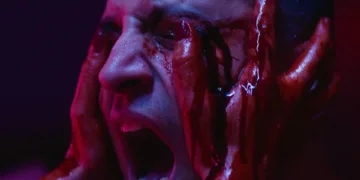
Finally, it detonates in a third act of outrageous, blood-soaked black comedy. This is not a smooth progression but a series of ruptures. The effect is destabilizing, preventing the audience from ever finding a comfortable footing. It is a bold choice that reflects the chaotic inner state of the characters and perhaps even the fractured nature of a media-saturated consciousness that consumes disparate genres with equal, voracious appetite.
An Erotic Thriller for a Post-Recession World
Bone Lake owes a significant debt to the erotic thriller, but it retools the genre’s preoccupations for a new social context. The 90s thriller was often concerned with anxieties of the professional class, its villains emerging from the boardroom or the courthouse to threaten a stable, affluent life.

This film’s anxieties are rooted in a more precarious world of freelance careers, creative pursuits, and the transactional nature of the sharing economy. The danger here is not an external stalker threatening a stable home, but the invited guest who exposes that the home was never stable to begin with. The film uses the genre’s tropes of lust and jealousy as a diagnostic tool, examining the health of a relationship and finding it critically ill.
Its central thesis is the unbreakable bond between the psychological and the physical, between sex and violence. Sexuality in Bone Lake is rarely about intimacy or pleasure; it is a weapon of espionage and control. Will and Cin use flirtation and seduction to perform reconnaissance, gathering information on their targets’ weaknesses before launching their assault.
The film makes the argument that civility and politeness are profound vulnerabilities. They are social constructs that predators can manipulate, relying on their victims’ unwillingness to cause a scene or appear rude. The eventual turn to physical violence is presented not as a shocking twist, but as the inevitable material expression of the psychological damage that has already been inflicted. The bloodletting is merely a confirmation of a death that occurred long before the first blow was struck.
The Absurdist Abattoir
The film’s finale is a radical departure, a giddy plunge into a theatrical abattoir. All psychological subtlety is jettisoned in favor of a visceral, splattery spectacle. When the chainsaw appears, it acts as a declaration of intent: the time for mind games is over. The villains shed their charming facades to reveal a cartoonish, almost joyful malevolence.

This shift forces Sage and Diego into a primal state, their complex relational issues rendered moot by the simple, urgent need to survive. They must become as resourceful and brutal as their tormentors, and the film finds a dark, gallows humor in their clumsy transformation from jaded millennials into desperate combatants.
The success of this climax is a matter of taste. It is undoubtedly a cathartic release, a messy, energetic explosion that pays off the slow-burn tension with interest. Yet it also risks feeling like a chaotic, undisciplined frenzy, a sensory bludgeoning that prioritizes shock over suspense. By embracing total absurdity, the film cleverly sidesteps the need to resolve its own plot holes.
The question of “why didn’t they just leave?” becomes irrelevant in a world that has abandoned all logic. This is either a brilliant meta-narrative strategy, suggesting that absurdity is the only sane response to the film’s events, or it is a convenient and entertaining way to write oneself out of a corner. The film leaves you laughing, wincing, and not entirely sure which it is.
Bone Lake is a 2024 American independent horror thriller directed by Mercedes Bryce Morgan. The film had its world premiere at Fantastic Fest on September 21, 2024, and was distributed in the United States by Bleecker Street for a theatrical release on October 3, 2025. The plot centers on a couple whose romantic vacation at a secluded lakeside estate spirals out of control when they are forced to share the mansion with a mysterious and attractive couple. What begins as a dream getaway quickly devolves into a nightmare of sex, lies, and manipulation, triggering a bloody battle for survival.
Full Credits
Director: Mercedes Bryce Morgan
Writers: Joshua Friedlander
Producers and Executive Producers: Mickey Liddell, Pete Shilaimon, Jacob Yakob, Joshua Friedlander, Jason Blumenfeld
Cast: Maddie Hasson, Alex Roe, Marco Pigossi, Andra Nechita, Eliane Reis, Clayton Spencer
Director of Photography (Cinematographer): Nick Matthews
Editors: Anjoum Agrama
Composer: Roque Baños, Ben Cherney
The Review
Bone Lake
Bone Lake is a viciously stylish and often entertaining thriller that succeeds more as a sensory experience than a coherent narrative. While its psychological insights into modern relationships are sharp, they are built on a foundation of questionable character logic that is difficult to ignore. Director Mercedes Bryce Morgan delivers a visually stunning film that builds considerable tension before gleefully detonating in a third act of absurd, gory spectacle. It's a flawed, messy, but undeniably energetic descent into madness that will reward viewers seeking visceral thrills over narrative plausibility.
PROS
- Visually striking direction with a distinct, "neo-giallo" aesthetic.
- A wildly entertaining and darkly comedic third act filled with over-the-top violence.
- Intelligent themes that explore modern anxieties surrounding relationships, finance, and social etiquette.
- Effective use of its single location, turning the luxury rental into a menacing character.
CONS
- A central plot hole regarding the protagonists' motivation to stay weakens the film's credibility.
- The abrupt tonal shifts can feel jarring rather than seamless.
- Characters sometimes function more as symbolic figures than fully realized, believable people.
- The screenplay relies on convenience to move the plot forward in key moments.