















Some houses are not structures of wood and stone but of memory and violence. They are wounds in the landscape, spaces where the past refuses to die, breathing a cold air into the present. The manor in Taratoa Stappard’s Mārama is such a place. It does not wait for night to become haunted; it is a monument to a haunting that occurred in broad daylight, under the banner of empire. The film begins not with a journey but with an uprooting.
In 1859, Mārama, a Māori woman whose identity has been veiled by the Anglicized name Mary, is pulled from her home in Aotearoa by a paper promise. A letter from North Yorkshire speaks of truth, a word that proves to be a lure into a labyrinth of genteel horror.
Hired by the estate’s owner, the unnervingly cultured Nathaniel Cole, she finds the truth she sought is not a story to be told, but a crime scene to be inhabited. This is a gothic tale where the most terrifying specter is history itself, a relentless presence that demands a reckoning in blood.
The Manor as Museum and Mausoleum
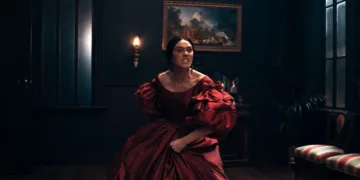
The world of the Cole estate exists in a state of perpetual twilight, a place where the light seems not to fade but to be actively smothered. The cinematography creates a painterly rot, saturating the frame with deep, bruised colors and shadows that possess a physical weight, clinging to the corners of rooms and swallowing sound.
A splash of crimson against the gloom is not a color but an event, a reminder of the blood that paid for the oppressive tranquility. This visual texture is more than atmosphere; it is the film’s central argument. The house itself is the primary antagonist, its architecture a cage built of colonial plunder. Its corridors are arteries clogged with stolen life, and its silence is the watchfulness of a predator.
Every object within its walls is an act of violence. Sacred Māori artifacts are stripped of their spiritual essence, their mauri, and displayed with the sterile precision of a lepidopterist. They are beautiful corpses, their meaning extinguished by the act of possession.
A traditional meeting house, a place of community and spirit, stands imprisoned on the damp English lawn, a profound emptiness at the heart of the estate. For Mārama, to walk these halls is to navigate a graveyard of her own living culture. She is surrounded by the ghosts of her heritage, not as ethereal apparitions, but as silenced, cataloged things. The house is a mausoleum where a vibrant history is laid out for display, and the price of admission is a piece of one’s own soul.
The Collector and the Collected
There is a particular horror in kindness when it is used as a tool of subjugation. Nathaniel Cole is a master of this insidious art. He is not a sneering villain but a man of culture and warmth, whose appreciation for Mārama’s heritage is the most terrifying thing about him. His command of the Māori language is not an act of respect but of infiltration, a key used to unlock and control.
This is the studied interest of the conqueror, the one who learns the name of a thing before destroying it. His obsession is a form of consumption; he seeks to absorb the vitality of a people while presiding over their erasure. His genteel manner is a poison, a slow-acting agent that corrodes the spirit and makes resistance feel like an act of rudeness.
Mārama’s experience in his home is a slow, methodical suffocation. The hope for connection that brought her across the world curdles into the cold realization that she is not an employee but an exhibit, the latest piece in his collection of living artifacts. Her waking hours are a performance of subservience, while her dreams are a rebellion of the soul, visited by visions that are her own history clawing its way back to the surface.
This psychological torment culminates in a party scene of breathtaking cruelty, a scene that serves as a microcosm of the entire imperial project. A grotesque parody of a sacred ritual is performed for the amusement of Cole’s guests, their polite applause a chilling indictment. The moment rips away the final veil of civility, revealing the leering skull of contempt beneath. For Mārama, it is the breaking point where her silent endurance finally ignites into the cold, hard fury of the truly violated.
Reclaiming the Body, Reclaiming the Name
An identity that has been stolen can only be reclaimed through an act of profound spiritual warfare. Mārama’s transformation is an eruption, a violent rejection of the quiet rooms and stifling courtesies that sought to contain her. Shedding the name Mary like a shroud, she embraces her true self and the ancestral power that flows through it.
The film’s climax is forged in the fire of a Haka, a performance that is not a plea or a dance but a seismic rupture in the fabric of the manor’s reality. It is the sound of a history that refuses to be a museum piece, a raw, elemental cry that makes the stone walls tremble. The air crackles with a power the house cannot hold, and the shadows themselves seem to recoil.
This act of reclamation clears the way for a terrible, and necessary, retribution. The slow-burn dread of the narrative catches fire, and the film explodes into a brutal revenge thriller where every blow feels like a word in a long-suppressed language. The final violence is not a descent into madness but a ritual of purification, a surgical excision of the colonial cancer.
For a person who has been systematically objectified, the reclaiming of agency becomes an absolute. Ariāna Osborne’s ferocious performance captures this existential necessity, moving beyond simple rage into a state of chilling, righteous purpose. Her vengeance is not just a conclusion; it is a restoration of balance, a bloody and cathartic answer to the film’s opening, unspoken question.
Mārama is a New Zealand gothic horror film released in 2025, written and directed by Taratoa Stappard. It premiered at the Toronto International Film Festival (TIFF) on September 5, 2025. The film is set in 19th-century Yorkshire, England, and follows a young Māori woman named Mary who travels there and takes a job on a local estate. She soon begins to experience terrifying visions that reveal a gruesome past. The movie explores themes of colonial abuses and revenge, blending Māori culture with folk horror and gothic cinematic elements. Specific streaming or home video release platforms are not yet widely announced, but the film is being distributed by Vendetta Films and is represented for international sales by MPI Media Group.
Full Credits
Director: Taratoa Stappard
Writers: Taratoa Stappard
Producers and Executive Producers: Sharlene George, Ricky Russell-Waipuka, Rouzie Hassanova, Victoria Dabbs, Gal Greenspan, Jill Macnab, Phil Bremner, Badie Ali, Hamza Ali, Greg Newman
Cast: Ariāna Osborne, Toby Stephens, Umi Myers, Errol Shand, Jordan Mooney, Evelyn Towersey, Mihi Te Rauhi Daniels, Turia Schmidt-Peke
Director of Photography (Cinematographer): Ginny Loane
Editors: Dan Kircher
Composer: Karl Steven, Rob Thorne
The Review
Mārama
Mārama is a masterful and merciless piece of gothic horror, trading supernatural ghosts for the far more terrifying specters of colonial history. It is a visually stunning, atmospherically dense film anchored by a breathtakingly powerful lead performance from Ariāna Osborne. While its narrative follows a path of inevitable reckoning, the journey is a potent and unflinching examination of cultural violation and the ferocious beauty of righteous rage. It is a deeply intelligent, stylish, and cathartic revenge thriller that lingers long after the credits roll.
PROS
- A transcendent and commanding lead performance by Ariāna Osborne.
- Superb direction, with a deeply atmospheric and visually striking gothic aesthetic.
- A powerful and intelligent allegorical story about colonialism, cultural appropriation, and historical trauma.
- Effectively blends slow-burn psychological dread with a cathartic, violent climax.
CONS
- The pacing can feel uneven, with a slow burn that may not engage all viewers.
- Some plot points and reveals may feel predictable to those familiar with the genre.
- The first act occasionally relies on conventional jump scares before settling into its more unique atmospheric horror.