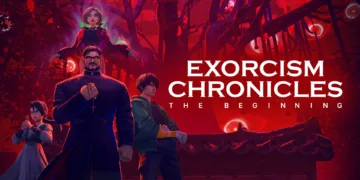















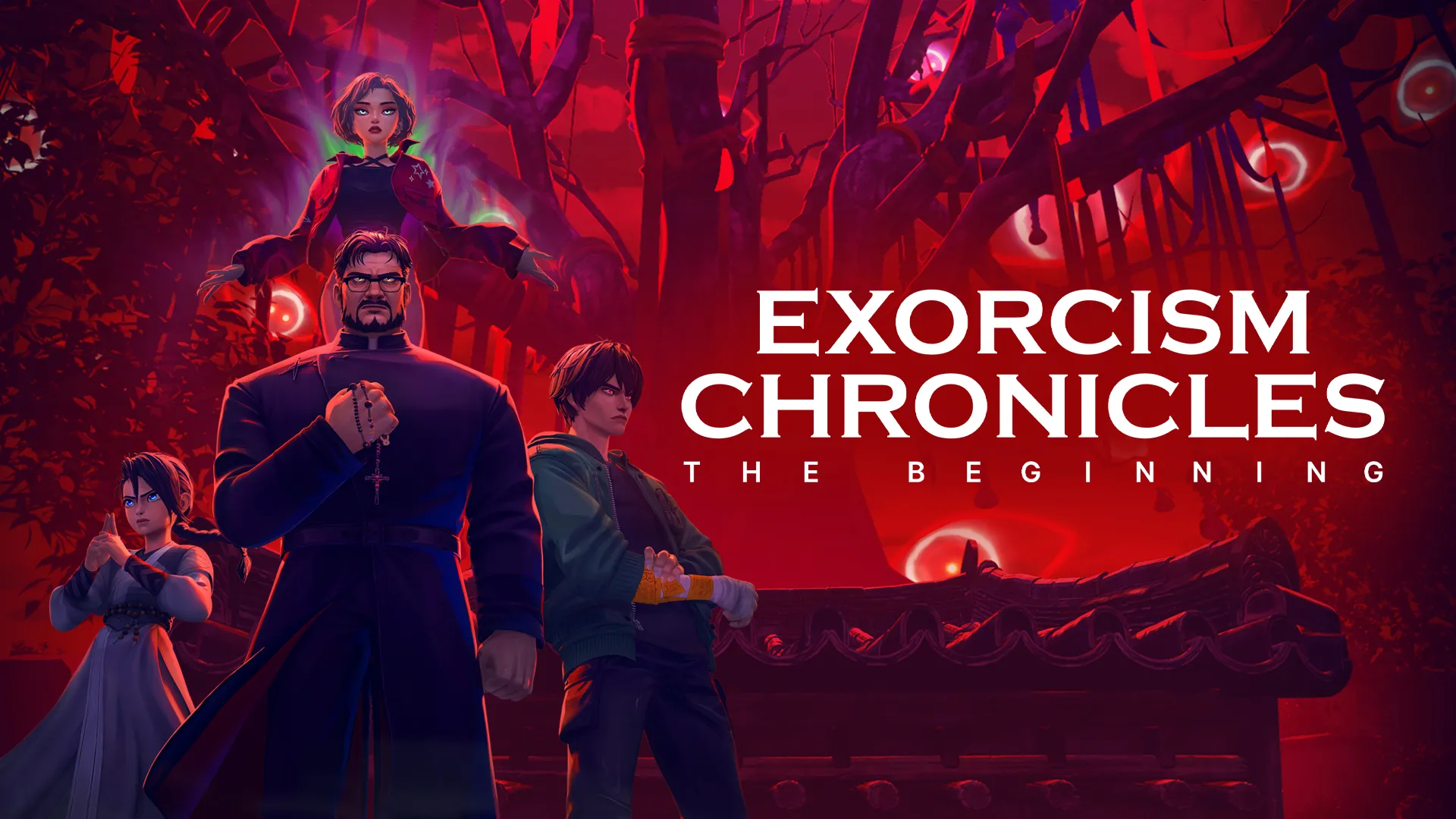

Exorcism Chronicles: The Beginning adapts Lee Woo-hyeok’s Toemarok into a Korean animated feature that opens with dense mystery and sustained unease. The film throws the viewer into a tactile world of spiritual horror paired with high-risk fantasy combat. Father Park anchors the story, a man marked by wounds both seen and hidden. He once practiced medicine and wore the collar; excommunication sent him into drift until an old ally calls him back.
The task is blunt: shield the gifted child Joon-hoo from Master Seo’s zealotry and a “Grand Ritual” that threatens the order of the spirit world. The film builds its theology in images. A fused 2D and 3D palette produces textured surfaces, marrying beauty and rot in its portraits of the demonic. Guilt hangs in the air. So does peril. The stage suits a study of faith under pressure.
Lore Density and the Existential Crisis
The narrative design attempts an entire cosmology inside a compact runtime. Secret orders, sacred prophecies, and a stratified bestiary of demons and Guardians crowd the frame. The mythology draws on a striking syncretism.
Christian iconography meets Buddhist principles and Korean Pagan traditions that include the Shamanists and the Mudang Denomination. Multiple belief systems step toward a single darkness. The idea has force. Faith appears as a composite instrument shaped by need and circumstance.
Speed complicates that ambition. Pacing favors a rapid cadence of exposition that produces drag. The feature reads like a prologue stuffed to the edges, at times closer to a pilot cut or a string of game cinematics than a sealed narrative. Absolute attention becomes a requirement as fresh names and old histories arrive with minimal pause.
A calmer structure would have lightened the load. Even so, the core philosophical thread remains audible. The horror takes shape in Father Park’s interior life. Doubt, heavy guilt, and shaken belief move in parallel with the supernatural turmoil. The demon on screen mirrors an ethical problem that refuses to resolve.
The Expressionistic Frame
The craft is formidable. LOCUS Corporation spent six years on rendering, and the result is a handsome, highly polished surface where the interlocking 2D and 3D work stands out as a technical apex. Expressionistic framing dominates. Stark shadow patterns and stylized distortion carve the image.

High contrast evokes classic noir chiaroscuro and tightens the grip of every confrontation, turning spiritual conflict into something tactile. The look alternates between calm evocations of Korean landscapes used as visual touchstones and the foul architecture of demonic forms.
Action arrives with snap. Choreography moves with decisive energy, drawing on the physics vocabulary of traditional anime power surges to create impact. The scale remains cinematic. Blood flows. Brutality marks the stakes and keeps the horror designation firm.
Sound design and score amplify that edge. These elements sync with the image and steer perception, keeping the audience in a measured state of anxiety and forward pull. Short silences crackle. Crescendos push the pulse. The manipulation is deft.
The Burden of the Exorcist
Father Park stands in the eye of the storm and fits the noir mold. He is burly, scarred, and highly capable in a fight. The exterior suggests control; the interior holds tenderness and long memory. One habit becomes a character note with bite: he drinks holy water from a flask, a joke he appears to share with no one. Combat skill arrives early and decisively, yet the story’s weight sits on older wounds.
Guardian Jang, a former classmate and monk, brings him back. The plea he makes supplies the necessary spark for movement and feeling, and their connection registers as the most persuasive bond on screen. The remaining ensemble surrounds them. Joon-hoo and Master Seo shape the stakes, and the named Guardians circle with striking abilities.
The film’s crowded architecture leaves many of them as functions rather than full portraits. Their appearances serve plot turns and elemental showcases, then recede. The pattern fits the film’s scale and speed. It also confirms the central line of inquiry. Father Park carries the theme, and the theme circles moral cost.
Exorcism Chronicles: The Beginning is a South Korean adult animated supernatural action film based on the best-selling novel Toemarok by Lee Woo-hyeok. The movie premiered at the 2024 Annecy International Animation Film Festival in June, and had its theatrical release in South Korea on February 21, 2025. It was later released in North American theaters on October 17, 2025, distributed by Viva Pictures. The film, produced by Locus Animation Studios, is currently available to stream or rent/buy on platforms such as Prime Video.
Credits
Director: Kim Dong-Chul
Writers: Lee Dong Ha, Lee Woo-hyouk (Story Creator)
Producers and Executive Producers: Juliano SungPil Choi, Sujin Hwang
Cast: Choi Han, Nam Doh-hyeong, Jung Yoo-jung, Kim Yeon-woo, Hong Seung-hyo, Hwang Chang-yung, Lim Chae-bin
Director of Photography (Cinematographer): Park Yong-keon
Editors: Kim Woo-il
The Review
Exorcism Chronicles: The Beginning
This animated horror piece offers a visually arresting spectacle, boasting exceptional technical artistry and a compelling spiritual syncretism rarely seen in the genre. Its philosophical depth, particularly in Father Park's internal struggle with doubt and guilt, is powerful. However, the film is hampered by a taxing narrative density, functioning more as a fast-paced, exposition-heavy pilot for a larger series than a cohesive feature. It's a visually stunning, if structurally chaotic, beginning.
PROS
- Gorgeous, vibrant, and technically accomplished blend of 2D/3D styles.
- Deep exploration of guilt, doubt, and spiritual legacy.
- Bold merging of Christian, Buddhist, and Korean Pagan belief systems.
- Thrilling, visceral, and well-choreographed fight scenes.
CONS
- Taxing, rushed, and overwhelming with lore and exposition.
- Feels like an overstuffed first episode rather than a complete feature.
- Many supporting characters lack depth and float in and out.
- The sheer density makes the story difficult to parse on a first viewing.