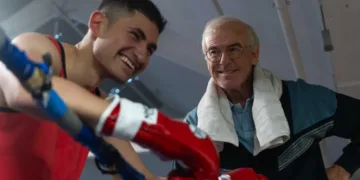














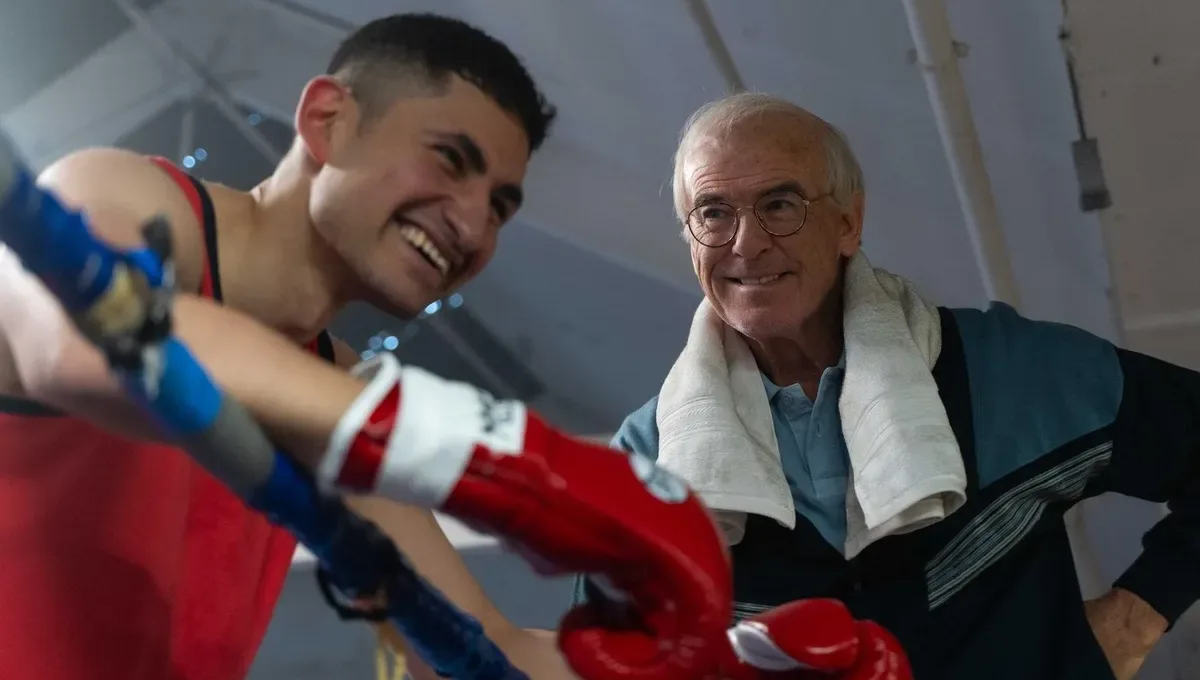

Giant, written and directed by Rowan Athale, frames itself as a sports drama charting the rise of featherweight Naseem “Prince” Hamed. The story opens in 1980s Sheffield and follows Hamed from childhood in a Yemeni-British household that encounters casual racism to the height of a transatlantic career, where he becomes the first British Muslim world champion.
The deeper charge arrives through the bond between the audacious fighter and his Irish-born trainer, Brendan Ingle. Ingle teaches Hamed to convert the hostility around him into competitive force, a lesson that begins as armor and then calcifies into an ego fed by money. That shift breaks a relationship that plays like a surrogate father and son. A hero turns toward tragic anti-hero territory, and the film sets its philosophical field of play there.
The Mentor, The Prodigy, and the “Success-Sickness”
Casting supplies the core friction. Pierce Brosnan, stripping away the cartoonish brogue of recent roles, inhabits Brendan Ingle with brisk, convincing energy. He gives the trainer the shape of a devoted guide, kind by instinct, inventive in method, and tinged with an entrepreneurial streak. The film treats Ingle as moral compass, the figure who feels like the true “giant” whose imprint goes unacknowledged.
Amir El-Masry lands Hamed’s swagger, ring dynamism, and meticulous preparation. He nails the showmanship and the quick, almost jazzy footwork. The script limits him. Adult Hamed arrives as a sustained study in bratty arrogance, with little access granted to the psychological machinery that leads to self-sabotage.
Their partnership begins as a fortress against prejudice. The rupture, fueled by success and wealth, turns the piece into a modern morality tale about celebrity “success-sickness.” Nearby, Toby Stephens charges through as promoter Frank Warren, a bullish wide-boy presence that amplifies material appetite.
Aesthetics of Pugilism and Narrative Economy
Athale’s staging stays energetic without flash, a meat-and-potatoes approach to incident and scene. The film draws from the boxing-movie canon of struggle against adversity (you can trace a line through Rocky). Fights arrive with verve, translating Hamed’s aggressive evasions into crisp aerial views.
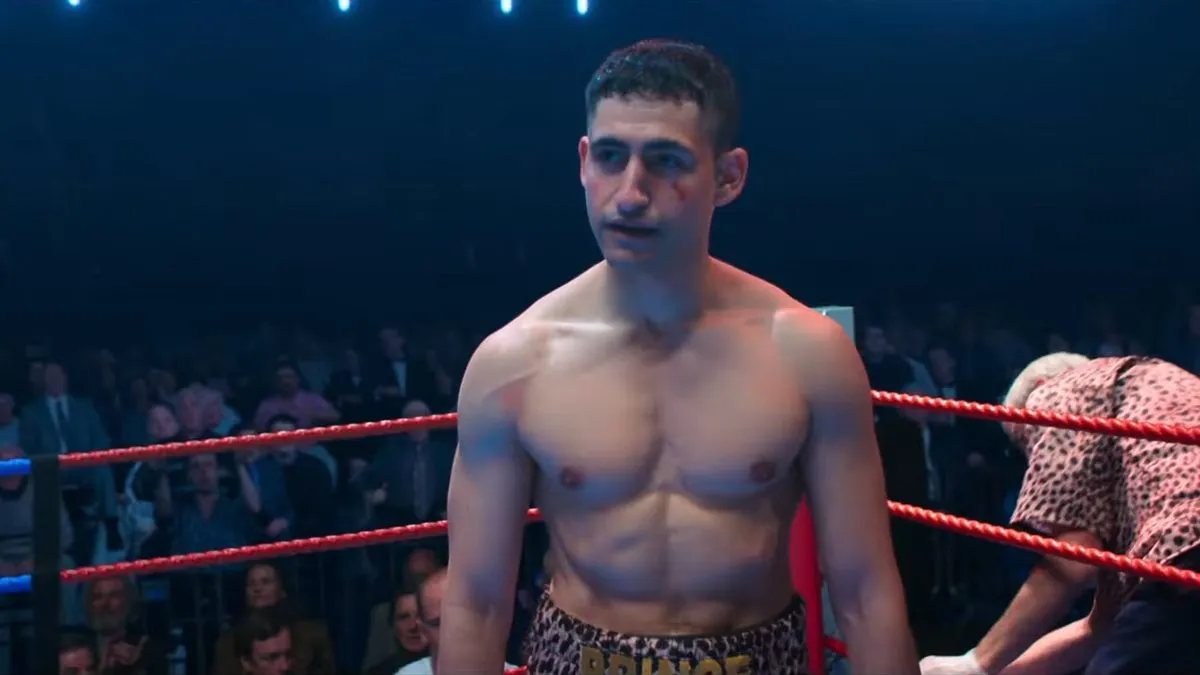
Some sequences land short of their own wind-up; key set-pieces feel clipped at the bell. The script follows a schematic grid. Functional exposition dominates, a habit that favors telling. Dialogues often serve clarity checks for viewers, with limited payoff in character depth. The recurring journalist scenes repeat a beat that the film has already conveyed.
Graphic flourishes, including newsprint-style animations for career milestones, distract from the central drama. Certain scenes ride with music that plays too loud, which dilutes the weight of the moment. A question lingers about the true protagonist, Ingle or Hamed, and that uncertainty diffuses the central drive. The narrative plays like a cut that needs one more pass, a film caught between two claims on its focus.
Prejudice as Fuel: The “Antipathy Engine”
The sociopolitical charge carries the film. Early-1980s Britain sits in the background, and the racism aimed at Hamed’s family presses in from walls marked by National Front graffiti and from boxing officials who gatekeep the sport. Ingle’s core instruction, turning prejudice into performance fuel, builds the “antipathy engine” that powers Hamed’s run.
Hamed’s identity as a British Muslim champion carries broad significance, challenging embedded habits inside the sport. The film also notes the friction between his expressions of faith, prayer and thanks to Allah, and the later pursuit of wealth that takes center stage. A cheeky young confidence, once monetized and freed from mentorship, stiffens into flaw.
The film maps a cultural moment where talent that matters to a community gets consumed by the shine of money. With Ingle placed as moral anchor, the story offers a clear statement about loyalty and the price of fame in spiritual terms. Hamed’s retirement at 28 reads less like strategy and more like the visible result of breaking with the source of his guidance.
Giant is a biographical sports drama that chronicles the rise of British boxer Prince Naseem Hamed and his complex relationship with trainer Brendan Ingle. The film premiered at the BFI London Film Festival on October 18, 2025. It is scheduled for a UK theatrical release on January 9, 2026, with US distribution by Vertical following in 2026. Currently, the movie is only viewable at film festivals and in cinemas upon its release.
Credits
Director: Rowan Athale
Writers: Rowan Athale
Producers and Executive Producers: Stuart Ford, Mark Lane, Kevin Sampson, Sylvester Stallone, Braden Aftergood
Cast: Amir El-Masry, Pierce Brosnan, Katherine Dow Blyton, Austin Haynes, Arian Nik, Ali Saleh, Ghaith Saleh, Elika Ashoori, Olivia Barrowclough
Director of Photography (Cinematographer): Larry Smith
The Review
Giant
Giant is elevated by Pierce Brosnan’s compelling portrayal of trainer Brendan Ingle, who emerges as the film's true emotional focus. While the movie intelligently explores themes of racial adversity and the corrosive nature of fame, Rowan Athale's script remains frustratingly schematic. Amir El-Masry captures Hamed’s kinetic energy, but the adult character’s emotional depth is often left unexplored. It is a solid, albeit conventional, sports biopic that struggles to escape the well-worn cinematic tropes it employs.
PROS
- Pierce Brosnan's energetic and charismatic performance as Brendan Ingle.
- Intelligent exploration of racial adversity and identity in 1980s Britain.
- Amir El-Masry captures the physical dynamism of Hamed’s unique boxing style.
- Effective visualization of the intense boxing sequences.
- Clear focus on the tragic breakdown of the surrogate father-son relationship.
CONS
- Schematic script relying on functional, expository dialogue.
- Lack of psychological nuance in the adult Hamed character, often reduced to one-note arrogance.
- Boxing set-pieces are sometimes truncated, diminishing the climax.
- Distracting visual flourishes (e.g., newsprint animation) and overly loud background music.
- Ambiguity about the true protagonist makes the narrative feel slightly disjointed.