











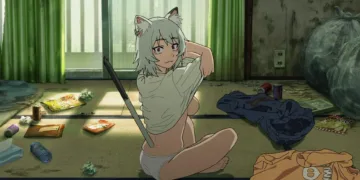










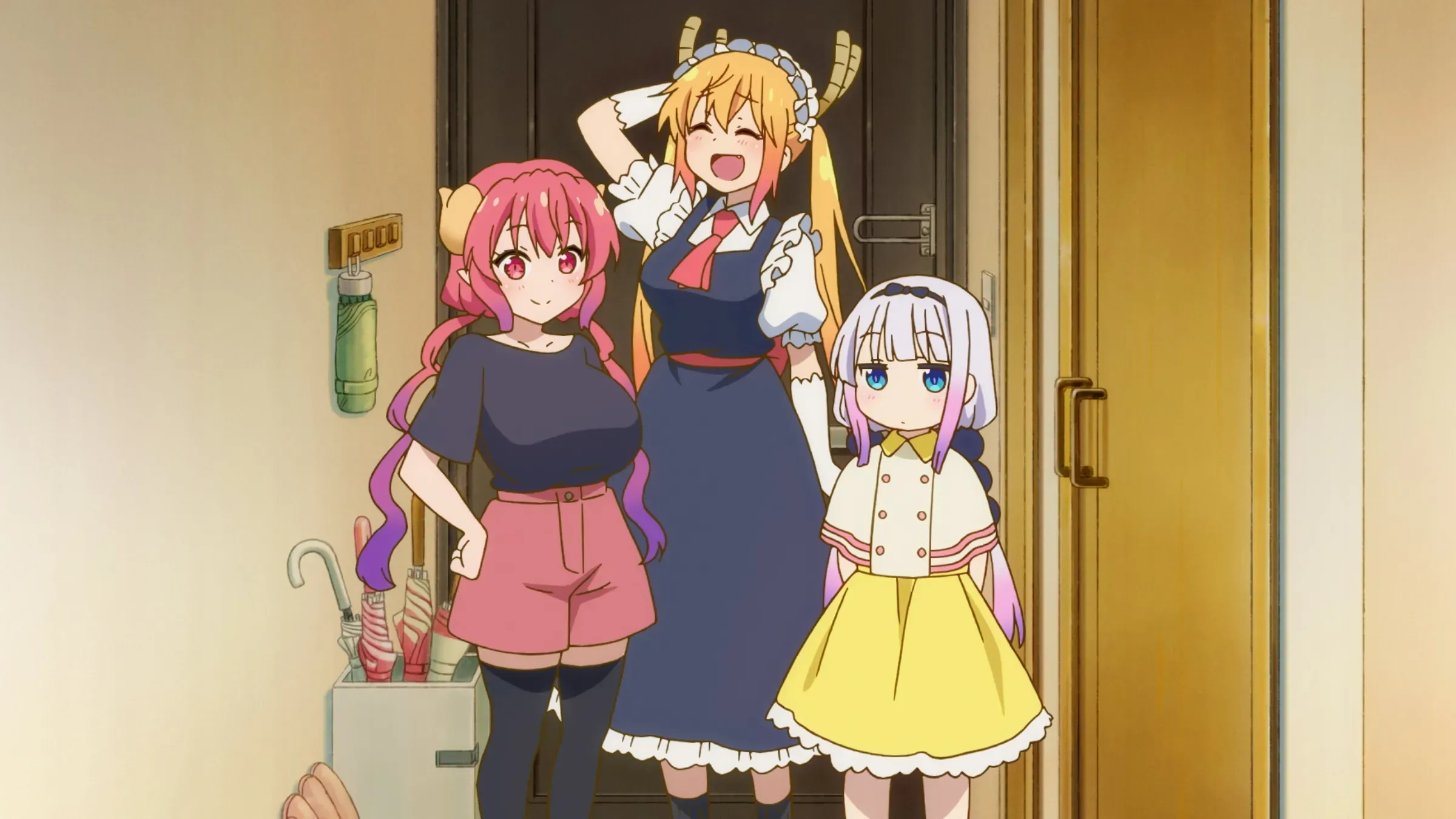

Miss Kobayashi’s Dragon Maid: A lonely dragon wants to be loved converts its fanciful premise into full theatrical muscle. The feature-length expansion of this supernatural slice-of-life opens on a compact domestic rupture. Kanna Kamui receives a summons from her biological father, a call to duty in the dragon realm. That single notice shakes the household.
Kobayashi and Tohru feel the strain, forced to look at how fragile their makeshift unit can be. The series’ charm and moe grace notes remain, yet the film turns toward heavier, stormier currents. The emotions rise. The set pieces grow in scale. Humor lands as oxygen between spells of grief, a pressure-release familiar to psychological thrillers.
The Philosophy of Affection: A Chiaroscuro of Kinship
The film studies family like a philosopher with a light meter, measuring where love fails to reach. In older lore, dragons discount kinship, treating offspring as rivals or instruments. Kanna’s yearning for her father, Kimun, becomes the central motor. She gambles the safety she enjoys with Kobayashi for a brief signal of paternal recognition. The script frames emotional neglect as a quiet cruelty. Kimun arrives as a chilling absence rather than a theatrical scoundrel, a figure who treats communication as a transaction for political gain.
Against that void stands the household on Earth. Kobayashi and the dragons around her have retooled instinct through human contact, adopting protection and care as learned practices. This acquired love anchors the film’s ethics and lends weight to the drama. The film argues for nurture over inherited dragon habit. Kobayashi’s dilemma sits in full view: she sees the neglect, she respects Kanna’s choice, and she accepts the pain that follows. She keeps the doors open. Sometimes a guardian can only set the table and stay nearby. Dry humor surfaces here in brief lines, a shrug against the abyss.
Cinematography and staging sharpen the theme. Framing often isolates Kanna at thresholds and corridors, compressing space around a small silhouette. Close compositions create a low hum of anxiety, then release it when the domestic group snaps into a shared frame. Light carries meaning. Soft interiors bathe the found family in warm gradients, while scenes tied to Kimun read cooler and remote, an aesthetic of distance. The rhythm toggles between still, contemplative setups and brisk movement, a quiet question about free will underscored by the cut. Do we inherit roles or choose them. The film keeps that question alive.
Geometries of Conflict: Scale and Subtext
Lore widens. Domestic comedy gives way to a larger political field and the specter of a dragon civil war. Azad enters as an antagonist shaped by loss to dragon violence. His worldview compresses a private wound into a judgment on an entire species. Monoliths are easier to fight than individuals. He embraces manipulation and stokes conflict to justify that stance. Classic noir DNA flickers here: a grief-struck figure who repaints the world in one tone and calls it truth.
Also Read







Action works as counterargument. The Earth dragons join in mutual defense, with Tohru’s choices as a focal example. Care overrides appetite for domination. Change appears on screen as behavior, not mission statement. The answer the film supplies rests in emotional education. The battles accelerate and expand. Skirmishes give way to full-dragon engagements that fill the theatrical frame. Motion reads clean and intentional. Cuts track cause and effect. The spectacle marks a clear departure from the show’s smaller canvases, and the scale serves theme rather than smothering it. Audience psychology sits front row here. Crescendos stretch time, then a quiet beat snaps tension like a twig. You feel the manipulation and welcome it.
The lineage to noir and thriller practice extends beyond character. Expressionistic geometry rules the conflict spaces. Lines converge. Masses collide. Negative space turns into threat. Moral gray zones receive literal gray values. The film still plays modern, with tempo shifts and comedic jolts, yet the backbone points to older craft. A wink to tradition, not a museum tour.
The Expressionistic Canvas: Sound and Vision
Kyoto Animation delivers striking visual work. The series palette and designs carry over, and the theatrical format enhances fine detail and kinetic flow. Backgrounds deepen into expressive fields that comment on action. During combat, animation embraces flourish and speed, crafted for cinema-scale legibility.
A painterly approach meets extreme movement, and the result feels both controlled and exuberant. Camera language, even in animated space, reads with intent. Lateral sweeps map territory. Push-ins tighten the vise on a decision. Static holds let a choice hurt. Chiaroscuro accents slip into key moments and make the moral weather visible.
Sound finishes the argument. Piano figures in the score press on the pressure points, brief phrases that fall like a thought you cannot shake. The opening song sets the tone with thematic clarity. Voice performances land across the board. Kimun’s portrayal stands out for its immaculate chill, a sterile remove that embodies the idea of absence. Casting, direction, and mix align to keep that void present even when the frame looks bright. The psychology of the audience gets careful treatment. Loud-quiet dynamics steer attention, and silence carries a sting when the film needs it. Short beats. Then impact. Then air.
The film’s architecture uses framing, light, and tempo to ask hard questions about affection, choice, and the learning of care. It stages political threat as a shadow play of grief. It lets action pulse with meaning. It remembers to smile for a second before breaking your heart again. Dry, precise, a little wry. And very alive.
Miss Kobayashi’s Dragon Maid: A lonely dragon wants to be loved is an animated feature film that continues the story of the popular supernatural slice-of-life anime series. The film had its Japanese premiere on June 27, 2025. Internationally, the film was released in theaters as part of Crunchyroll Anime Nights starting in October 2025. The movie centers on the young dragon Kanna Kamui, whose peaceful life is interrupted by the arrival of her biological father, Kamun Kamui, who demands she return to the Dragon World amidst a brewing war. The film focuses on the emotional conflict Kanna faces between her duty and the found family she has with Kobayashi and Tohru.
Credits
Director: Tatsuya Ishihara, Yasuhiro Takemoto (Series Director credit)
Writers: Yuka Yamada, Coolkyoushinja (Original Creator)
Producers and Executive Producers: Ai Lian Cai, Shinichi Nakamura, Masayuki Nishide, Satori Senami, Hisato Usui (Producer credits from Anime News Network)
Cast: Mutsumi Tamura, Yūki Kuwahara, Maria Naganawa, Yūki Takada, Minami Takahashi, Daisuke Ono, Yūichi Nakamura, Emiri Katō, Kaori Ishihara, Shiori Sugiura, Fumihiko Tachiki
Director of Photography (Cinematographer): Hiroki Ueda
Editors: Kengo Shigemura
Composer: Masumi Itō, Hikaru Nanase
The Review
Miss Kobayashi's Dragon Maid: A lonely dragon wants to be loved
The film masterfully uses its supernatural premise to interrogate complex themes of parental neglect and the philosophical weight of chosen family. The visual presentation is stunning, leveraging the theatrical canvas for dynamic, high-stakes action while maintaining Kyoto Animation's signature expressive quality. While centered on an emotionally difficult arc, the movie champions the power of learned affection over rigid biological or cultural destiny. It is an emotionally resonant, visually spectacular expansion of the franchise that handles its shift to dramatic territory with grace.
PROS
- Deeply explores complex themes of parental neglect, ethical ambiguity, and the nature of chosen family.
- Stunning visual presentation, detail, and dynamics tailored for the big screen.
- Successfully shifts the narrative scope to include high-stakes action and expanded political lore.
- Effective use of music and professional voice acting enhances the emotional weight.
CONS
- The central storyline focusing on Kanna's yearning for her neglectful father is genuinely painful to observe.
- Some established main cast members are utilized less, appearing in more secondary or supportive roles to center Kanna's arc.
- The pronounced move into heavier, dramatic territory may be jarring for viewers expecting the series' typical light slice-of-life tone.